
Loading, please wait...


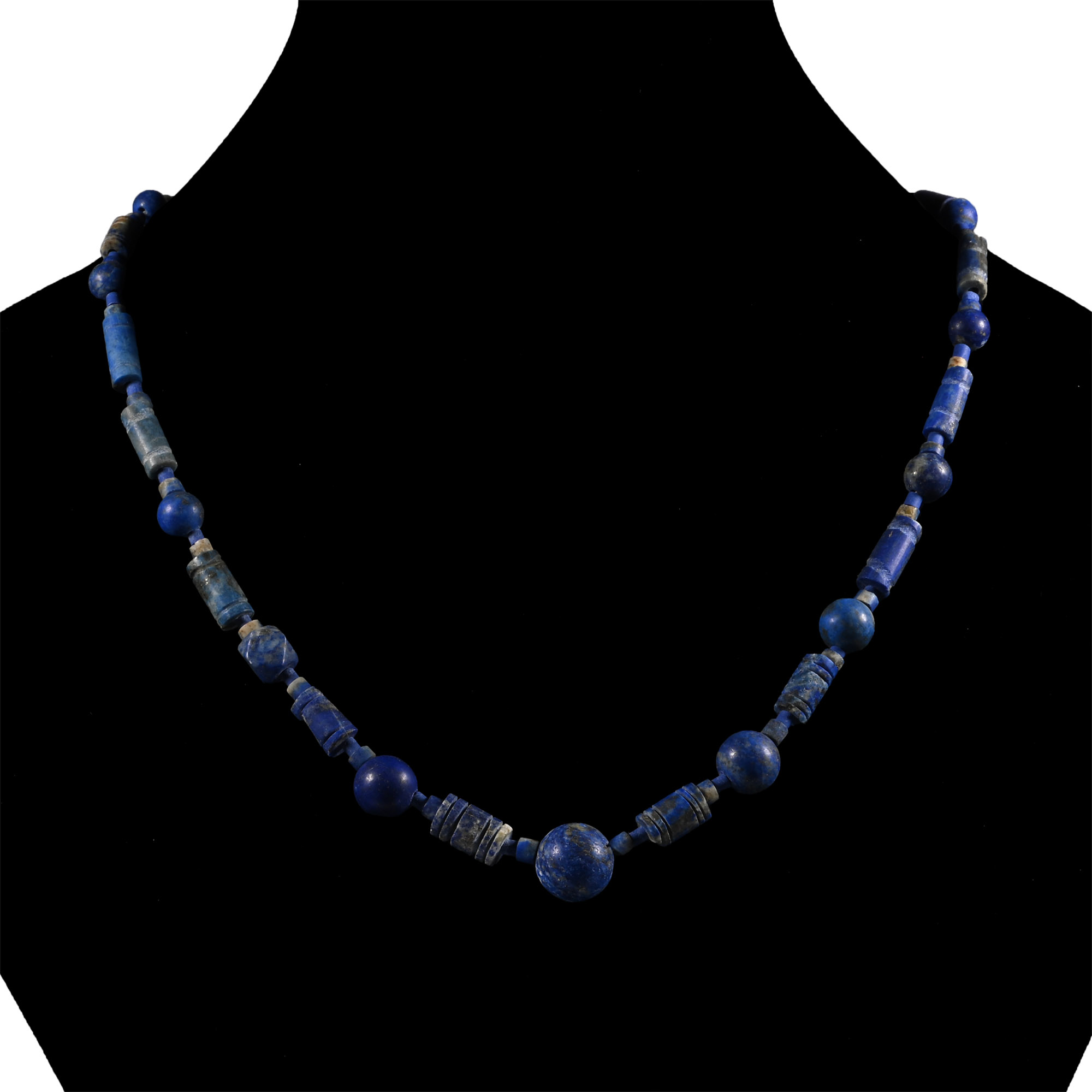
LOT 2233
Bactrian Style Lapis Lazuli Bead Necklace String
20TH CENTURY A.D.
16 1/2 in. (36.8 grams, 42 cm).
Composed of alternating grooved tubular and spherical beads interspersed with small tubular beads; restrung. [No Reserve]
ProvenanceEx London art market.
Property of a North London, UK, gentleman.
This lot is accompanied by an illustrated lot declaration signed by the Head of the Antiquities Department, Dr Raffaele D’Amato.
TimeLine Auctions follows a vetting process to ensure the authenticity and legality of all items, reinforcing our commitment to integrity and responsible trading. Each antiquity, antique, and coin lot undergoes thorough examination by a vetting committee of at least ten external specialists, professional trade association members, scientists, and archaeologists: Our Vetting Process
AUCTIONS:
TimeLine is a leading auction house specialising in antiquities, ancient art, collectables, natural history, coins, medals, and books. Our auctions offer museums, collectors, historians, and enthusiasts the opportunity to acquire unique and historically significant pieces.
-

Post Medieval Gilt Plaque with Winged Cherub
17th-18th century A.D.Sold for (Inc. bp): £234
Depicted with a young face, curly hair, crowned by a halo, six radiating wings with feather detail; two holes for attachment. 33 grams, 19 cm
Acquired Brigantia Antiques, York, UK, circa 2007. Ian Wilkinson collection, Nottinghamshire, UK, formed since 1985. This lot is accompanied by an illustrated lot declaration signed by the Head of the Antiquities Department, Dr Raffaele D’Amato.
The plaque represents the central applique of a riphidion, an ecclesiastic fan worn by the Deacons during the Liturgical celebration of the Orthodox Church. The iconography refers to the Cherubim, the Angelic creatures with many wings and many eyes, ‘Singing the triumphal hymn, exclaiming, proclaiming, and saying' Holy, holy, holy. Fans are appointed to symbolise the invisible presence of the angels during significant liturgical acts. They are carried in the Great Entrance while the choir sings, ‘We who mystically represent the Cherubim and who sing the thrice-holy hymn to the life-creating Trinity, now lay aside all cares of this life, that we may receive the King of All, who comes invisibly escorted by the angelic host’. The altar servers take the place of angels, and they carry seraphic fans like the ancient Roman soldiers who carry the banner of their regiment. -
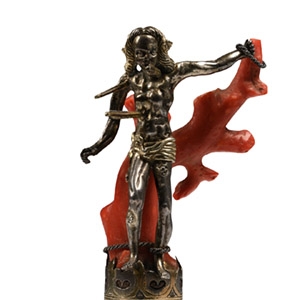
Renaissance Devotional Aid Depicting Saint Sebastian Tied to a Coral Branch
Southern Germany, circa 1500-1520 A.D., adapted by Jacob Frick of Constance, circa 1590 A.D.Sold for (Inc. bp): £2,860
Comprising a parcel-gilt raised discoid base with fluted hexafoil developing to a central column with braided collar and openwork crown socket; inset portion of natural coral branch; figure of St Sebastian modelled in the round with three arrows piercing his shoulders and chest and the stub of a fourth in his shin, portrayed with gilt loincloth and centre-parted hair, braided wire bonds to the left wrist and one ankle' old collector's numbers 'V.590.3H1 7' and '18688' to underside. 190 grams, 12.4 cm
F.K.A. Huelsmann, Hamburg. with Christie's, Geneva, 13 May 1981, no.7. Private collection, South Germany. with Hargesheimer & Gunther, 22 September 2017, no.1307. This lot has been checked against the Interpol Database of stolen works of art and is accompanied by search certificate number no.12507-230673. This lot has been cleared against the Art Loss Register database, and is accompanied by an illustrated lot declaration signed by the Head of the Antiquities Department, Dr Raffaele D’Amato.
This lot will require a CITES licence when exported outside the UK. -
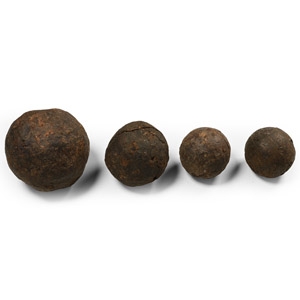
Civil War Iron Shot Collection
17th century A.D.Sold for (Inc. bp): £13
Comprising small grape or canister shots, and a larger shot, likely for a smoothbore cannon. 1.66 kg total, 37-61 mm
Found on various UK sites since 1974. Property of an Essex collector. This lot is accompanied by an illustrated lot declaration signed by the Head of the Antiquities Department, Dr Raffaele D’Amato.
