
Loading, please wait...


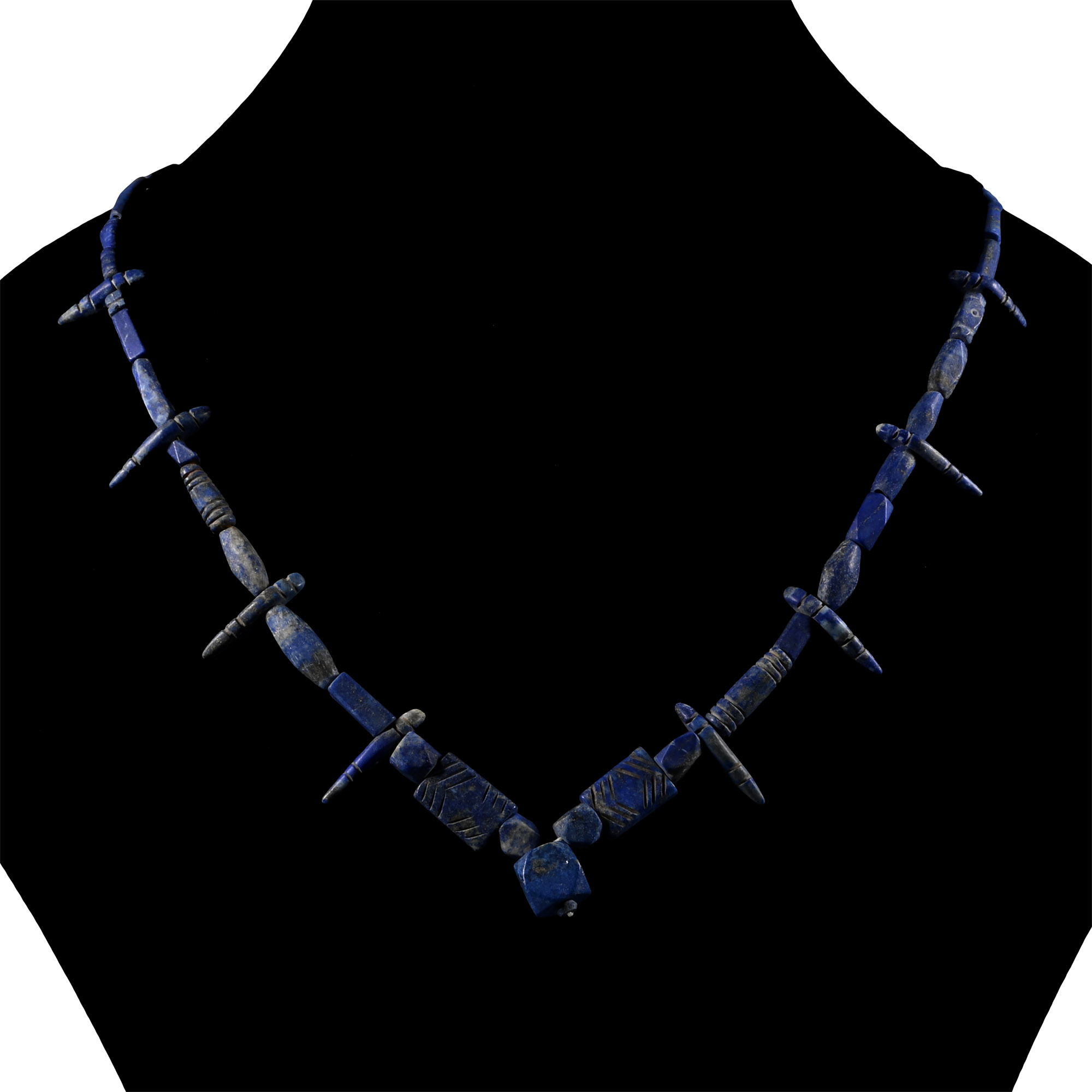
LOT 2210
Bactrian Style Lapis Lazuli Bead Necklace String
20TH CENTURY A.D.
16 3/4 in. (35.8 grams, 42.5 cm).
Composed of facetted, barrel-shaped and grooved cylindrical beads with long amuletic beads; central feature composed of two large tabular beads with chevron decoration and a large multifactted bead. [No Reserve]
ProvenanceEx London art market.
Property of a North London, UK, gentleman.
This lot is accompanied by an illustrated lot declaration signed by the Head of the Antiquities Department, Dr Raffaele D’Amato.
TimeLine Auctions follows a vetting process to ensure the authenticity and legality of all items, reinforcing our commitment to integrity and responsible trading. Each antiquity, antique, and coin lot undergoes thorough examination by a vetting committee of at least ten external specialists, professional trade association members, scientists, and archaeologists: Our Vetting Process
AUCTIONS:
TimeLine is a leading auction house specialising in antiquities, ancient art, collectables, natural history, coins, medals, and books. Our auctions offer museums, collectors, historians, and enthusiasts the opportunity to acquire unique and historically significant pieces.
-
.jpg)
Silver Merchant's Ring with Monogram
15th-17th century A.D.Sold for (Inc. bp): £650
With fluted shoulders and scooped edges to the bezel, pointillé border and Greek monogram of a cross with 'MHNλ' finials. 6.72 grams, 21.82 mm overall, 18.19 mm internal diameter (approximate size British P 1/2 , USA 7 3/4, Europe 16.86, Japan 16)
Acquired 1960s-1990s. From the collection of the late Alison Barker collection, a retired London barrister. This lot is accompanied by an illustrated lot declaration signed by the Head of the Antiquities Department, Dr Raffaele D’Amato. -
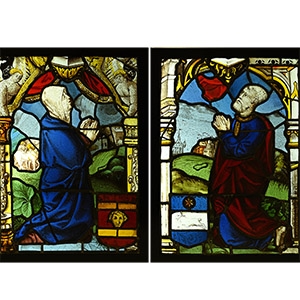
Renaissance Stained Glass Window Pair
Bern, Switzerland, circa 1520 A.D.Sold for (Inc. bp): £12,350
Pair of stained glass window panels comprising: a kneeling female figure in a blue robe in a landscape, within an arch with heraldic supporters on the capitals; with heater shield lower right with mask on a barry field; a kneeling bearded male in a landscape within a lancet arch with heater shield lower left, running goat in fess beneath a mullet; both from the circle of Hans Funk, each supplied with frame including integral backlight, 12V DC transformer and three-pin plug. 16.5 kg total, 59 x 43 cm including frame
Kept in a private collection for several decades, Zurich, Switzerland. with Schuler Auktionen, 24 March 2021, no.529. This lot has been checked against the Interpol Database of stolen works of art and is accompanied by a search certificate number no.12551-230650. This lot has been cleared against the Art Loss Register database, and is accompanied by an illustrated lot declaration signed by the Head of the Antiquities Department, Dr Raffaele D’Amato. -
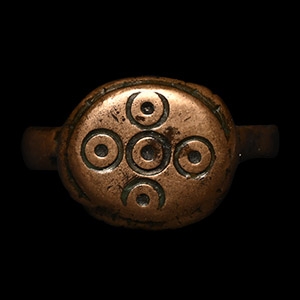
Tudor Period Bronze Ring with Ring-and-Dot Cross
16th-17th century A.D.Sold for (Inc. bp): £52
With a D-section hoop supporting an oval bezel with stamped ring-and-dot decoration. 5.15 grams, 23.69 mm overall, 20.56 mm internal diameter (approximate size British T, USA 9 1/2, Europe 21.26, Japan 20)
Property of a County Durham collector; acquired on the UK art market. This lot is accompanied by an illustrated lot declaration signed by the Head of the Antiquities Department, Dr Raffaele D’Amato.
