
Loading, please wait...
_900x900.jpg "Bactrian Style Lapis Lazuli Bead Necklace String")
_200x200.jpg "Bactrian Style Lapis Lazuli Bead Necklace String")
.jpg "Bactrian Style Lapis Lazuli Bead Necklace String")
LOT 2089
Bactrian Style Lapis Lazuli Bead Necklace String
20TH CENTURY A.D.
18 7/8 in. (30.8 grams, 48 cm long).
Composed of carved cylindrical and small cylindrical spacer beads interspersed with teardrop-shaped pendant beads with a central spherical feature bead. [No Reserve]
ProvenanceAcquired 1980-2015.
Ex Abelita family collection.
TimeLine Auctions follows a vetting process to ensure the authenticity and legality of all items, reinforcing our commitment to integrity and responsible trading. Each antiquity, antique, and coin lot undergoes thorough examination by a vetting committee of at least ten external specialists, professional trade association members, scientists, and archaeologists: Our Vetting Process
AUCTIONS:
TimeLine is a leading auction house specialising in antiquities, ancient art, collectables, natural history, coins, medals, and books. Our auctions offer museums, collectors, historians, and enthusiasts the opportunity to acquire unique and historically significant pieces.
-
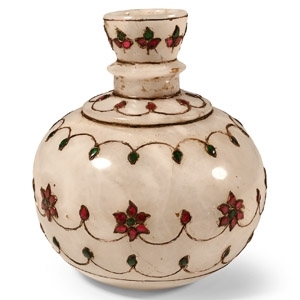
Boxed Quartz Vase with Cabochons
20th century A.D.Sold for (Inc. bp): £208
Bulbous jar with ribbed neck and funicular mouth; bands of applied wire tendrils with green and rose glass cabochons. 1.28 kg, 15.5 cm (2.37 kg total with box, 21.8 x 21.8 x 19.5 cm)
Property of a South West London gentleman. -
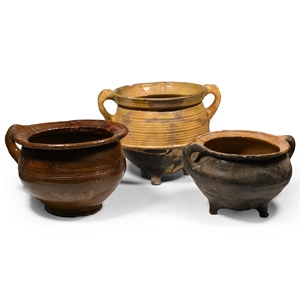
Large Glazed Vessel Group
Circa 16th-18th century A.D.Sold for (Inc. bp): £46
Comprising a mustard glazed biconical pot with tripod feet, a squat brown-glazed pot with loop handle and a broad pot with carinated profile and two loop handles to the shoulder. 3.25 kg total, 24-26 cm
Acquired 1990s-early 2000s. Ex East Anglian private collection. -
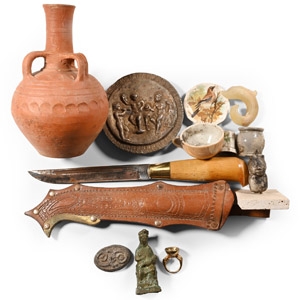
Mixed Artefact Group
20th century A.D.Sold for (Inc. bp): £26
Including: ceramic ewer with three loop handles to the shoulder, miniature bowls, plates and other vessels, glazed thimble and other items. 920 grams total, 2.8-29 cm
From a collection acquired on the UK art market from various auction houses and collections mostly before 2000. From an important Cambridgeshire estate; thence by descent.
