
Loading, please wait...
_900x900.jpg "Bactrian Polished Stone Fishing Net Weight")
_200x200.jpg "Bactrian Polished Stone Fishing Net Weight")
.jpg "Bactrian Polished Stone Fishing Net Weight")
LOT 1073
Bactrian Polished Stone Fishing Net Weight
2ND-1ST MILLENNIUM B.C.
1 5/8 in. (30.2 grams, 42 mm).
Drilled for suspension and amorphous in shape. [No Reserve]
ProvenanceGabby family collection since the late 1960s, thence by descent.
CONDITIONTimeLine Auctions follows a vetting process to ensure the authenticity and legality of all items, reinforcing our commitment to integrity and responsible trading. Each antiquity, antique, and coin lot undergoes thorough examination by a vetting committee of at least ten external specialists, professional trade association members, scientists, and archaeologists: Our Vetting Process
AUCTIONS:
TimeLine is a leading auction house specialising in antiquities, ancient art, collectables, natural history, coins, medals, and books. Our auctions offer museums, collectors, historians, and enthusiasts the opportunity to acquire unique and historically significant pieces.
-
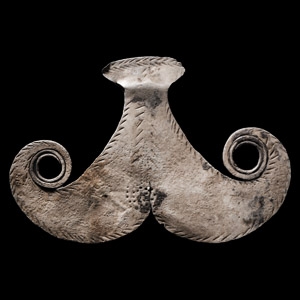
Elamite Silver Female Idol Pendant
3rd-2nd millennium B.C.Estimate: £700 - 900 (+bp*)
Opening Bid: £350
Composed of bifurcated body with each arm tapering to a coiled terminal, splayed head with suspension loop, decorative diagonal grooves around the perimeter and to the centre. 48 grams, 12.7 cm
Fine condition.
London collection since the 1980s. Property of a Canadian family. -
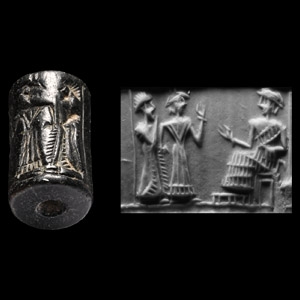
Western Asiatic Haematite Cylinder Seal with Presentation Scene
2nd-1st millennium B.C.Sold for (Inc. bp): £520
With incised frieze of a seated figure with hand extended to a figure in floor-length pleated garment, second figure behind him in a fringed robe, blank panel to the rear. 5.92 grams, 20 mm
Acquired 1970s-1996. Property of a North American collector; collection no.05. London collection, 2016. -
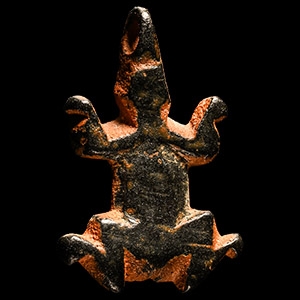
Western Asiatic Lapis Lazuli Frog Amulet
1st millennium B.C. or laterSold for (Inc. bp): £182
With a flat cross-section, a suspension loop drilled through the head. 2.38 grams, 21 mm
Ex Simmons Gallery, London E11, UK, in the 1990s. From a North London collection.
