
Loading, please wait...
_900x900.jpg "Bactrian Manuscript of an Order to Meyam's Servant")
_200x200.jpg "Bactrian Manuscript of an Order to Meyam's Servant")
.jpg "Bactrian Manuscript of an Order to Meyam's Servant")
LOT 0832
Bactrian Manuscript of an Order to Meyam's Servant
5TH-8TH CENTURY A.D.
3 in. (1.16 grams, 77 mm).
A possibly complete document written on leather, recto with four lines of Avestan cursive script; verso blank; wide bottom margin with diamond-shaped hole to accept seal string; likely an order rather than a letter due to lack of formal address. [No Reserve]
ProvenanceDavid Lindahl, Sweden, 2001.
Collection of Bruce Ferrini, USA
Central London gallery.
Property of a UK collector.
For UK buyers only.
Sims-Williams, N., Bactrian Documents II: Letters and Buddhist Texts, (Studies in the Khalili Collections, volume III), London, The Nour Foundation, 2012, pp.24, doc.xs, p.166-167, and Bactrian Documents III: pl.214.
CONDITIONTimeLine Auctions follows a vetting process to ensure the authenticity and legality of all items, reinforcing our commitment to integrity and responsible trading. Each antiquity, antique, and coin lot undergoes thorough examination by a vetting committee of at least ten external specialists, professional trade association members, scientists, and archaeologists: Our Vetting Process
AUCTIONS:
TimeLine is a leading auction house specialising in antiquities, ancient art, collectables, natural history, coins, medals, and books. Our auctions offer museums, collectors, historians, and enthusiasts the opportunity to acquire unique and historically significant pieces.
-
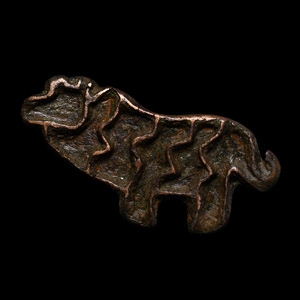
Central Asian Compartmented Seal Pendant with Bovine
23rd-20th century B.C.Sold for (Inc. bp): £208
A bronze compartmented stamp seal in the form of a stylised bovine, suspension loop to reverse; accompanied by a typed and signed scholarly note by W.G. Lambert, the late Professor of Assyriology at the University of Birmingham, 1970-1993, which states: '...This is a compartmented seal, not openwork, with a stout suspension loop on the back. The shape is that of a bovine with short curly tail, heavy body, thick neck and only a very slight hump. For practical reasons there are only the shortest of horns, where, as with the feet, the ridge around the edges of the seal is not continued. This comes from west central Asia, and dates to c.2300-2000 B.C. It is a very rare piece of great merit.' 22 grams, 52 mm
1980s-early 1990s collection, UK. Accompanied by an original typed and signed scholarly note issued by the late Professor W.G. Lambert. -
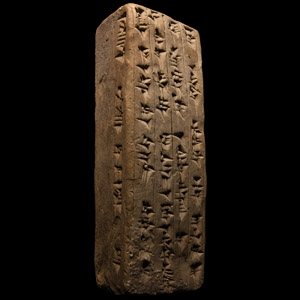
Assyrian Cuneiform Tablet
13th century B.C.Estimate: £6,000 - 8,000 (‡+bp*)
Opening Bid: £3,000
A roughly tabular clay tablet bearing impressed cuneiform text arranged in vertical columns to five of its six faces. 682 grams, 17.5 cm
Ex French art market. with Boisgirard & Associés, Paris, 14 February 2005, lot 246. Private Swiss collection since 2005. This lot has been checked against the Interpol Database of stolen works of art and is accompanied by search certificate no.11638-198993. -
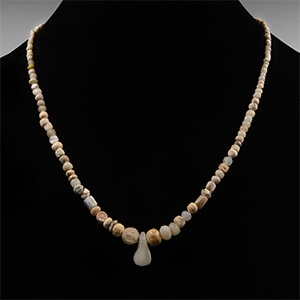
Western Asiatic Stone Bead Necklace
1st millennium B.C. and laterSold for (Inc. bp): £46
A restrung designer necklace composed mainly of graduated pottery, glass and stone beads of various dates, types and colours, including a central piriform bead. 16.6 grams, 73 cm long
Acquired 1980-2015. Ex Abelita family collection.
