
Loading, please wait...
_900x900.jpg "Bactrian Manuscript Fragment of a Letter")
_200x200.jpg "Bactrian Manuscript Fragment of a Letter")
_900x900.jpg "Bactrian Manuscript Fragment of a Letter")
_200x200.jpg "Bactrian Manuscript Fragment of a Letter")
.jpg "Bactrian Manuscript Fragment of a Letter")
.jpg "Bactrian Manuscript Fragment of a Letter")
LOT 0949
Bactrian Manuscript Fragment of a Letter
LATE 6TH-EARLY 7TH CENTURY A.D.
4 1/4 in. (1.72 grams, 11 cm).
A fragment of a leather document, likely a letter, written in Avestan cursive script; folded. [No Reserve]
ProvenanceCollection of Bruce Ferrini, USA.
Central London gallery, acquired c.1994.
Property of a UK collector.
For UK buyers only.
Damage to the centre; seemingly preserves the outer edges of a document written up to the edges of the sheet, was folded over and sealed. The letter comprised nine lines of text, of which significant proportions of the upper and lower three remain, while the middle three are less-well preserved. Beyond the damaged area would once have been a flap.
CONDITIONTimeLine Auctions follows a vetting process to ensure the authenticity and legality of all items, reinforcing our commitment to integrity and responsible trading. Each antiquity, antique, and coin lot undergoes thorough examination by a vetting committee of at least ten external specialists, professional trade association members, scientists, and archaeologists: Our Vetting Process
AUCTIONS:
TimeLine is a leading auction house specialising in antiquities, ancient art, collectables, natural history, coins, medals, and books. Our auctions offer museums, collectors, historians, and enthusiasts the opportunity to acquire unique and historically significant pieces.
-
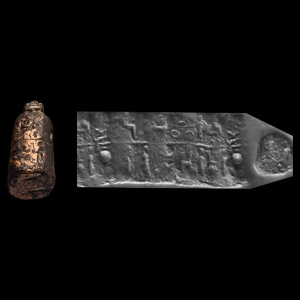
Western Asiatic Bronze Cylinder Seal Pendant
Late 2nd-early 1st millennium B.C.Sold for (Inc. bp): £117
A rare bronze cylinder seal with loop; two registers depicting figures with a wheeled vehicle, domestic animals and other items; possibly from the Bactria-Margiana archaeological complex. 19.2 grams, 26 mm
Acquired 1969-1999. London collection of the late S.M., thence by descent. -
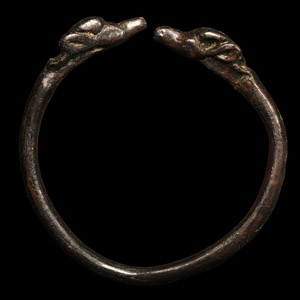
Luristan Zoomorphic Bracelet
Circa 8th-6th century B.C.Sold for (Inc. bp): £78
A copper-alloy bracelet composed of a round-section hoop and horned animal head terminals. 40 grams, 69 mm
with a London, UK gallery 1971-early 2000s. -
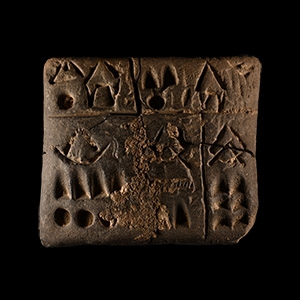
Mesopotamian Pictographic Tablet Relating to Cattle
Uruk III, circa 3000 B.C.Sold for (Inc. bp): £3,120
A bifacial pillow-shaped clay tablet bearing pictographs relating to cattle to both principal faces; repaired. 130 grams, 56 mm wide
Specialised collection of cuneiform texts, the property of a London gentleman and housed in London before 1992. Thence by descent to family members. Examined by Professor Wilfrid George Lambert FBA (1926-2011), historian, archaeologist, and specialist in Assyriology and Near Eastern archaeology, in the late 1980s and early 1990s. The collection is exceptional for the variety of types, including some very rare and well preserved examples.
Early writing was used primarily as a means of recording economic data. At the end of the 4th millennium B.C., written language developed in Mesopotamia as pictographs, later evolving into abstract forms called cuneiform. Pictographs were drawn in the clay with a pointed implement. Circular impressions alongside the pictographs represented numerical symbols. Cuneiform (meaning wedge-shaped) script was written by pressing a reed pen or stylus with a wedge-shaped tip into a clay tablet.
