
Loading, please wait...
_900x900.jpg "Bactrian Bronze Claw Axehead-Mace")
_200x200.jpg "Bactrian Bronze Claw Axehead-Mace")
.jpg "Bactrian Bronze Claw Axehead-Mace")
LOT 1480
Bactrian Bronze Claw Axehead-Mace
2ND-1ST MILLENNIUM B.C.
4 1/4 in. (190 grams, 10.9 cm).
Egg-shaped with spiked sleeves or prongs, the top of the weapon with a narrow edge.
ProvenanceAcquired on the UK art market before 2000.
Property of an Essex, UK, gentleman.
This lot is accompanied by an illustrated lot declaration signed by the Head of the Antiquities Department, Dr Raffaele D’Amato.
This lot is accompanied by an illustrated lot declaration signed by the Head of the Antiquities Department, Dr Raffaele D'Amato.
The 'claw mace' was an enigmatic ancient bronze weapon from the Bronze Age Near East. The hollow bulbous head was trailed by tines of varying lengths. It is believed that it was affixed over a wooden shaft and used like a club in combat, and not necessarily used as ceremonial weapon. The knife edge bulb end could have broken bones and proven to be a formidable striking weapon requiring no skill to wield. The tines would have not only been decorative, but have served to add strength below the striking end to prevent breakage. In battle, maces were often used by commanders to display rank when giving orders in battle and leading soldiers, inspiring leadership and power. Egg-shaped with spiked sleeves or prongs, the top of the weapon with a narrow edge, the sleeves with small internal tangs for mounting.
CONDITIONTimeLine Auctions follows a vetting process to ensure the authenticity and legality of all items, reinforcing our commitment to integrity and responsible trading. Each antiquity, antique, and coin lot undergoes thorough examination by a vetting committee of at least ten external specialists, professional trade association members, scientists, and archaeologists: Our Vetting Process
AUCTIONS:
TimeLine is a leading auction house specialising in antiquities, ancient art, collectables, natural history, coins, medals, and books. Our auctions offer museums, collectors, historians, and enthusiasts the opportunity to acquire unique and historically significant pieces.
LOT 1480
Bactrian Bronze Claw Axehead-Mace
Estimate £100 - 140€120 - 160 (for guidance only)$140 - 190 (for guidance only)
-
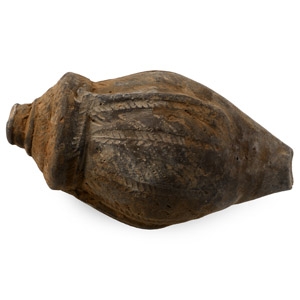
Turco-Mongol 'Greek Fire' Ceramic Fire Bomb or Hand Grenade
13th-15th century A.D.Sold for (Inc. bp): £78
A hollow vessel with cylindrical body and short neck, raised vertical lugs on the upper body; intended to be filled with explosive liquid and a wick, and used as a hand grenade. 587 grams, 16.5 cm
From an important specialist collection, London, UK, 1990s onwards. This lot is accompanied by an illustrated lot declaration signed by the Head of the Antiquities Department, Dr Raffaele D'Amato. -
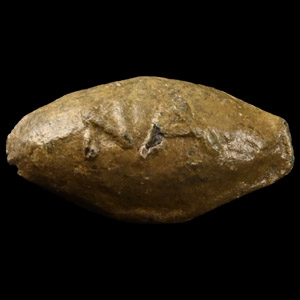
Greek Macedonian Lead Inscribed Slingshot
3rd-1st century B.C.Sold for (Inc. bp): £85
A biconical glans with an inscription 'MEP' to one side and 'NA' to the other. 27.5 grams, 28 mm
Ex German art market, 2000s. Acquired from an EU collector living in London. From the collection of a Surrey, UK, gentleman. This lot is accompanied by an illustrated lot declaration signed by the Head of the Antiquities Department, Dr Raffaele D'Amato.
The leaden bullets, which were thrown from slings, were called in Greek Molivdainai (μολύβδαιναι), and in Latin glandes- the former indicating the material ‘lead’, the latter the shape ‘acorns’. These bullets were cast in a mould, and bore letters or devices or both, on two sides or on only one. In form they were more like an almond than an acorn, but many are pointed at both ends; in size, they are generally about one inch and a half maximum length, and under one inch in maximum width. Bullets from Mecyberna possess the abbreviated inscription MER (obverse) and NA (reverse), which some scholar translated as Mecyberna. The presence of the Mecyberna inscription is expected, since the Polis of Mecyberna produced clay moulds, which suggests local production. Inscribed bullets with the name of a city may also denote the place of manufacture -
.jpg)
Post Medieval Cased 'Manchester Area' Militaria and Other Artefact Collection
18th-20th century A.D.Sold for (Inc. bp): £33
Including cap badges, cartwheel pennies, snake-buckle, buttons and other items, mounted in a glazed wooden frame. 1.1 kg, 29.5 x 35 cm
From the private collection of a Manchester, UK, detectorist, 1990s. This lot is accompanied by an illustrated lot declaration signed by the Head of the Antiquities Department, Dr Raffaele D’Amato. This lot is accompanied by an illustrated lot declaration signed by the Head of the Antiquities Department, Dr Raffaele D'Amato.
