
Loading, please wait...
LOT 0269
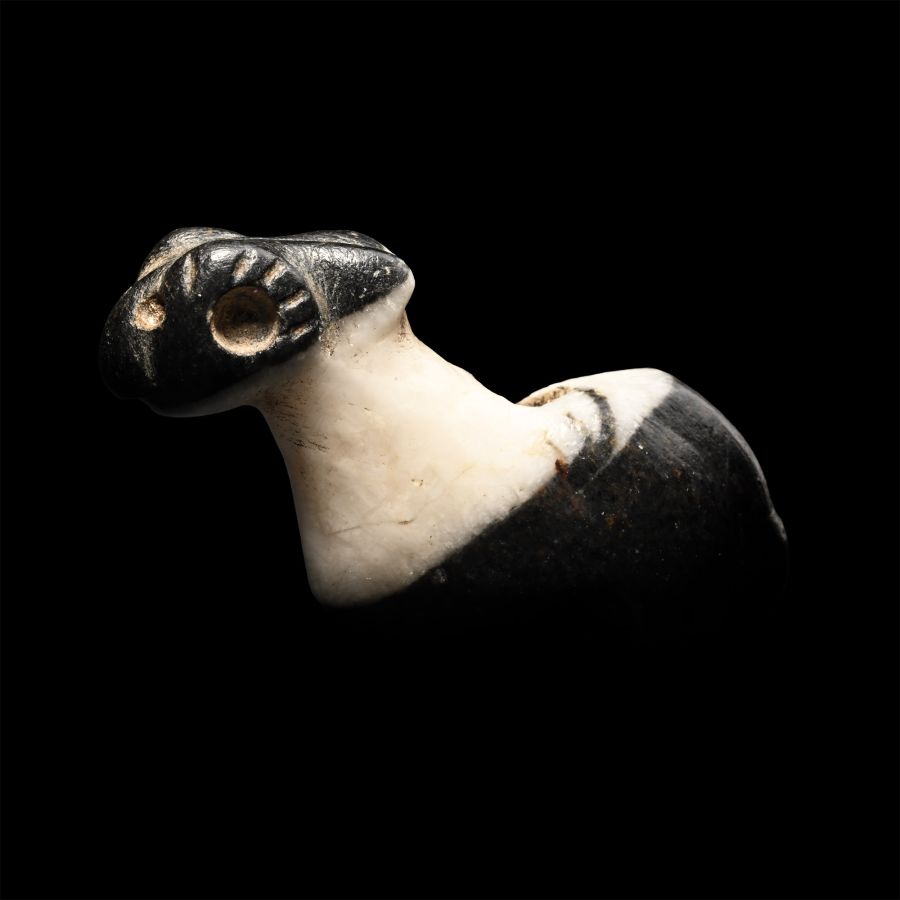
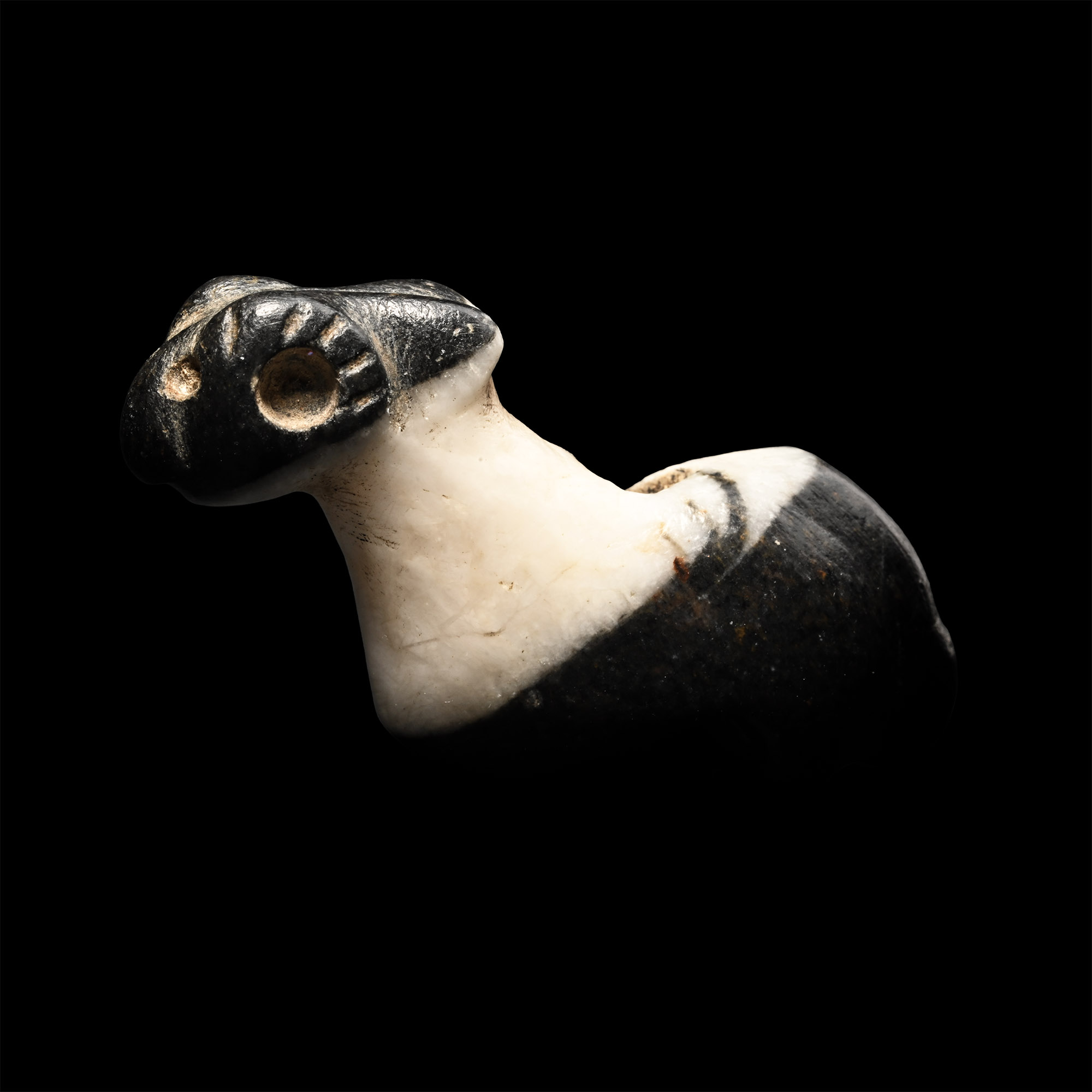
Babylonian Stone Bead in the Shape of a Ram
1ST MILLENNIUM B.C.
1 1/2 in. (8.66 grams, 40 mm).
Carved in the round to take advantage of the banded colouration, pierced vertically through the rump, with eye and ribbed horn detailing.
ProvenancePrivate collection, acquired in the late 1980s-early 1990s; thence by descent.
CONDITIONTimeLine Auctions follows a vetting process to ensure the authenticity and legality of all items, reinforcing our commitment to integrity and responsible trading. Each antiquity, antique, and coin lot undergoes thorough examination by a vetting committee of at least ten external specialists, professional trade association members, scientists, and archaeologists: Our Vetting Process
AUCTIONS:
TimeLine is a leading auction house specialising in antiquities, ancient art, collectables, natural history, coins, medals, and books. Our auctions offer museums, collectors, historians, and enthusiasts the opportunity to acquire unique and historically significant pieces.
LOT 0269
Babylonian Stone Bead in the Shape of a Ram
Estimate £700 - 900€810 - 1,040 (for guidance only)$950 - 1,220 (for guidance only)
Opening Bid
£350 (EUR 406; USD 473) ‡+BP*
-
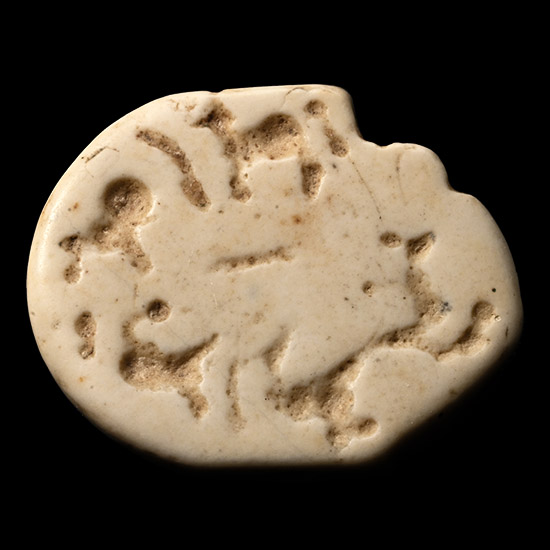
Jemdet Nasr White Stone Stamp Seal in the Form of a Lion with Engraved Animals
Circa 3000 B.C.Estimate: £800 - 1,000 (+bp*)
Opening Bid: £400
Carved in the half-round as a stylised animal head, restrung with round red stone beads at each end, accompanied by an old scholarly note, typed and signed by W.G. Lambert, late Professor of Assyriology, University of Birmingham, 1970-1993, which states: 'Stamp Seal of White Marble, 20 x 24 x 7.5 mm. This seal has the form of a lion's head on the top side, cut from a pebble with snout, mouth, eyes and ears marked by cuts in the stone. It is pierced from top to bottom in the middle. The flat base is engraved with five animals done mostly with the drill. One horned animal, and three springing rodents and one sheep (?) can be made out. Five almost vertical lines, four between the animals, one in the centre, probably represent snakes. This is a seal of the Jemdet Nasr period, c. 3000 B.C., from Sumer or south-west Iran, and is in very good state of preservation. It is an interesting example of sculpture from the dawn of history'; supplied with a museum-quality impression. 6.9 grams total, seal: 24.5 mm
Ex Mr K. Kobayashi, Galerie Archaique Ltd, Osaka, Japan, prior to 1988. Accompanied by a copy of an old scholarly note, typed and signed by W.G. Lambert, late Professor of Assyriology, University of Birmingham, 1990. -
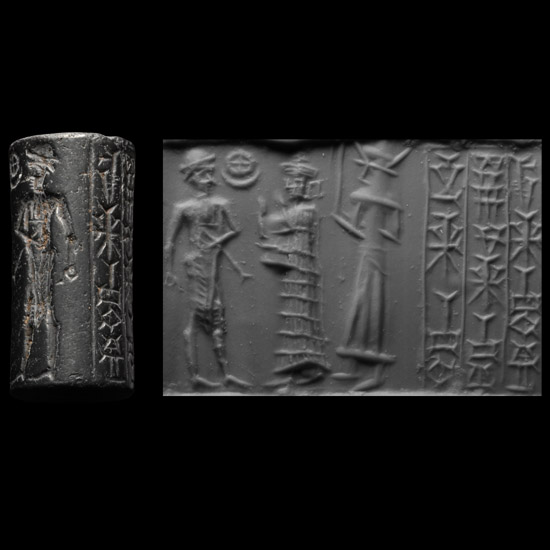
Old Babylonian Hematite Cylinder Seal for Lu-Enkika, Son of Iddin-Sin, Servant of Enki
Circa 1900-1700 B.C.Estimate: £2,500 - 3,500 (+bp*)
Bids: 3 | Current Bid: £1,700
Cylinder with figures and inscription, restrung red stone bead to each end; accompanied by a copy of an old scholarly note, typed and signed by W.G. Lambert, late Professor of Assyriology, University of Birmingham, 1970-1993, which states: 'Description of Cylinder Seal of Hematite, 29.5 x 14.5 mm. The original art work consists of a pair of standing figures: a Lamma goddess to the right, with both hands raised, wearing a horned tiara of divinity and a long flounced dress reaching to the feet, and facing her the god with mace, wearing a Gudes-type hat, a role which reaches to the knees, and holding a mace at the waist with his right hand. Between them in the sky is a combined sun disk and lunar crescent. A third figure to the far right is out in a different style, and was added a century or two later. It shows a standing god with projections from his headdress and holding up a long rod in his right hand. His robes reach a little above the feet. There is a three line cuneiform inscription: 'Du-Enkika, son of Iddin-Sin, servant of (the god) Enki". The inscription identifies the owner. This is an Old Babylonian seal, either from southern Iraq or from the closest parts of south west Iran, such as Susa. It dates to c. 1900-1700 B.C. and is out in the fine detailed best style of the period. After 1700 B.C., until about 1500, there existed a simplified style, using especially the mechanical tools possessed by the craftsmen of the day, namely the drill and cutting wheel. The cutting wheel was used to supply the extra figure, and this was with reasonable certainty done in Iran, not Mesopotamia. The projecting hat and the rod are paralleled in seals from Susa, see P. Amiet, Glyptique Susienne nos. 1748, 1755, for the hat, and nos. 1748, 1749, 1756 for the rod.'; supplied with a museum-quality impression. 19.8 grams total, seal: 28.8 mm
Private collection, London UK. Accompanied by a copy of an old scholarly note, typed and signed by W.G. Lambert, late Professor of Assyriology, University of Birmingham, 1991. This lot has been checked against the Interpol Database of stolen works of art and is accompanied by search certificate no.13467-262421.
The Old Babylonian style produced several relatively simple yet sometimes ornate designs, some quite early but many more probably of the first half of the 18th century B.C., especially from the time of Hammurabi. -
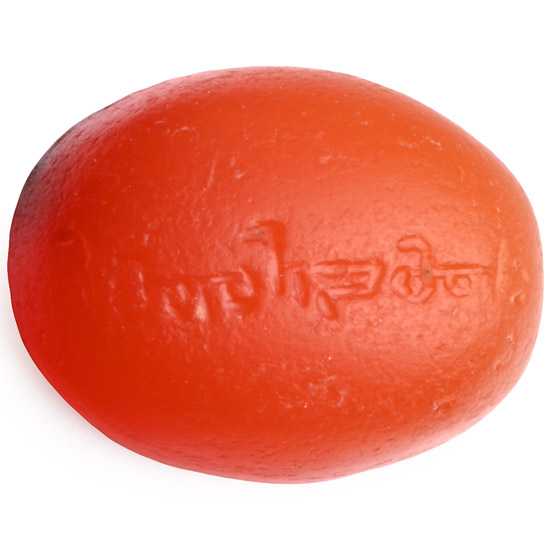
Western Asiatic Carnelian Calligraphic Gemstone
12th-14th century A.D.Estimate: £100 - 140 (+bp*)
Bids: 1 | Current Bid: £5
Plano-convex in section with incuse median line of Kufic text. 0.44 grams, 9.9 mm
From the private collection of a European gentleman (1942-2024), formed since the 1970s.
