
Loading, please wait...
LOT 1051
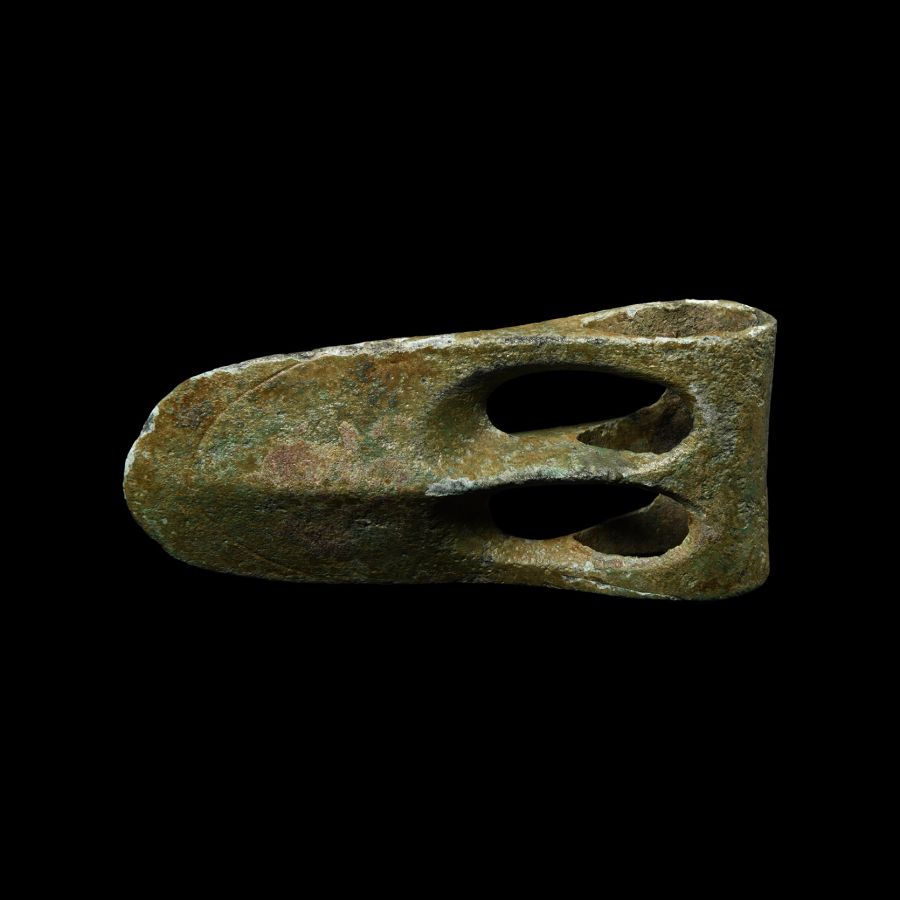
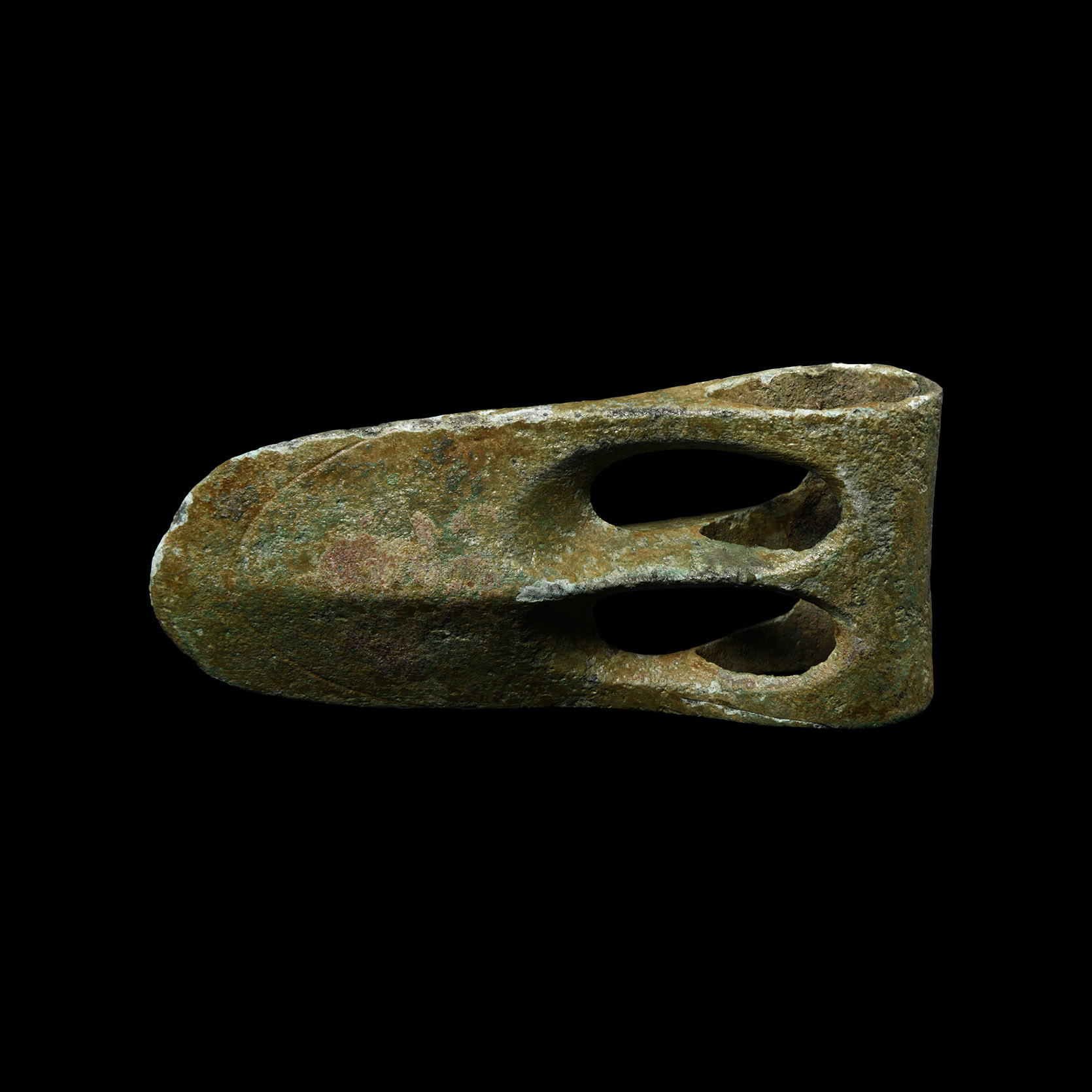
Babylonian Duck-Billed Axehead
2ND MILLENNIUM B.C.
4 in. (170 grams, 10 cm).
A bronze duck-billed axehead with a curved, beak-shaped blade, with two pierced eyes and a raised ridge down the centre.
ProvenanceAcquired in the 1990s.
Ex Paris Gallery.
Cf. Gernez, G., L’armament en métal au Proche et Moyen-Orient: des origines a 1750 av. J.C., Paris, 2007, fig.2.42, type H4b.
FootnotesThis axe corresponds to the type H4B of the Gernez classification. Several of these models, with their moulds, are known from the Levant, like those in Byblos, Ras Shamra, and Tell Arqa. On the other hand, a workshop level II of the Kültepe karum delivered two moulds, showing a local production of arms intended either for export or for the inhabitants originating from Mesopotamia or the Levant. This sub-type of eye-axes is characteristic of the Middle Bronze Age 1 (2050-1750 B.C.).
CONDITIONTimeLine Auctions follows a vetting process to ensure the authenticity and legality of all items, reinforcing our commitment to integrity and responsible trading. Each antiquity, antique, and coin lot undergoes thorough examination by a vetting committee of at least ten external specialists, professional trade association members, scientists, and archaeologists: Our Vetting Process
AUCTIONS:
TimeLine is a leading auction house specialising in antiquities, ancient art, collectables, natural history, coins, medals, and books. Our auctions offer museums, collectors, historians, and enthusiasts the opportunity to acquire unique and historically significant pieces.
-
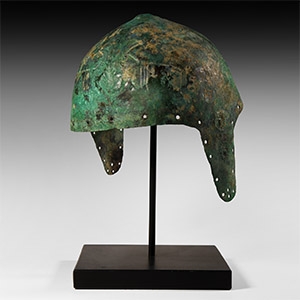
Levantine Helmet with Opposing Ibexes
8th century B.C.Sold for (Inc. bp): £5,200
A Levantine or Assyrian domed bronze helmet of ovoid shape with slightly pointed top and integral cheek-pieces; chased low-relief decoration to both front and back depicting insignia of a pair of opposing ibexes flanking a small palm tree; the edge with regularly disposed holes for fastening of the leather lining; accompanied by a custom-made display stand. 458 grams, 23 cm high (2.36 kg total, 31.5 cm high including stand)
Fine condition, some restoration.
Acquired 1960s-1990s. Late Alison Barker collection, a retired London barrister. Accompanied by an academic report by Dr Raffaele D'Amato. This lot has been checked against the Interpol Database of stolen works of art and is accompanied by search certificate no.11386-190447.
This rare helmet is an unusual example of a conical strap-helmet, linked with similar Greek strap helmets, but until now in the Near East, known only from the Assyrian reliefs. It is shown together with the crested helmets, on the reliefs of Tiglapilaser III and Sennacherib. -
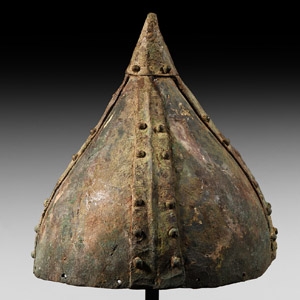
Sassanian Spangenhelm with Rivets
6th-7th century A.D.Sold for (Inc. bp): £4,160
A copper-alloy multi-segmented spangenhelm with an ogival profile, rivetted conical finial and riveted straps running vertically around the circumference, some restoration. 1.14 kg, 23 cm high
UK private collection before 2000. UK art market. Property of a London gentleman. Accompanied by an academic report by Dr Raffaele D'Amato. This lot has been checked against the Interpol Database of stolen works of art and is accompanied by searcher certificate no.11589-199700.
The Spangenhelm is a protective headgear made up from segments or plates held together by a frame. As a popular form of helmet it came to prominence in western Europe in the later Roman Empire, and remained in use for some centuries until replaced by helmets formed from a single sheet. -
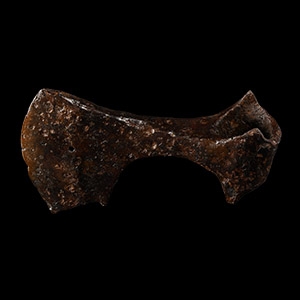
Viking Period Bearded Axehead
Circa 9th-11th century A.D.Sold for (Inc. bp): £169
A hand-forged iron axehead with triangular-section narrow blade widening to a broad bevelled edge with square chin, socket with lateral flanges and rectangular panel to the rear. 422 grams, 15.2 cm
Acquired 1971-1972. From the collection of the vendor's father. Property of a London, UK, collector.
The axe appears to belong to the typology of Viking side axes of Wheeler type B (Wheeler III / Rygh 559). Usually these bearded axeheads (skeggöks) had a longer edge, designed to split tree trunks into planks and beams, or heads during the battle. Some of the bearded axes were known as halfÞynna öx, the neck on such 'half thin axe' was thinly forged, to make it lighter.
