
Loading, please wait...
_900x900.jpg "Babylonian Cuneiform Foundation Nail")
_200x200.jpg "Babylonian Cuneiform Foundation Nail")
_900x900.jpg "Babylonian Cuneiform Foundation Nail")
_200x200.jpg "Babylonian Cuneiform Foundation Nail")
.jpg "Babylonian Cuneiform Foundation Nail")
.jpg "Babylonian Cuneiform Foundation Nail")
LOT 0217
Babylonian Cuneiform Foundation Nail
CIRCA 3RD MILLENNIUM B.C.
2 1/4 in. (36 grams, 58 mm).
Conical in form with facetted faces bearing cuneiform text. [No Reserve]
ProvenanceAcquired by the vendor's mother 1960s-1970s, thence by descent.
Ex Spray family collection, Norfolk, UK.
See Aruz, J., Art of the First Cities. The Third Millennium B.C. from the Mediterranean to the Indus, New York, 2003, for discussion.
CONDITIONTimeLine Auctions follows a vetting process to ensure the authenticity and legality of all items, reinforcing our commitment to integrity and responsible trading. Each antiquity, antique, and coin lot undergoes thorough examination by a vetting committee of at least ten external specialists, professional trade association members, scientists, and archaeologists: Our Vetting Process
AUCTIONS:
TimeLine is a leading auction house specialising in antiquities, ancient art, collectables, natural history, coins, medals, and books. Our auctions offer museums, collectors, historians, and enthusiasts the opportunity to acquire unique and historically significant pieces.
-
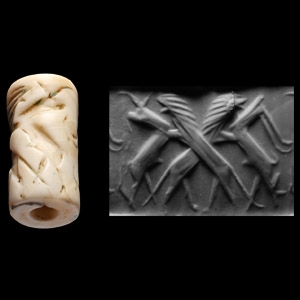
Western Asiatic Shell Cylinder Seal with Attack Scene
Circa 3rd millennium B.C.Sold for (Inc. bp): £520
With incised frieze depicting two leaping lions attacking antelopes. 8.7 grams, 26 mm
Acquired 1970s-1996. Property of a North American collector; collection no.013. London collection, 2016. -
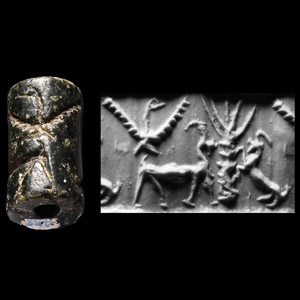
Western Asiatic Steatite Cylinder Seal with Animals
2nd-1st millennium B.C.Sold for (Inc. bp): £234
With frieze depicting a bird with wings spread above an advancing canine, tree and leaping goat. 7.5 grams, 23 mm
Acquired 1970s-1996. Property of a North American collector, collection no.028. London collection, 2016. -
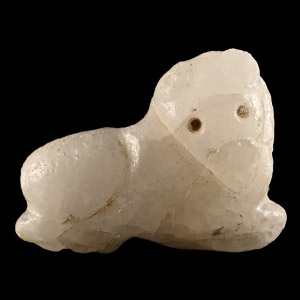
Western Asiatic Chalcedony Bull Amulet
Circa 3rd millennium B.C.Sold for (Inc. bp): £169
Carved figure of a recumbent bull with headed turned, drilled eyes, legs folded beneath the body; drilled at the midriff and shoulders for use as a bead. 12.7 grams, 32 mm
Acquired 1970s-1996. Property of a North American collector. London collection, 2016.
