
Loading, please wait...
LOT 1059
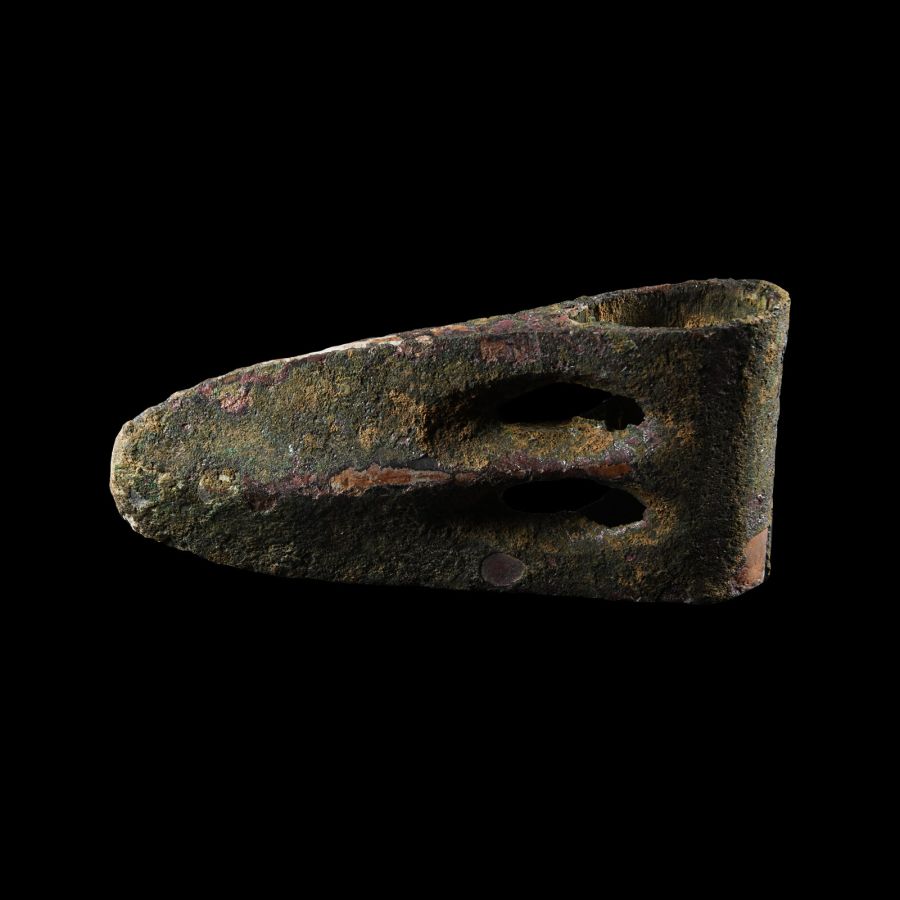
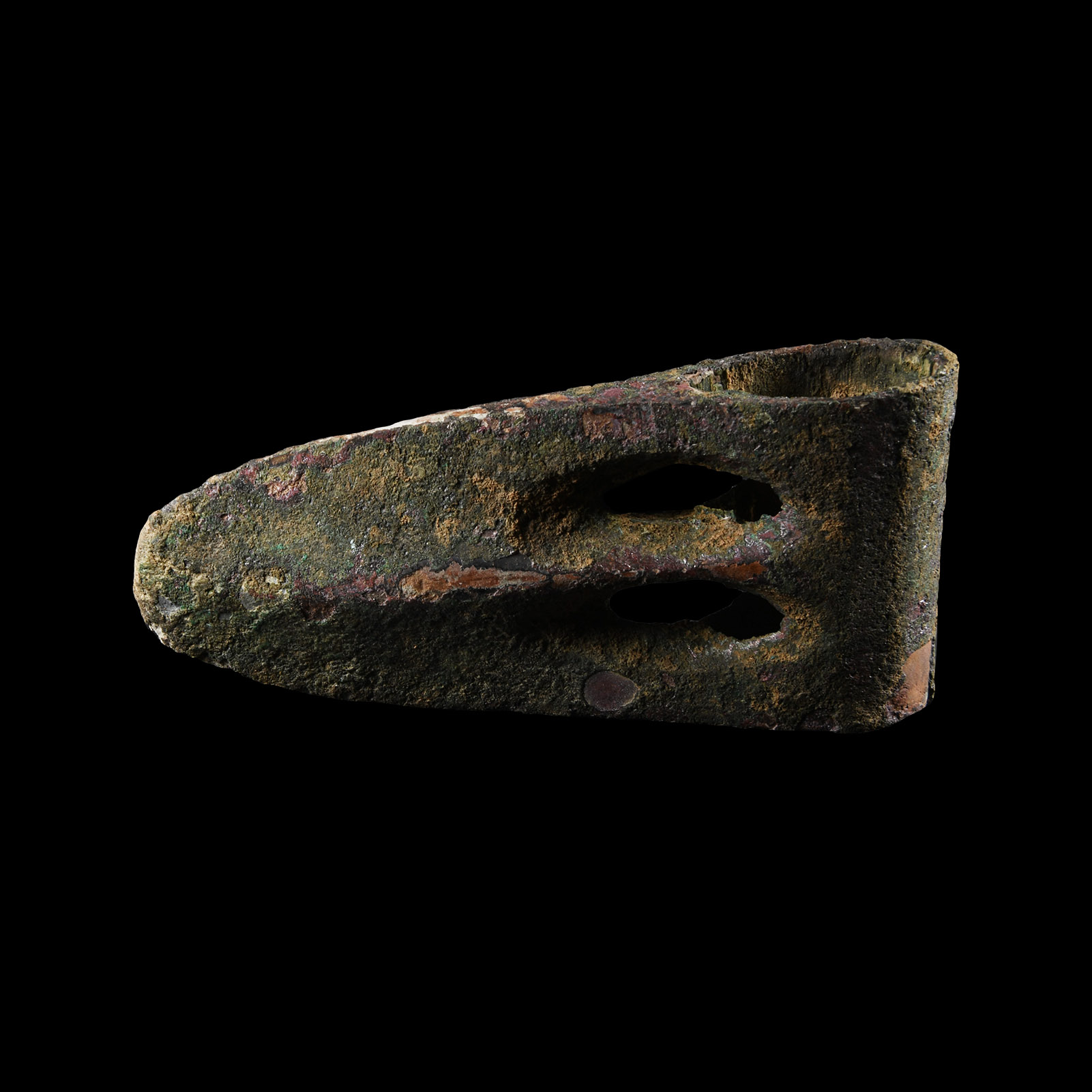
Babylonian Bronze Axehead
2ND MILLENNIUM B.C.
4 1/8 in. (204 grams, 10.5 cm).
A bronze duck-billed shaft-hole axe head featuring a curved, beak-shaped blade with two pierced eyes and a raised median ridge.
ProvenanceAcquired early 1990s.
Ex private American collection; thence by descent.
Private Swiss collection since 1998.
Cf. Gernez, G., L’armament en métal au Proche et Moyen-Orient: des origines a 1750 av. J.C., Paris, 2007, fig.2.42, type H4b.
CONDITIONTimeLine Auctions follows a vetting process to ensure the authenticity and legality of all items, reinforcing our commitment to integrity and responsible trading. Each antiquity, antique, and coin lot undergoes thorough examination by a vetting committee of at least ten external specialists, professional trade association members, scientists, and archaeologists: Our Vetting Process
AUCTIONS:
TimeLine is a leading auction house specialising in antiquities, ancient art, collectables, natural history, coins, medals, and books. Our auctions offer museums, collectors, historians, and enthusiasts the opportunity to acquire unique and historically significant pieces.
-
Western Asiatic Spearhead
12th-10th century B.C.Sold for (Inc. bp): £108
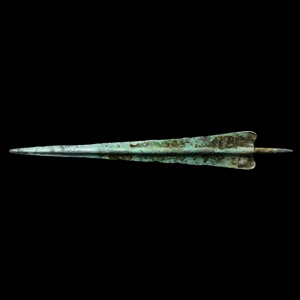
A bronze spearhead tapering from shoulders to rounded tip; the short tang tapering to end for insertion into a shaft. 375 grams, 42 cm
Fine condition.
Abelita family collection, 1980-2015.
This is a type 2 spearhead with a long blade and short tang. The elongated blade had two rivet heads at its base, here effaced by a later restoration. Similar pieces have been excavated in Marlik and Amlash. -
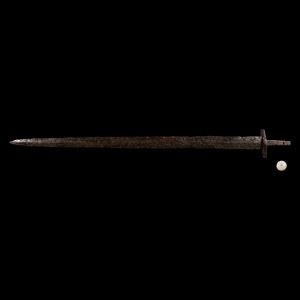
Migration Period Spatha Sword Blade with Sword Bead
Circa 4th-5th century A.D.Sold for (Inc. bp): £572
A double-edged spatha with a lentoid section parallel-sided iron blade with pointed tip; battle nicks to both cutting edges; rhomboid-section cross-guard; a fastening nail on the upper tang; accompanied by a sword bead. 921 grams total, 2.7- 86.5 cm
cleaned and conserved.
Acquired 1971-1972. From the collection of the vendor's father. Property of a London, UK, collector. Accompanied by an academic report by Dr Raffaele D’Amato.
A Migration Period sword, originating from Central Asia, often used by nomadic populations and particularly by the Huns, defined as a Nomadic-Asiatic sword by Menghin, or as a sword with plate guard. The long and thin blade, with a lenticular or lozenge section, was equipped with a guard composed of an iron plate inserted into the tang. Little is known about the scabbard of these swords but it is known that they usually had disc-shaped pommels, and stones hanging from the pommel or hilt. This typology was widespread in Central Europe by the Huns and there are also specimens attested in Gaul in the 5th century. -
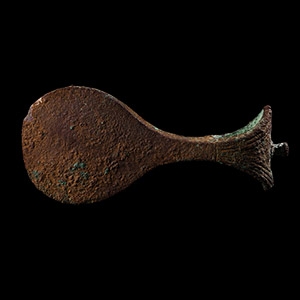
Western Asiatic Paddle-Shaped Axehead
3rd millennium B.C.Sold for (Inc. bp): £124
A copper-alloy axehead with roughly lozenge-shaped butt, oblong socket and paddle-shaped cheeks; incised concentric lines following the outline of the butt and flared, projecting knop at the centre. 335 grams, 16 cm
Early 1990s London collection. Acquired on the UK art market. From a private collection, Lancashire, UK.
The axe belongs to subtype H2.J.b of the Gernez classification. These axes are characterised by decoration often executed with remarkable care and technical skill. The enlargement and indentation of the back of the collar varies, whilst the shape of the blade is, by contrast, standardised, with divergent rectilinear edges and a straight cutting edge or, more rarely, a rounded cutting edge, as in the example offered here.
