
Loading, please wait...
LOT 1095
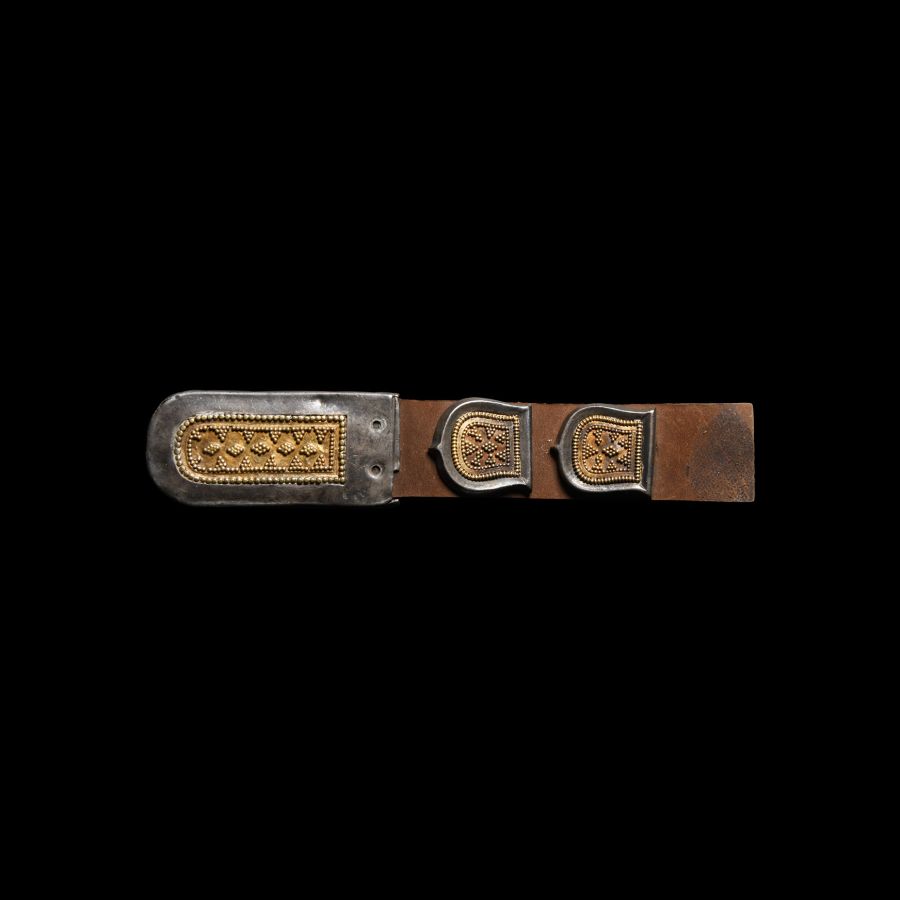
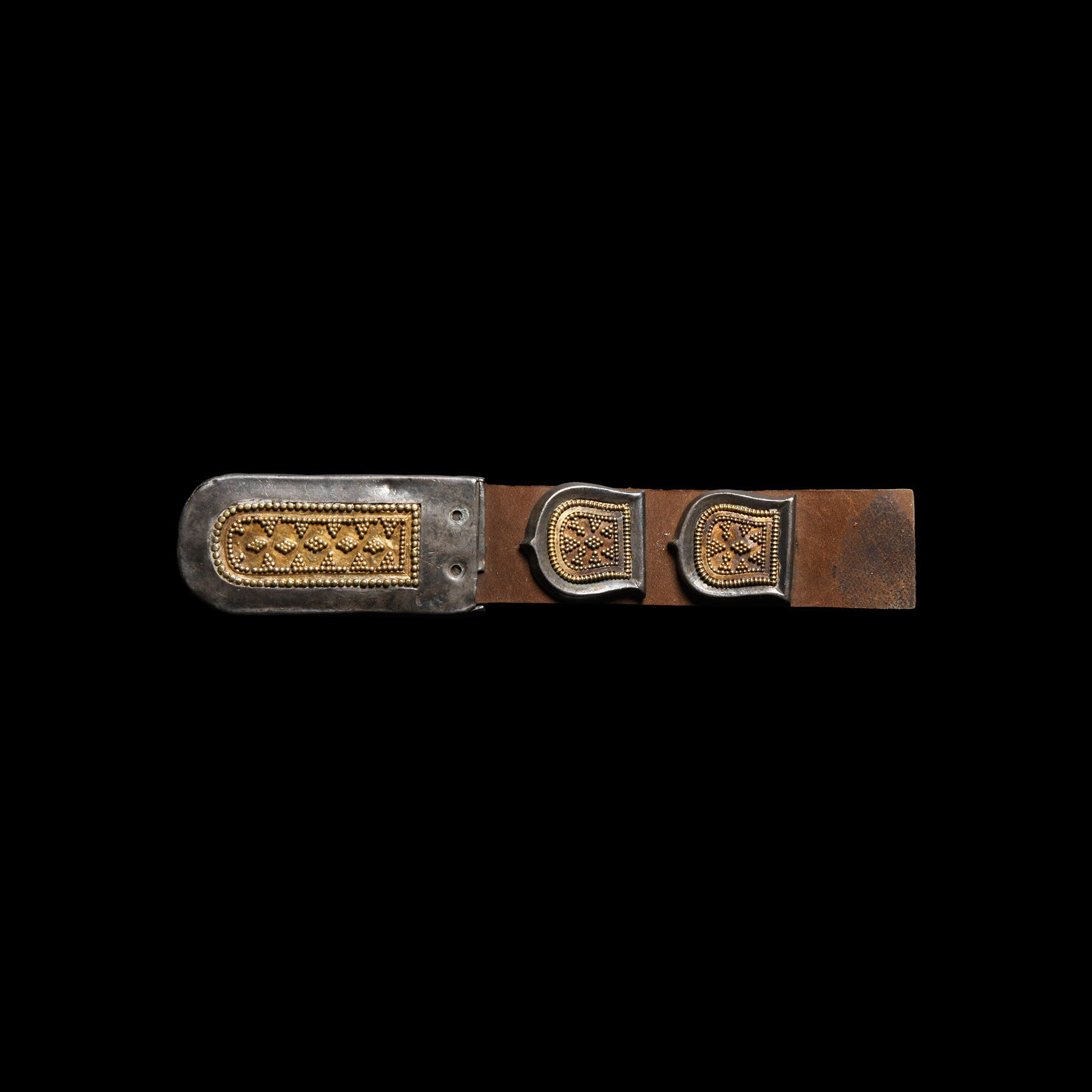
Avar-Byzantine Silver-Gilt Sword Belt Mount Group
7TH-9TH CENTURY A.D.
4 3/4 in. (26.5 grams, 12.2 cm long).
Comprising three belt mounts later remounted onto brown leather comprising: a rectangular strap end with rounded terminal, decorated with granulated borders, lozenges and chevrons; two roughly D-shaped mounts with apex flourish and waisted sides, also decorated with granulated lozenges and chevrons.
ProvenanceAcquired in the 1980s-1990s.
Ex an important central London gallery, London W1.
Cf. Daim, F., Hunnen + Awaren, Reitervölker aus dem Osten, Burgenländische Landesausstellung 1996, Schloß Halbturn, 26 April - 31 Oktober 1996, Eisenstadt, 1996, p.398, nos.5.365-5.367, for similar belt fittings.
FootnotesThis type of belt element, decorated with granulation, is present in the Avar graves of the second half of the 7th century, and was most likely produced in the workshops of the Eastern Roman Empire, from where they reached the Avar lands as imperial gifts (tomb of Kunbàboni) or spoils of war. They were part of multiple belts, to which sabres and knives were attached, commonly used among Avars, Bulgars and Romans during the 7th and 8th centuries A.D.
CONDITIONTimeLine Auctions follows a vetting process to ensure the authenticity and legality of all items, reinforcing our commitment to integrity and responsible trading. Each antiquity, antique, and coin lot undergoes thorough examination by a vetting committee of at least ten external specialists, professional trade association members, scientists, and archaeologists: Our Vetting Process
AUCTIONS:
TimeLine is a leading auction house specialising in antiquities, ancient art, collectables, natural history, coins, medals, and books. Our auctions offer museums, collectors, historians, and enthusiasts the opportunity to acquire unique and historically significant pieces.
-
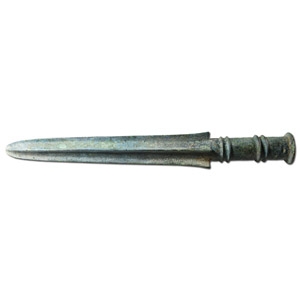
Chinese Bronze Military Flag or Banner Finial
Circa 5th-3rd century B.C. or laterSold for (Inc. bp): £468
Composed of a socketted blade divided into six sections with sharp grooves, the shaft with four circumferential bands. 873 grams, 34 cm
Ex old English collection. London art market, pre 2000. Property of a London, UK, gentleman.
The Chinese, having adopted the use of chariot from the west, judging by the monuments and literature used it primarily for archery combat, as evidenced by the absence of spearheads in chariot burials of the Yin Kingdom. But already from the early Zhou Dynasty chariot warriors used a spear. Massive Yin spears were the weapon of dense infantry formations. The shape of our specimen, probably used as standard finial, recalls that of a spear from Zhongzhoulu, Luoyang, Prov. Henan, dated at the 5th-4th centuries B.C., and of two spears from the Zheng fortress of Xinzheng Country, dated to the 4th-3rd century B.C. -
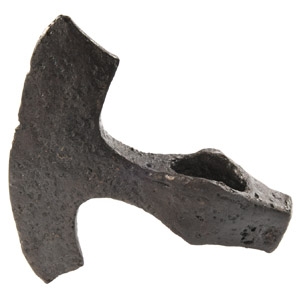
Viking Age Baltic Iron Wide-Bladed Axehead
11th-13th century A.D.Sold for (Inc. bp): £234
With narrow T-shaped blade with curved edge, large round socket with lateral triangular flanges and rectangular extension to the rear. 785 grams, 18 cm
From the private collection of a London gentleman, from his grandfather's collection formed before the early 1970s.
The Curonians were known as fierce warriors and sailors who were involved in several wars and alliances with the Swedish, Danish and Icelandic Vikings. Baltic tribes created an original and impressive set of weaponry. They included battle knives, battle axes and spears and javelins with medium sized heads of a characteristic shape. -
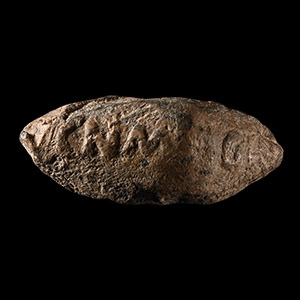
Roman 'Pompey the Great' Lead Slingshot
1st century B.C.Sold for (Inc. bp): £286
Biconical lead slingshot (glans) with inscription in Latin letters 'CN' (Cneius) 'MAG' (Magnus) on one side, and 'IMP' for 'IMPERATOR' (victorious general) to the other side, i.e Gnaeus Pompeius Magnus Imperator (Pompey the Great the victorious general). 47 grams, 39 mm
Ex M.Cummings, UK, 1990s.
The shot (Völling type 1C) is marked with the abbreviated name of Gnaeus Pompey; it was used in quantity at the Battle of Monda (or Munda) against Julius Caesar, 17th March 45 BC. The projectiles were made of different materials: lead (glandes) or in pottery or stone (lapides missiles). Sometimes they were signed with the name of the general, like our specimen.
