
Loading, please wait...
_900x900.jpg "Attic Red-Figure Fragment Attributed to the Thaliarchos Painter")
_200x200.jpg "Attic Red-Figure Fragment Attributed to the Thaliarchos Painter")
.jpg "Attic Red-Figure Fragment Attributed to the Thaliarchos Painter")
LOT 0105
Attic Red-Figure Fragment Attributed to the Thaliarchos Painter
5TH CENTURY B.C.
5 in. (95 grams, 12.5 cm).
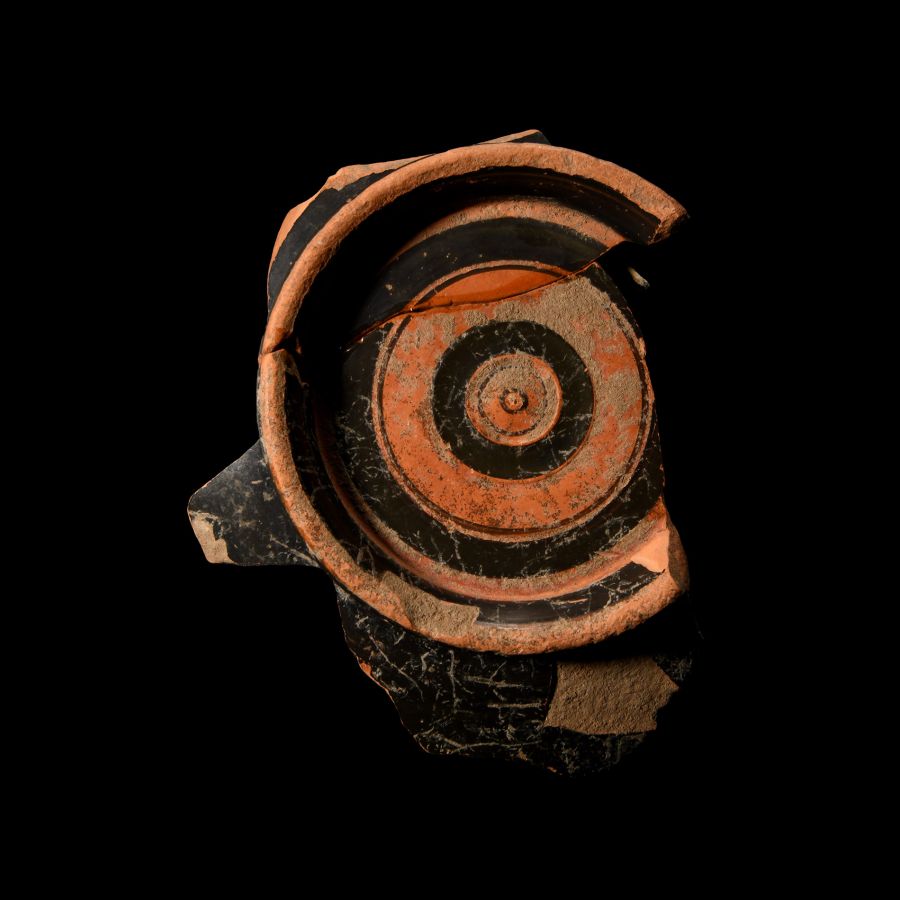
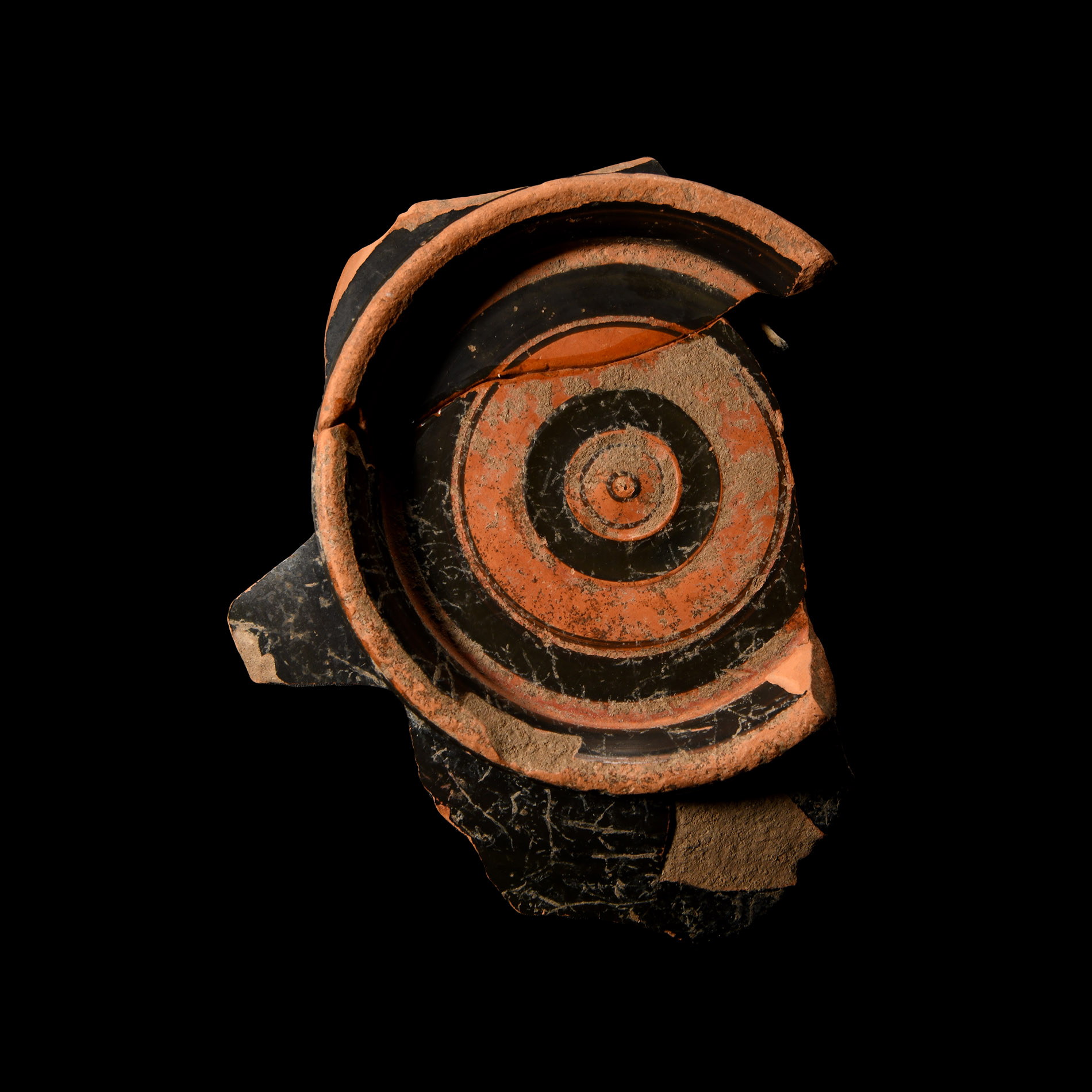
Comprising the bottom part of a cup-skyphos or pyxis, decorated with concentric circles in red and black, the internal part painted with the image of a young athlete, wrapped in a short chlamys and leaning upon his staff, the ground represented as a concave space.
ProvenanceAcquired in Europe before 1990.
This lot has been checked against the Interpol Database of stolen works of art and is accompanied by search certificate no.11810-206516.
Cf. Boardman, J., Athenian Red Figure Vases. The Archaic period, London, 1975, fig.81.
FootnotesThe everyday life of ancient Greeks is well represented on the Attic red figure paintings. The short cloak (chlamys) is the favourite garment for the men and the hair of the younger men is more often shown cropped than in the black Attic figure paintings. The nakedness of youths exercising at the palaistra could well have been an important source of inspiration for the Greek artists who were becoming increasingly aware of the possibilities to represent the physiology of subtle movement in paintings. The Thaliarchos painter is generally recognised as the artist of the tops of some powder-box pyxides, although it is not excluded that he was actively painting various types of vessels. The type of ground and the way in which the foot of the man is worked can support the thesis that the fragment is from his workshop.
CONDITIONTimeLine Auctions follows a vetting process to ensure the authenticity and legality of all items, reinforcing our commitment to integrity and responsible trading. Each antiquity, antique, and coin lot undergoes thorough examination by a vetting committee of at least ten external specialists, professional trade association members, scientists, and archaeologists: Our Vetting Process
AUCTIONS:
TimeLine is a leading auction house specialising in antiquities, ancient art, collectables, natural history, coins, medals, and books. Our auctions offer museums, collectors, historians, and enthusiasts the opportunity to acquire unique and historically significant pieces.
LOT 0105
Attic Red-Figure Fragment Attributed to the Thaliarchos Painter
Sold for (Inc. bp): £702
-
Greek Black-Ware Dish with Shell Decoration
Circa 5th-4th century B.C.Sold for (Inc. bp): £169
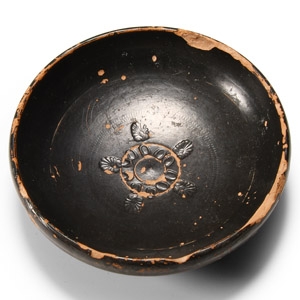
Composed of a shallow bowl with D-section wall, broad convex stem and foot; interior stamped with seashell and geometric motifs. 118 grams, 10.7 cm wide
Private UK collection formed 1990s-2000s. Property of an East Sussex, UK, teacher. -
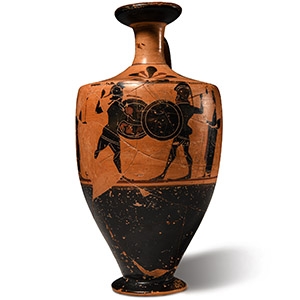
Greek Attic Black-Figure Lekythos with Fighting Hoplites
6th century B.C.Sold for (Inc. bp): £3,380
The piriform body tapering towards the splayed foot, D-section strap handle and calyx-shaped mouth with flat rim; the body painted with a scene of two duelling hoplites, dressed in full armour comprising shields, greaves and helmets, dressed in short chitons and assisted by their arbiters holding staffs and dressed in long himation; the shoulder with palmette decoration and facing figures of a man and a woman with long garments around the shoulder; restored. 381 grams, 23 cm high
Old Swiss collection. Acquired in Europe before 2011. Private collection, Europe. Accompanied by an academic report by Dr Raffaele D’Amato. This lot has been checked against the Interpol Database of stolen works of art and is accompanied by search certificate number no.11815-206482.
To the Greeks, lekythoi were containers for dispensing oil. The characteristics shape of this vessel was that of a long body, narrow neck, one handle and a cup-shaped mouth. The shape was fit for the function of the lekythos: the narrow neck prevented the unnecessary loss of oil by enabling small amounts to be distributed evenly and the mouth to collect the excess. The represented scene is probably taken from the Iliad and could represent the combat between Ajax and Hector, assisted by arbiters. -
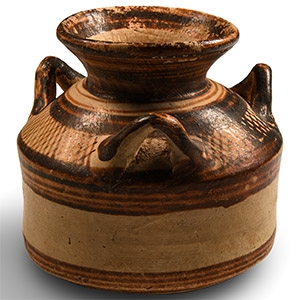
Mycenaean Painted Pottery Alabastron
13th-11th century B.C.Estimate: £2,000 - 3,000 (‡+bp*)
Opening Bid: £1,000
Drum-shaped with a sloping shoulder, short neck, trumpet-style neck and mouth and a gently rounded base; three loop handles at regular intervals around the shoulder; reddish-brown painted geometric bands and cross-hatching against a cream slip. 190 grams, 93 mm wide
Ex private collection, Holland. Acquired from Royal Athena Gallery, 2003. This lot has been checked against the Interpol Database of stolen works of art and is accompanied by search certificate number no.11852-206835.
