
Loading, please wait...
LOT 0070
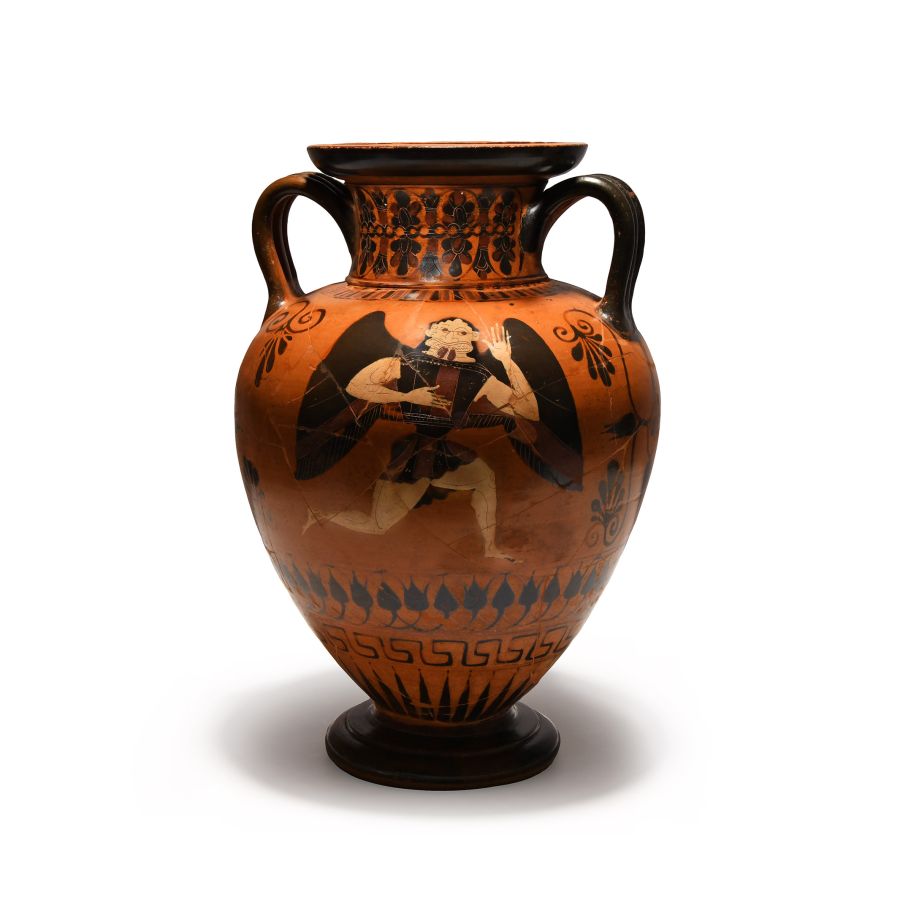
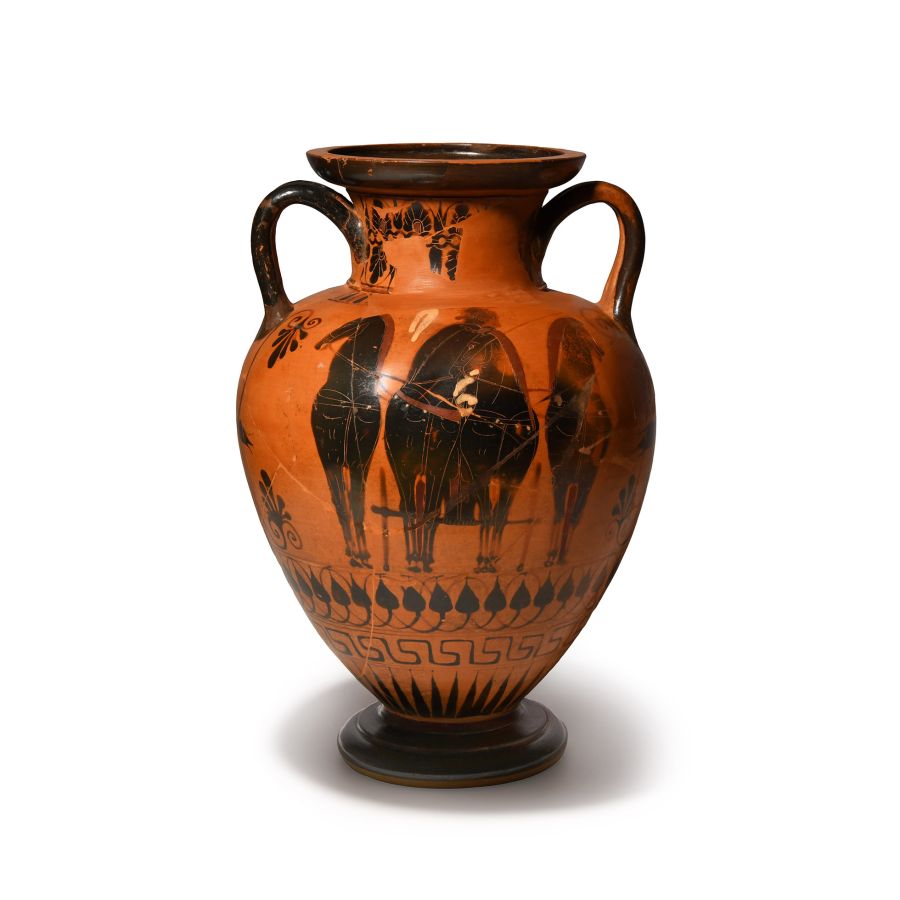
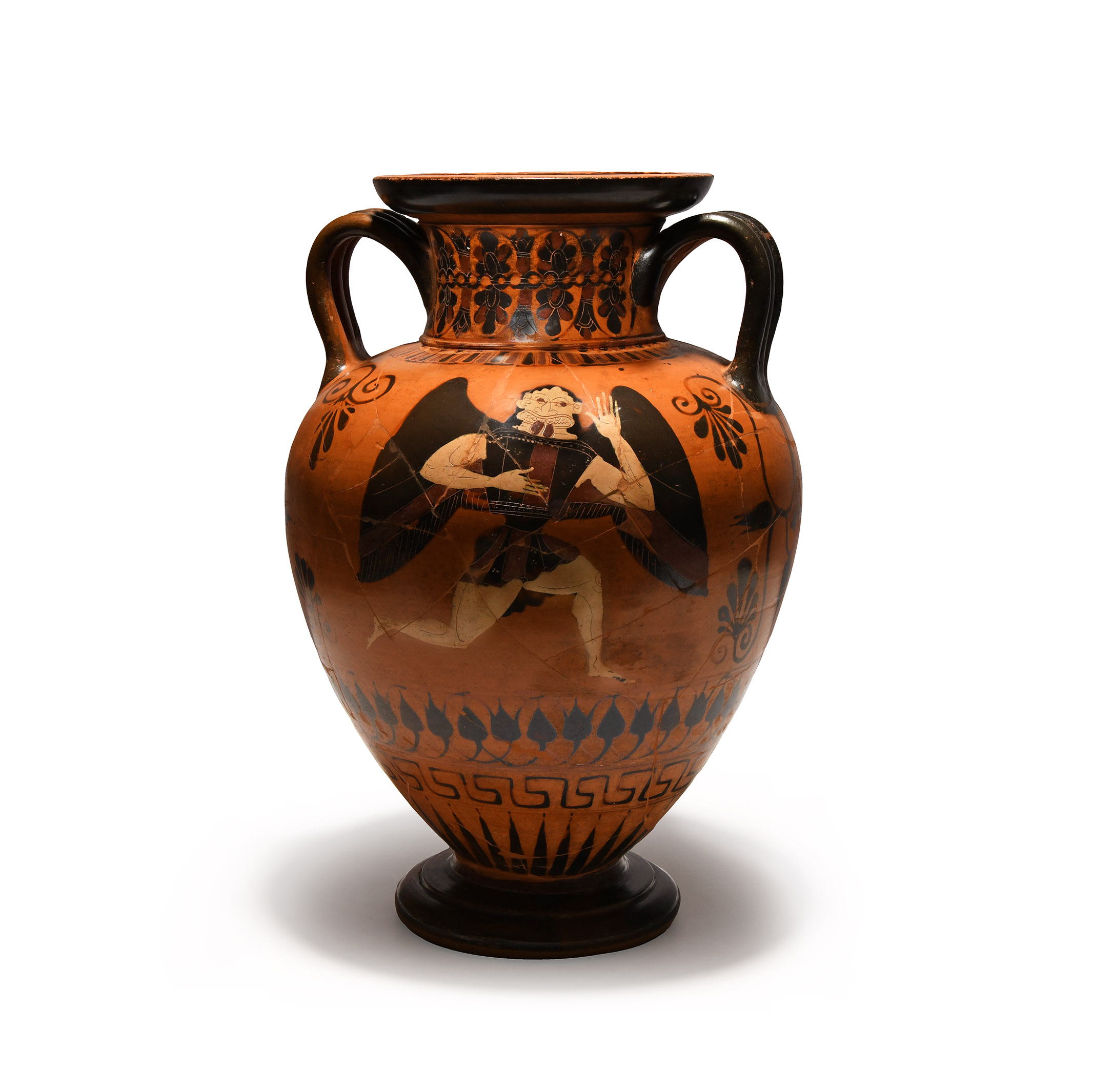
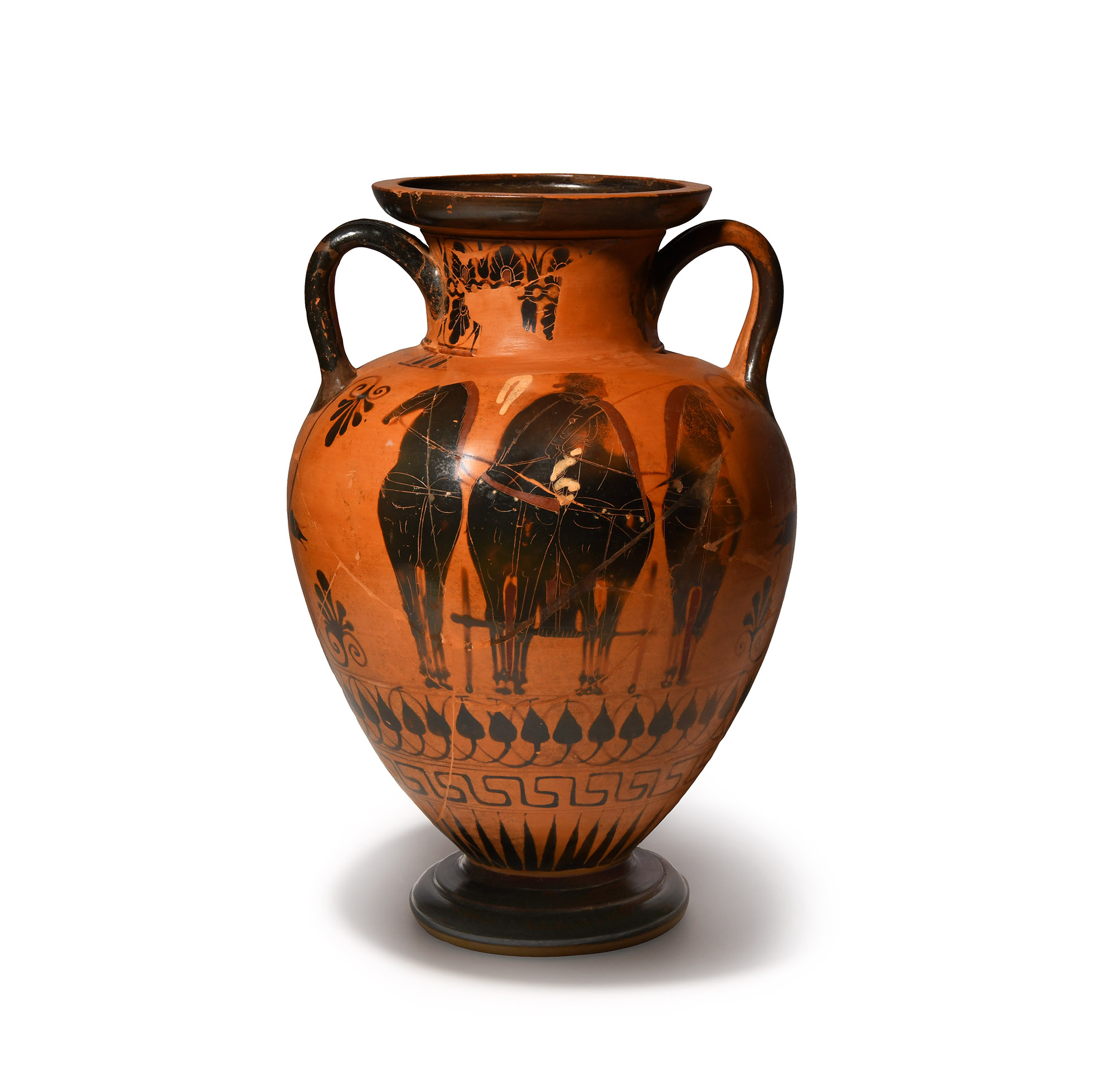
Attic Black-Figure Neck-Amphora with Gorgon and Quadriga Attributed to the Swing Painter
CIRCA 550 B.C.
15 3/8 in. (3.25 kg, 39 cm high).
With inverted echinus lip and tall neck, a ribbed handle to each side with coiling lotus buds and palmettes beneath the handles; Side a) a running winged Gorgon depicted frontally, dressed in a black and red chiton; Side b) an aristocratic warrior wearing a Chalcidian helmet and driving a quadriga, the two central horses superimposed, the other two turned outward; a frieze of lotus buds and a band Greek key motifs below, the neck decorated with red and black palmettes, and elongated lotus blossoms; restored.
ProvenanceAcquired in Geneva in 1954.
Formerly in the Y. Forrer collection, Geneva, Switzerland.
Private collection, Switzerland, 1999.
with Gorny & Mosch, Munich, 20 June 2012, no.73.
Accompanied by an academic report by Dr Raffaele D’Amato.
This lot has been checked against the Interpol Database of stolen works of art and is accompanied by a search certificate number no.11798-206784.
Cf. for the Swing Painter Boardmann, J., Athenian Black Figure Vases, London, 1974, pp.63, ill.142-146, and especially fig.146, for a comparable example; Beazley, J.D., Attic Black Figure Vase-Painters, New York, 1978, pp.304ff., 306, 40 (belly amphora housed in New York, Beazley Archive, no.301520); 308,80 (neck amphora housed in Louvre [F218bis]); Bohr, E., Der Schaukelmarer, Kerameus 4, Mainz-Rhein, 1982.
FootnotesThis wonderful vase can be attributed to the Swing Painter, active in Athens during the last part of the 6th century B.C. Beazley named him after the subject of a girl on a swing that he painted more than once. He was a pot painter, perhaps a pupil of the Princeton Painter. His black-figure paintings included a range of mythological subjects and some quite unusual images. A very large number of vases have been attributed to his hand on the basis of style. Characteristic of his paintings are contemporary touches, such as the presence of hoplites, in mythological scenes (München, Staatliche Antikensammlungen 1385 [J 729], Beazley Archive Pottery Database 301590; Poseidon fighting the giant Polybotes, Louvre F226). An important artwork is the famous representation of the Tyrant Pysistratos and his Rabdophoroi (bodyguards armed with clubs, Athens National Archaeological Museum 15111, Beazley Archive Pottery Database 301523).
CONDITIONTimeLine Auctions follows a vetting process to ensure the authenticity and legality of all items, reinforcing our commitment to integrity and responsible trading. Each antiquity, antique, and coin lot undergoes thorough examination by a vetting committee of at least ten external specialists, professional trade association members, scientists, and archaeologists: Our Vetting Process
AUCTIONS:
TimeLine is a leading auction house specialising in antiquities, ancient art, collectables, natural history, coins, medals, and books. Our auctions offer museums, collectors, historians, and enthusiasts the opportunity to acquire unique and historically significant pieces.
LOT 0070
Attic Black-Figure Neck-Amphora with Gorgon and Quadriga Attributed to the Swing Painter
Sold for (Inc. bp): £41,600
-
Greek Geometric Miniature Bronze Vessel with Cross
8th-7th century B.C.Sold for (Inc. bp): £26
Hemispherical bowl with lateral cranked arms to the rim, pierced lozenge beneath with stub arms. 16.3 grams, 42 mm
From a collection acquired on the UK art market from various auction houses and collections mostly before 2000. From an important Cambridgeshire estate; thence by descent. -
Cypriot Terracotta Figure Head Collection
Circa 1000 B.C.Sold for (Inc. bp): £468
Group of terracotta heads from figurines, one with moulded facial detailing, the others pinched. 476 grams total, 4.5-10.5 cm
One with antique tag: 'CYPRUS / C.1000 BC / Terracotta Fragment of / Mother-Goddess.' From a collection acquired on the UK art market from various auction houses and collections mostly before 2000. From an important Cambridgeshire estate; thence by descent. -
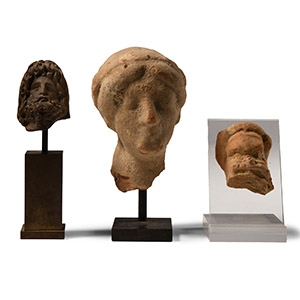
Classical Terracotta Head Group
Circa 4th-2nd century B.C. and laterSold for (Inc. bp): £286
Comprising: bust of a female (possibly Aphrodite) with diadem; hollow-formed mask of Silenus; a bearded head of Zeus or Poseidon, possibly not ancient. 772 grams total, 7.9-12.8 cm
From the collection of Jacques Schotte (1928-2007), Belgium, 1950s onwards. Acquired Bonhams, London, 29 April 2009 (part). Acquired from a Cambridgeshire gentleman. The comic actor from the Moonen collection, Belgium, 1980s; then Archea, Amsterdam, The Netherlands. Property of a North London collector. Accompanied by a copy of the relevant Bonhams catalogue pages and invoice. Accompanied by a previous owner's certificate of authenticity.
