
Loading, please wait...
_900x900.jpg "Assyrian Gypsum Relief with Head of a Bearded Man")
_200x200.jpg "Assyrian Gypsum Relief with Head of a Bearded Man")
_900x900.jpg "Assyrian Gypsum Relief with Head of a Bearded Man")
_200x200.jpg "Assyrian Gypsum Relief with Head of a Bearded Man")
.jpg "Assyrian Gypsum Relief with Head of a Bearded Man")
.jpg "Assyrian Gypsum Relief with Head of a Bearded Man")
LOT 0279
Assyrian Gypsum Relief with Head of a Bearded Man
704-681 B.C.
4 1/2 in. (530 grams total, 11.6 cm including stand).
Rectangular frieze fragment with low-relief carving of a profile bust with short straight hair confined by a brow-band, segmented curls forming the beard, furrowed brow, one arm extended; handwritten label to rear 'from the Koyunjik palace of Sennacherib at Nineveh and incised legend 'KOUYUNJIK' and 'A'; mounted on a custom-made stand.
ProvenanceAllegedly found in the Koyunjik Palace of Sennacherib.
Ex property of a gentleman, UK, acquired in the 1970s.
Ex private collection, Oxfordshire, UK, 1988.
Anonymous sale, with Christie's, London, 7 December 1994, no.235.
Art market, New York.
Ex private collection, Tokyo, Japan.
Private European collection, 2009.
This lot has been checked against the Interpol Database of stolen works of art and is accompanied by a search certificate number no.12880-241660.
This lot has been cleared against the Art Loss Register database, and is accompanied by an illustrated lot declaration signed by the Head of the Antiquities Department, Dr Raffaele D'Amato.
TimeLine Auctions follows a vetting process to ensure the authenticity and legality of all items, reinforcing our commitment to integrity and responsible trading. Each antiquity, antique, and coin lot undergoes thorough examination by a vetting committee of at least ten external specialists, professional trade association members, scientists, and archaeologists: Our Vetting Process
AUCTIONS:
TimeLine is a leading auction house specialising in antiquities, ancient art, collectables, natural history, coins, medals, and books. Our auctions offer museums, collectors, historians, and enthusiasts the opportunity to acquire unique and historically significant pieces.
LOT 0279
Assyrian Gypsum Relief with Head of a Bearded Man
Estimate £8,000 - 10,000€9,280 - 11,600 (for guidance only)$10,800 - 13,500 (for guidance only)
-
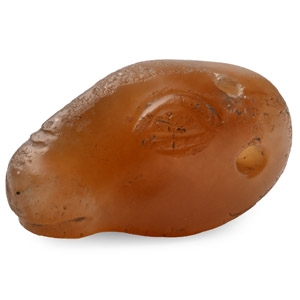
Mesopotamian Chalcedony Sheep's Head Amulet
3rd-2nd millennium B.C.Sold for (Inc. bp): £351
Finely carved bifacial sheep head with large lentoid eyes and wide mouth, pierced for suspension, two additional piercings to the top. 16.2 grams, 33 mm
Previously with a London, UK, dealership. Ex London, UK, art market, late 1990s. From a private UK collection. This lot has been cleared against the Art Loss Register database, and is accompanied by an illustrated lot declaration signed by the Head of the Antiquities Department, Dr Raffaele D'Amato. -
.jpg)
Red Glass Bead Necklace String
20th century A.D.Sold for (Inc. bp): £33
A designer necklace composed of small oblate beads with larger feature beads, restrung to a Y-shape with irregular feature beads. 6.7 grams, 39 cm
Acquired 1980-2015. Ex Abelita family collection. This lot has been cleared against the Art Loss Register database, and is accompanied by an illustrated lot declaration signed by the Head of the Antiquities Department, Dr Raffaele D'Amato. -
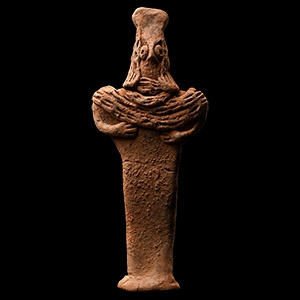
Syro-Hittite Terracotta Fertility Figure
1500-900 B.C. or laterSold for (Inc. bp): £234
Standing female deity (Astarte?), wearing a long robe and a broad textured necklace; arms bent and hands placed on the abdomen; beaked facial features with applied eyes and single spur to the rear. 158 grams, 18.5 cm
Acquired in Paris, France, in 1988. From the collection of G.M.R.H., London, UK. This lot has been cleared against the Art Loss Register database, and is accompanied by an illustrated lot declaration signed by the Head of the Antiquities Department, Dr Raffaele D'Amato.
