
Loading, please wait...
LOT 0237
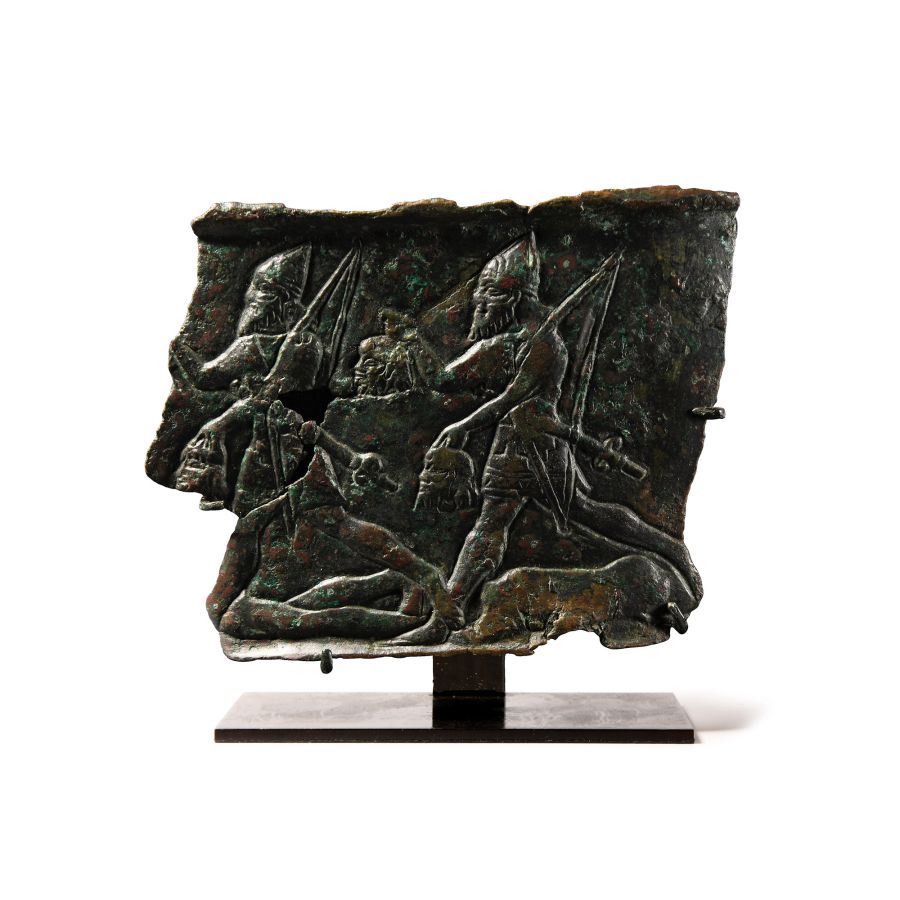
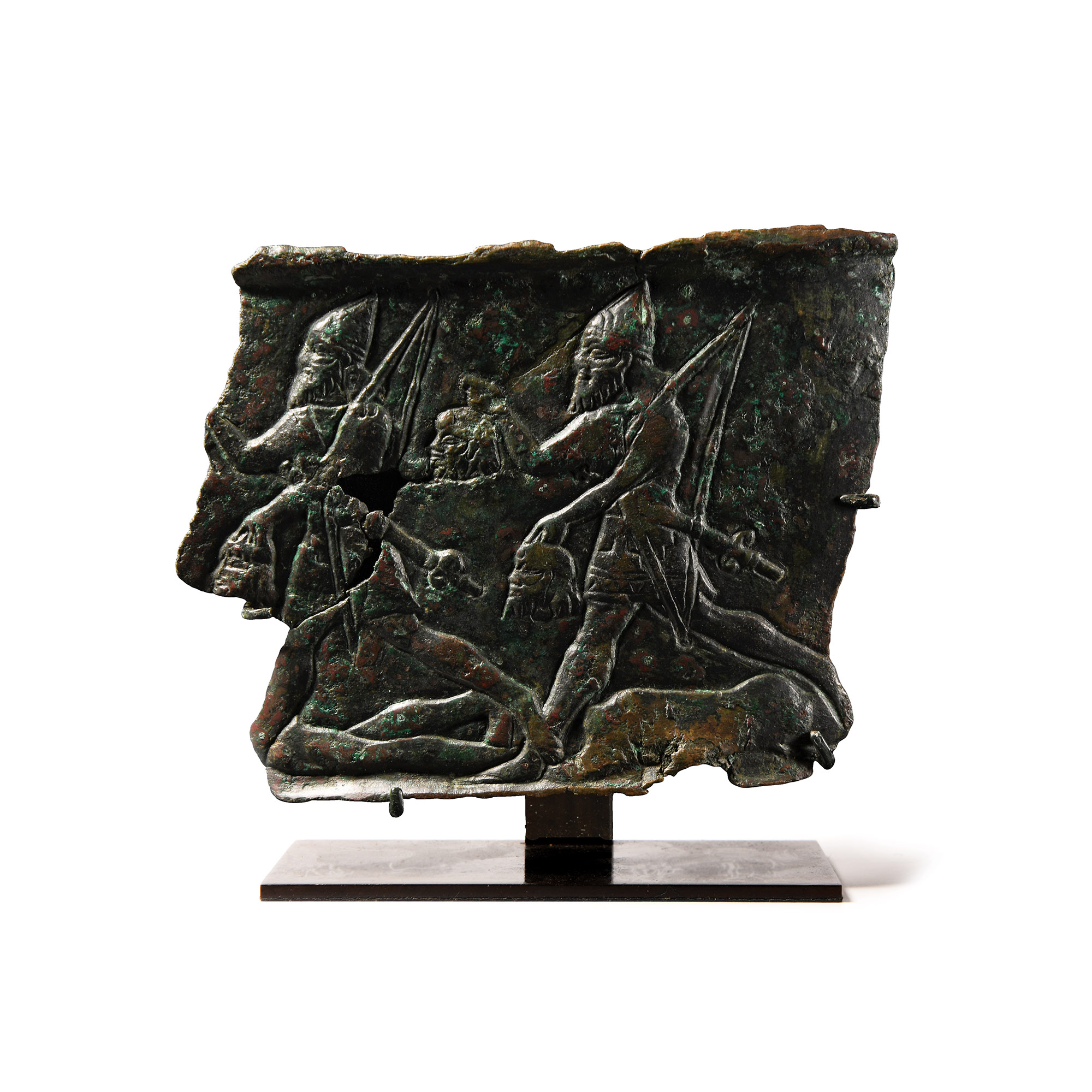
Assyrian Bronze Relief Fragment
CIRCA 9TH CENTURY B.C.
4 1/4 - 4 3/8 in. (72 grams, 10.8 cm wide (277 grams total, 11 cm high including stand)).
Displaying a corrugated rim above and below; two advancing soldiers, each striding forwards over the headless body of a dead enemy, carrying a severed head in each hand; the soldiers shown bearded and each wearing a pointed and segmented helmet with a recess to accommodate the ears, a cuirass and thigh-length tunic, with a bow over one shoulder and a sword slung from a waist belt; mounted on a custom-made display stand.
ProvenanceEx S. Moussieff collection, London, UK.
Acquired from C.J. Martin (Coins) Ltd.
Accompanied by an academic report by Dr Raffaele D'Amato.
This lot has been checked against the Interpol Database of stolen works of art and is accompanied by search certificate no.203209.
Battle-scenes - and especially images where the Assyrians overrun their enemies and achieve outright victory - appear to make up a large part of 'official' art of the period. Subjecting a defeated foe to torture and death is the theme of much of the wall-decoration of the palace of Nineveh. A battle-scene depicting the siege of a walled city shows similarly equipped infantrymen; it is in the Metropolitan Museum of Art, New York, under accession no.55.121.4a, b.
CONDITIONTimeLine Auctions follows a vetting process to ensure the authenticity and legality of all items, reinforcing our commitment to integrity and responsible trading. Each antiquity, antique, and coin lot undergoes thorough examination by a vetting committee of at least ten external specialists, professional trade association members, scientists, and archaeologists: Our Vetting Process
AUCTIONS:
TimeLine is a leading auction house specialising in antiquities, ancient art, collectables, natural history, coins, medals, and books. Our auctions offer museums, collectors, historians, and enthusiasts the opportunity to acquire unique and historically significant pieces.
-
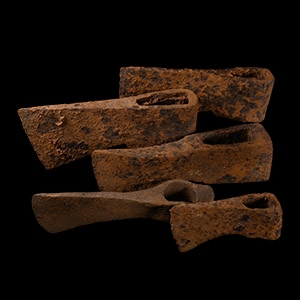
Medieval and Later Iron Axehead Collection
14th-18th century A.D.Sold for (Inc. bp): £117
Including socketted heads of various types, each with a convex cutting edge. 4.27 kg total, 12-19.2 cm
Acquired 1990s-early 2000s. East Anglian private collection. -
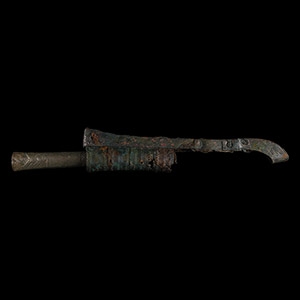
Viking Age Bronze Dagger Hilt with Scabbard
10th-11th century A.D.Sold for (Inc. bp): £130
The scabbard with bronze hoop reinforcements to the upper third decorated with bands of punched holes; lateral suspension flap between bronze plates with reserved interlace motifs on hatched field; hilt with Borre Style ring-chain motifs to the upper end; hollow to the upper face. 119 grams, 24 cm
From the collection of a North American gentleman, formed in the 1990s. -
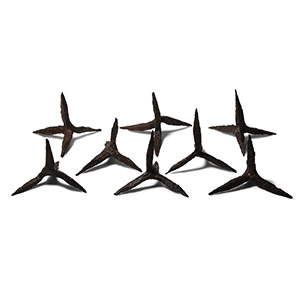
Roman Iron Anti-Cavalry Caltrop Group
3rd-4th century A.D.Sold for (Inc. bp): £338
Comprising eight caltrops, hand-forged with square-section spikes. 494 grams total, 83-92 mm
Acquired 1971-1972. From the collection of the vendor's father. Property of a London, UK, collector.
Caltrops were scattered on battlefields in an effort to stop or slow advancing enemy cavalry or foot soldiers; regardless of how a caltrop lands, one spike is always facing upwards. Caesar used widely them at Alesia (Caes., BG 7.73; 82): 'Stakes a foot long, with iron hooks attached to them, were entirely sunk in the ground before these, and were planted in every place at small intervals; these they called spurs'.
