
Loading, please wait...
LOT 0253
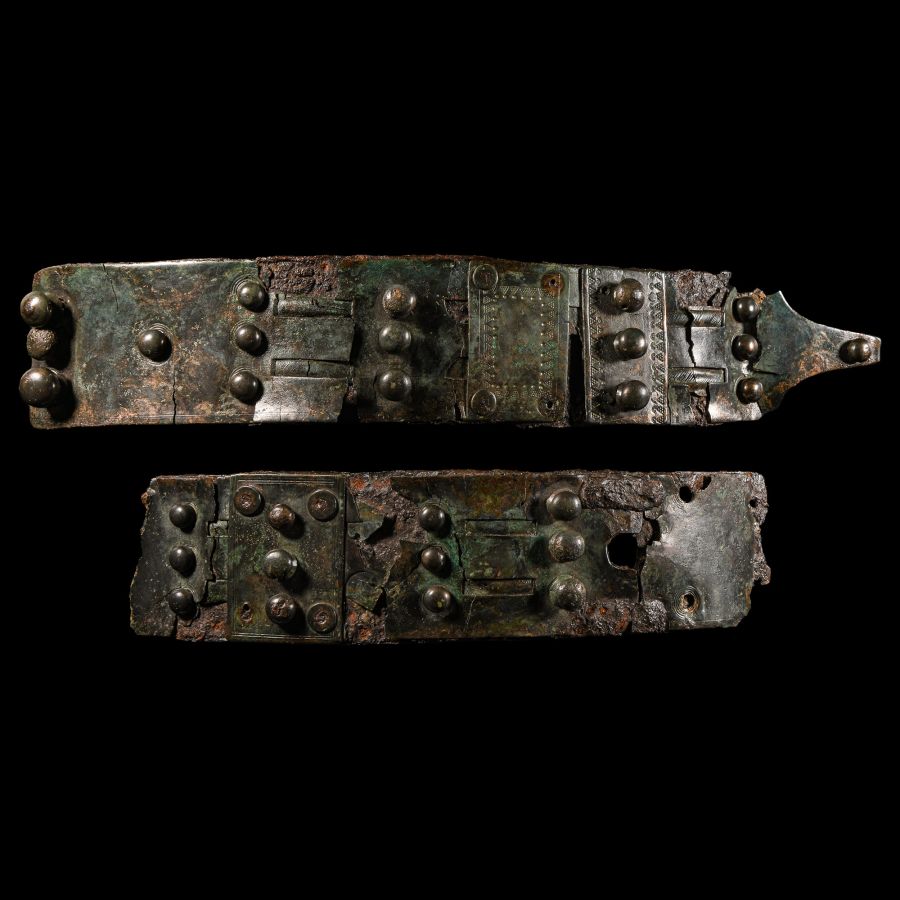
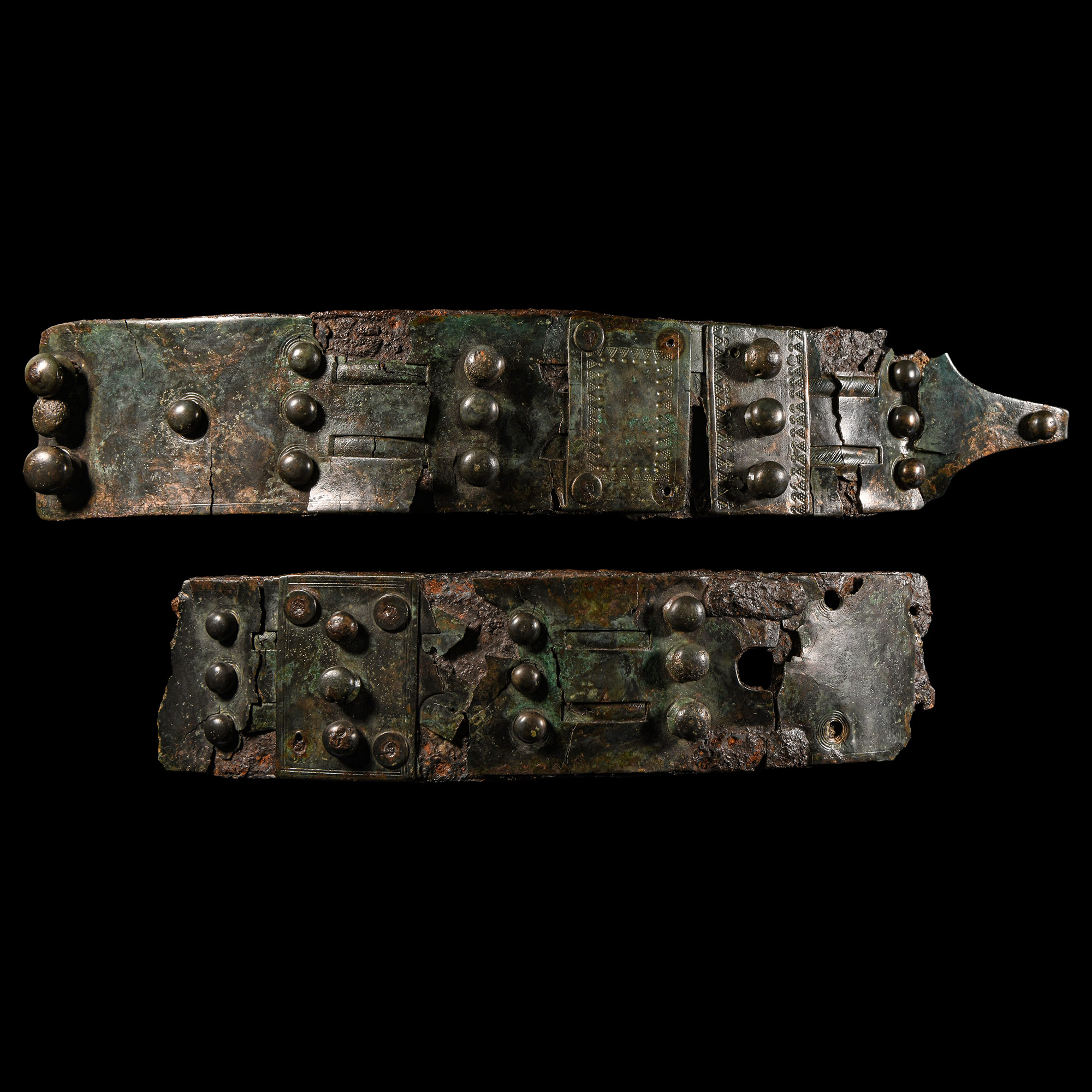
Assyrian Belt Fragment Group
9TH-7TH CENTURY B.C.
9 - 11 7/8 in. (609 grams total, 23-30 cm).
Comprising two bronze belt sections, each with a ferrous backing; applied sheet-bronze rectangular plates held in place with domed rivets and washers, some decorated with a border of pelleted triangular punchmarks topped with a pellet or ring-and-dot motif; one fragment with finial with remains of a riveted hook, the other with corresponding hole. [2, No Reserve]
ProvenanceEx Axel Guttmann collection.
LiteratureCf. Esayan, S.A., Gürtelbleche der Älteren Eisenzeit in Armenien in Beiträge zur allgemeinen und vergleichenden Archäologie, vol.6, pp.97-198, pls. 8 & 25, nos.25 and 26 (belts from Golovino).
CONDITIONTimeLine Auctions follows a vetting process to ensure the authenticity and legality of all items, reinforcing our commitment to integrity and responsible trading. Each antiquity, antique, and coin lot undergoes thorough examination by a vetting committee of at least ten external specialists, professional trade association members, scientists, and archaeologists: Our Vetting Process
AUCTIONS:
TimeLine is a leading auction house specialising in antiquities, ancient art, collectables, natural history, coins, medals, and books. Our auctions offer museums, collectors, historians, and enthusiasts the opportunity to acquire unique and historically significant pieces.
-
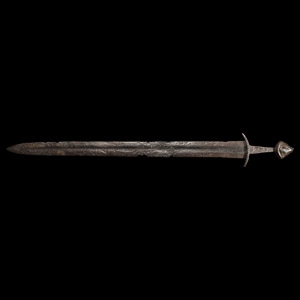
Viking Age Iron Sword with Cocked Hat Type Pommel
10th century A.D.Sold for (Inc. bp): £5,720
Petersen Type L variant with double-edged pattern-welded blade (waving pattern) showing evidence of being employed, tapering fullers and hefty tang; boat-shaped lower guard, cocked hat pommel with traces of silver inlay; some restoration. 996 grams, 90 cm
From the private collection of a London gentleman, from his grandfather's collection formed before the early 1970s. Accompanied by an academic report by Dr Raffaele D’Amato. This lot has been checked against the Interpol Database of stolen works of art and is accompanied by search certificate number no.11816-206858.
This sword shows evidence of beautiful pattern-welding. The great curvature of the hilt, stronger than any other type of Viking swords, characterises the typology of L swords. This is clearly visible on the specimens from Dolven and Nedre (Stokke) published by Petersen (1919, figs.94-95). -
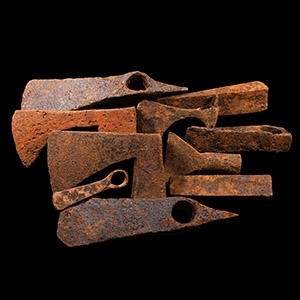
Viking Age and Later Iron Axehead Group
10th-18th century A.D.Estimate: £200 - 300 (+bp*)
Opening Bid: £88
Mainly comprising socketted axeheads and adzes, adze-axes, wedges and other items. 8.45 kg total, 12-30 cm
Acquired 1990s-early 2000s. East Anglian private collection. -
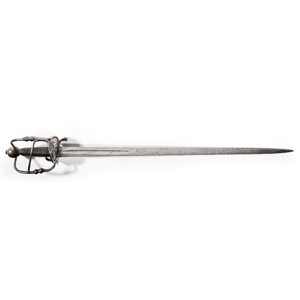
Dutch Thumb Ring Sword
Mid 16th century A.D.Sold for (Inc. bp): £1,430
The blade composed of a straight, double edge with single fuller and clear running wolf marks; signed 'S AH A GOM' in both fullers with 'shooting star' below and with punched crown mark just below the hilt; twisted wire grip, thumb ring, leaf-shaped guard to hilt, bulbous pommel. 826 grams, 84 cm
Acquired from West Street Antiques, Dorking, Surrey, UK, 2015. The Kusmirek Collection, UK. Accompanied by copy of a previous listing and item ticket.
