
Loading, please wait...
LOT 0589
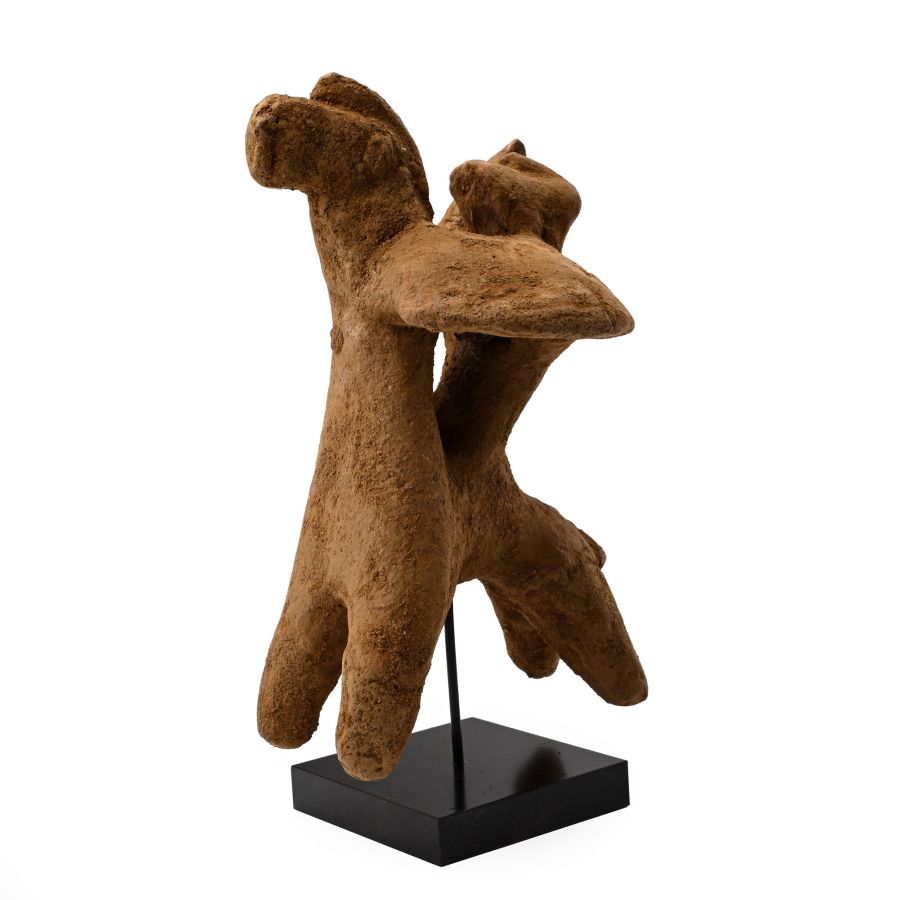
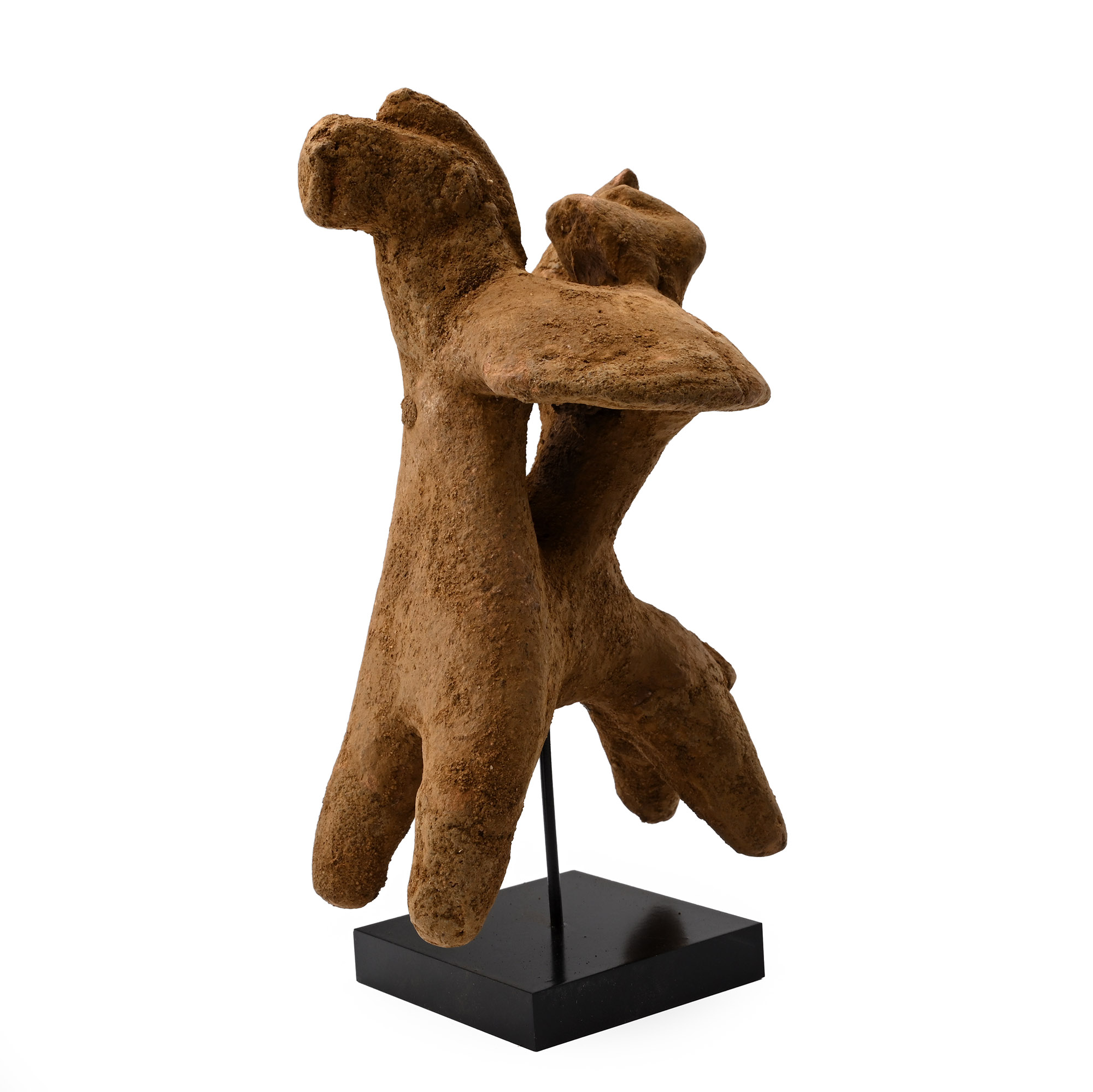
Archaic Greek Terracotta Figure of Mounted Warrior with Shield
7TH-5TH CENTURY B.C.
5 7/8 in. (286 grams total, 15 cm high including stand).
The horse with an elongated neck and stylised features; mounted by a bearded rider gazing towards the sky, holding a shield in his left hand and a sword(?) in his right hand; mounted on a custom-made display stand. [No Reserve]
ProvenanceAcquired before 1990.
From an old German collection.
From the private collection of John Meredith, acquired since the 1990s; thence by descent.
This lot is accompanied by an illustrated lot declaration signed by the Head of the Antiquities Department, Dr Raffaele D'Amato.
Cf. Marantidou, P., Terracotta statues and figurines of Cypriote type found in the Aegean. Provenance studies, Limassol, 2009, pls.XIII no.SAH69, XXXII, no.CYP50, for the type.
FootnotesTerracotta figurines of horse and rider were common grave offerings in Boeotia, northwest of Attica, particularly during the 6th century B.C. Representations of warriors on horseback were already widespread in the Geometric Period, and widely used in Cyprus, during this period.
CONDITIONTimeLine Auctions follows a vetting process to ensure the authenticity and legality of all items, reinforcing our commitment to integrity and responsible trading. Each antiquity, antique, and coin lot undergoes thorough examination by a vetting committee of at least ten external specialists, professional trade association members, scientists, and archaeologists: Our Vetting Process
AUCTIONS:
TimeLine is a leading auction house specialising in antiquities, ancient art, collectables, natural history, coins, medals, and books. Our auctions offer museums, collectors, historians, and enthusiasts the opportunity to acquire unique and historically significant pieces.
LOT 0589
Archaic Greek Terracotta Figure of Mounted Warrior with Shield
Sold for (Inc. bp): £169
-
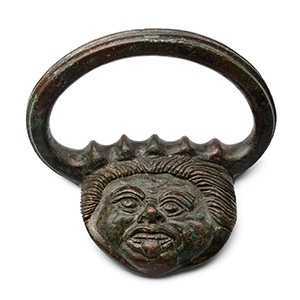
Greek Bronze Vessel Handle with Medusa
4th-3rd century B.C.Sold for (Inc. bp): £572
Comprising an ellipsoid domed plaque with grotesque gorgoneion in high-relief, ribbed loop handle. 257 grams, 94 mm
Acquired on the European art market in the early 2000s. with Galerie Rhéa, Zurich, Switzerland. This lot is accompanied by an illustrated lot declaration signed by the Head of the Antiquities Department, Dr Raffaele D'Amato. -
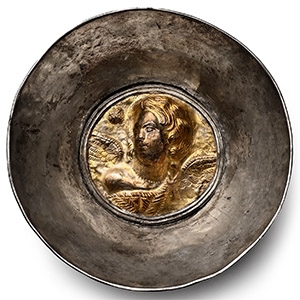
Hellenistic Silver-Gilt Cup with Nike
2nd-1st century B.C.Sold for (Inc. bp): £9,750
A hammered, chased and soldered silver-gilt cup with central medallion of Nike in high-relief; the bowl formed as a truncated cone with a shallow foot comprising an irregular circular 'ropework' border enclosing a floral motif, or double rosette; the bust of Nike showing the goddess draped in a goat skin with knot and ungulate leg with hoof at right shoulder, wings spread, hair dressed in curls, torc at neck, gazing left; face with almond-shaped eyes, straight nose and full, closed lips; with the exception of the face, all elements of the central medallion were originally gilt; housed in a custom-made velvet-lined box. 96.8 grams, 12.6 cm wide
Private collection, Mainz, Germany, 1980s. Acquired by the current owner from the above, 2006. Accompanied by a copy of a seven page examination report number 114/2019 by Dr Habil Mikhail Treister. This lot has been checked against the Interpol Database of stolen works of art and is accompanied by search certificate number no.12764-237139. This lot has been cleared against the Art Loss Register database, and is accompanied by an illustrated lot declaration signed by the Head of the Antiquities Department, Dr Raffaele D'Amato.
Nike was the winged goddess of victory. Goat-skin clothing was an attribute of Artemis, but here it is worn by Nike, attesting to the syncretic nature of the art embodied by this object. The workmanship of this piece suggests a local workshop in the Kuban basin. -
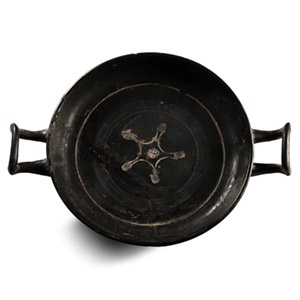
Greek Terracotta Black-Glazed Stemless Cup
Campanian, circa 4th century B.C.Sold for (Inc. bp): £572
With two lateral handles on a low, profiled ring foot; incised and stamped decoration to the interior comprising a central blossom surrounded by palmettes connected by curved lines, the whole framed by a concentric circle made up of dashes; restored. 227 grams, 20.5 cm
with S.C., Basel, prior 2003. Accompanied by a copy of an Art Loss Register certificate no.S00075178. This lot is accompanied by an illustrated lot declaration signed by the Head of the Antiquities Department, Dr Raffaele D’Amato. This lot is accompanied by an illustrated lot declaration signed by the Head of the Antiquities Department, Dr Raffaele D'Amato.
