
Loading, please wait...
_900x900.jpg "Archaic Greek Modified Bronze Corinthian Helmet")
_200x200.jpg "Archaic Greek Modified Bronze Corinthian Helmet")
_900x900.jpg "Archaic Greek Modified Bronze Corinthian Helmet")
_200x200.jpg "Archaic Greek Modified Bronze Corinthian Helmet")
_900x900.jpg "Archaic Greek Modified Bronze Corinthian Helmet")
_200x200.jpg "Archaic Greek Modified Bronze Corinthian Helmet")
_900x900.jpg "Archaic Greek Modified Bronze Corinthian Helmet")
_200x200.jpg "Archaic Greek Modified Bronze Corinthian Helmet")
.jpg "Archaic Greek Modified Bronze Corinthian Helmet")
.jpg "Archaic Greek Modified Bronze Corinthian Helmet")
.jpg "Archaic Greek Modified Bronze Corinthian Helmet")
.jpg "Archaic Greek Modified Bronze Corinthian Helmet")
LOT 1112
Archaic Greek Modified Bronze Corinthian Helmet
LATE 7TH-EARLY 6TH CENTURY B.C.
12 1/4 in. (2.2 kg total, 31.5 cm high including stand).
Consisting of two sections joined with bronze rivets; above a domed section with row of rivets; below, a folded band with rolled rim, with rivets to the rear holding two halves; line of holes to the base for securing an inner lining.
ProvenanceAcquired in the 1970s.
Ex private Austrian collection.
The Kusmirek Collection, UK.
Accompanied by an academic report by Dr Raffaele D'Amato.
Accompanied by a metal analysis and appraisal by Dr Brian Gilmour.
This lot has been checked against the Interpol Database of stolen works of art and is accompanied by search certificate number no.11764-203980.
Cf. Hixenbaugh, R., Ancient Greek Helmets, New York, 2019, nos.C245 and C248; for a similar helmet skull from Torre di Satriano e Benevento (Bottini, Egg, Von Hase, Pflug, Schaaf, Schauer, Waurick, 1988, p.72, fig.7, cat.14, p.392) and Melfi (Museo Nazionale del Melfese, 1996, p.4).
FootnotesThe upper part of the helmet was probably modified in antiquity, the lower part of the eye holes and the cheek pieces have been cut away, and replacement cheek pieces, now lacking, were once crudely rivetted to the sides.
CONDITIONTimeLine Auctions follows a vetting process to ensure the authenticity and legality of all items, reinforcing our commitment to integrity and responsible trading. Each antiquity, antique, and coin lot undergoes thorough examination by a vetting committee of at least ten external specialists, professional trade association members, scientists, and archaeologists: Our Vetting Process
AUCTIONS:
TimeLine is a leading auction house specialising in antiquities, ancient art, collectables, natural history, coins, medals, and books. Our auctions offer museums, collectors, historians, and enthusiasts the opportunity to acquire unique and historically significant pieces.
LOT 1112
Archaic Greek Modified Bronze Corinthian Helmet
Estimate £4,000 - 6,000€4,640 - 6,960 (for guidance only)$5,400 - 8,100 (for guidance only)
-
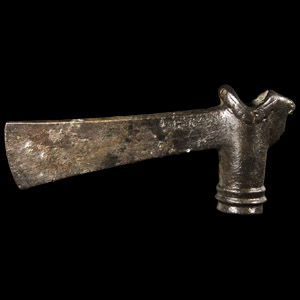
Luristan Bronze Socketted Axe
13th-7th century B.C.Estimate: £180 - 240 (+bp*)
Opening Bid: £90
The cylindrical socket with collared base and upper face of zoomorphic form, possibly representing a gaping snake's mouth; wedge-shaped axehead with convex cutting edge. 271 grams, 14 cm
Acquired 1980-2015. Ex Abelita family collection. -
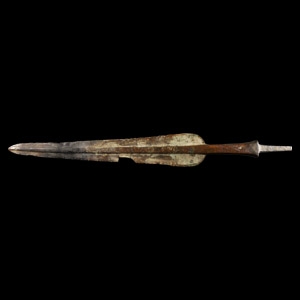
Amlash Tanged Spearhead
12th century B.C.Estimate: £150 - 200 (+bp*)
Opening Bid: £83
Composed of a tapering leaf-shaped blade with raised midrib, splayed neck and tapering tang. 637 grams, 49 cm
Acquired on the London art market, prior to 1980s. The Kusmirek Collection, UK.
The weapon belongs to the type 1 of the Khorasani spearhead classification, mainly from Marlik or Amlash areas. Similar pieces have been dated by Stutzinger to 1200-1100 B.C. -
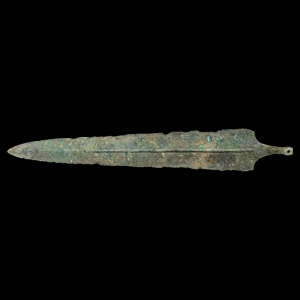
Luristan Bronze Spearhead Blade
2nd-1st millennium B.C.Sold for (Inc. bp): £117
With a short tang and long blade, raised midrib, a rivet to the base. 254 grams, 33 cm
Acquired 1980-2015. Ex Abelita family collection.
The spearhead belongs to type 2 according to the classification of Khorasani. A similar specimen was excavated by Negahban in Marlik.
