
Loading, please wait...
LOT 0093
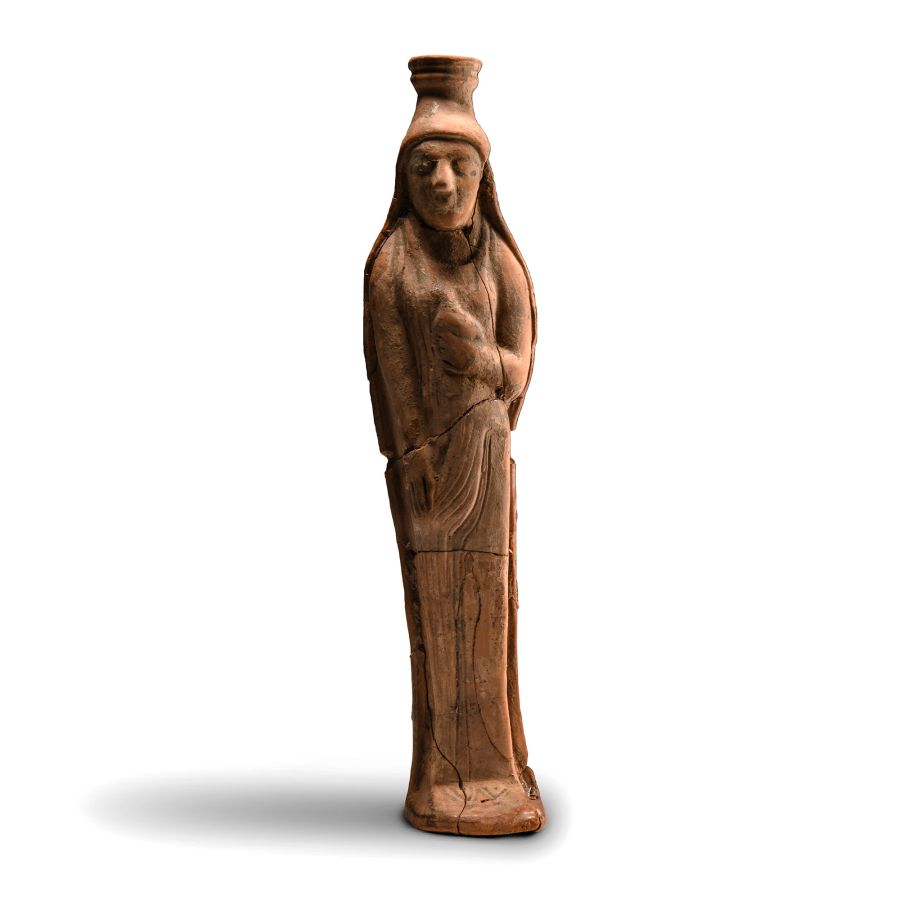
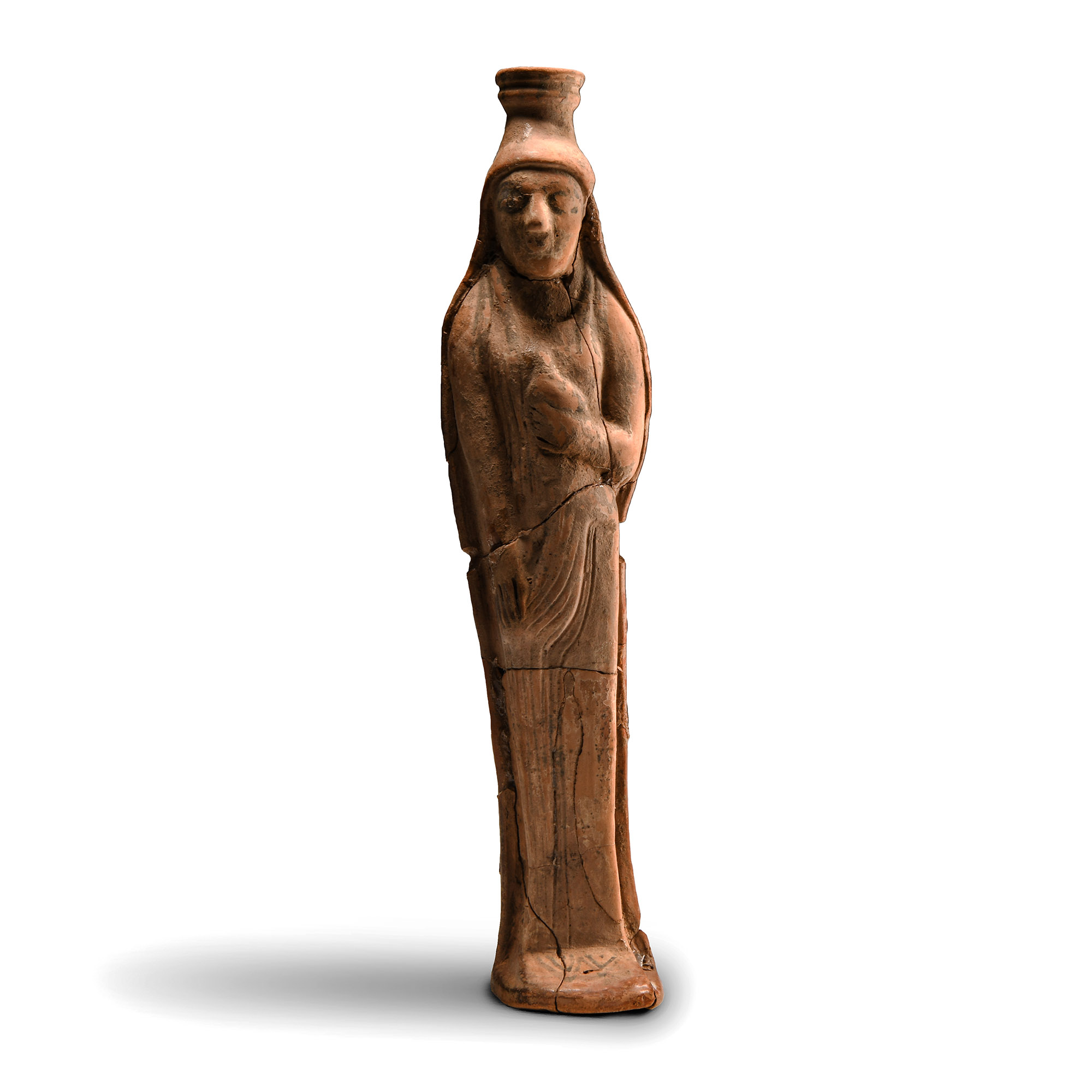
Archaic Greek Figural Alabastron
6TH CENTURY B.C.
8 5/8 in. (269 grams, 22 cm high).
The free-standing perfume vase modelled as a standing and draped female figure, the neck and mouth of the vessel possibly formed as a modius worn on her head, holding what is possibly a dove to her chest; moulded and painted detailing to her face and garments; heavily repaired.
ProvenanceAcquired in Europe before 2001.
LiteratureCf. The Metropolitan Museum, accession number 54.151, for similar.
CONDITIONTimeLine Auctions follows a vetting process to ensure the authenticity and legality of all items, reinforcing our commitment to integrity and responsible trading. Each antiquity, antique, and coin lot undergoes thorough examination by a vetting committee of at least ten external specialists, professional trade association members, scientists, and archaeologists: Our Vetting Process
AUCTIONS:
TimeLine is a leading auction house specialising in antiquities, ancient art, collectables, natural history, coins, medals, and books. Our auctions offer museums, collectors, historians, and enthusiasts the opportunity to acquire unique and historically significant pieces.
LOT 0093
Archaic Greek Figural Alabastron
Estimate £1,000 - 1,400€1,160 - 1,620 (for guidance only)$1,350 - 1,890 (for guidance only)
-
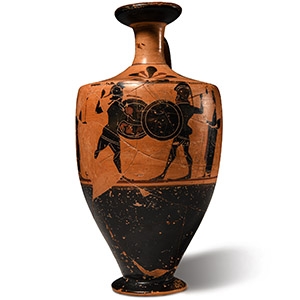
Greek Attic Black-Figure Lekythos with Fighting Hoplites
6th century B.C.Sold for (Inc. bp): £3,380
The piriform body tapering towards the splayed foot, D-section strap handle and calyx-shaped mouth with flat rim; the body painted with a scene of two duelling hoplites, dressed in full armour comprising shields, greaves and helmets, dressed in short chitons and assisted by their arbiters holding staffs and dressed in long himation; the shoulder with palmette decoration and facing figures of a man and a woman with long garments around the shoulder; restored. 381 grams, 23 cm high
Old Swiss collection. Acquired in Europe before 2011. Private collection, Europe. Accompanied by an academic report by Dr Raffaele D’Amato. This lot has been checked against the Interpol Database of stolen works of art and is accompanied by search certificate number no.11815-206482.
To the Greeks, lekythoi were containers for dispensing oil. The characteristics shape of this vessel was that of a long body, narrow neck, one handle and a cup-shaped mouth. The shape was fit for the function of the lekythos: the narrow neck prevented the unnecessary loss of oil by enabling small amounts to be distributed evenly and the mouth to collect the excess. The represented scene is probably taken from the Iliad and could represent the combat between Ajax and Hector, assisted by arbiters. -
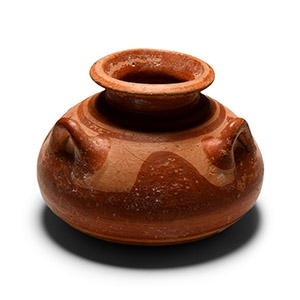
Mycenaean Painted Pottery Alabastron
14th-13th century B.C.Estimate: £2,000 - 3,000 (‡+bp*)
Opening Bid: £1,000
Formed with a squat globular body, everted rim and three lug handles to the shoulder; painted reddish-brown over a cream slip with concentric bands and rings to the mouth, neck, shoulder and base, larger solid undulating forms covering the lower body. 70 grams, 69 mm
Acquired from Royal Athena Gallery, 2003. This lot has been checked against the Interpol Database of stolen works of art and is accompanied by search certificate number no.11851-206833.
Late Helladic IIIA period of Mycenaean culture. -
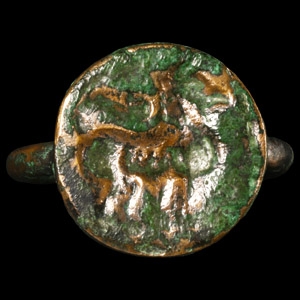
Greek Bronze Ring with Animal
3rd-2nd century B.C.Sold for (Inc. bp): £130
With round-section hoop, the round bezel with a standing quadruped with its tail curved above its back. 7.80 grams, 26.32 mm overall, 20.45 mm internal diameter (approximate size British U 1/2, USA 10 1/4, Europe 23.15, Japan 22)
Ex old English collection. London art market, 1980s.
