
Loading, please wait...
_900x900.jpg "Archaic Greek Bronze Statuette of a Coiled and Rearing Snake")
_200x200.jpg "Archaic Greek Bronze Statuette of a Coiled and Rearing Snake")
.jpg "Archaic Greek Bronze Statuette of a Coiled and Rearing Snake")
LOT 0531
Archaic Greek Bronze Statuette of a Coiled and Rearing Snake
ARCHAIC, 6TH-5TH CENTURY B.C.
4 1/4 in. (312 grams, 11 cm).
Modelled in the round with coiled body and rearing head, barbed fin to the forehead, punched annulet texturing on the body.
ProvenancePrivate collection, Neuchâtel, Switzerland, assembled in the 1980s.
Acquired in 1995 by a European private collector.
Private collection, since the late 1990s.
This lot has been checked against the Interpol Database of stolen works of art and is accompanied by a search certificate number no.12856-241689.
See Dallas Museum of Art, object number 1969.7.
FootnotesSnakes were important symbols in ancient Greek culture and were often linked with protection, healing, and renewal. Because they shed their skin, they were seen as a sign of rebirth and new life. They were also connected with gods and spirits of the earth and underworld, and in some cases were thought to protect the home or sacred places. In Greek art, a snake could therefore carry both religious and symbolic meaning.
CONDITIONTimeLine Auctions follows a vetting process to ensure the authenticity and legality of all items, reinforcing our commitment to integrity and responsible trading. Each antiquity, antique, and coin lot undergoes thorough examination by a vetting committee of at least ten external specialists, professional trade association members, scientists, and archaeologists: Our Vetting Process
AUCTIONS:
TimeLine is a leading auction house specialising in antiquities, ancient art, collectables, natural history, coins, medals, and books. Our auctions offer museums, collectors, historians, and enthusiasts the opportunity to acquire unique and historically significant pieces.
LOT 0531
Archaic Greek Bronze Statuette of a Coiled and Rearing Snake
Estimate £5,000 - 7,000€5,800 - 8,120 (for guidance only)$6,750 - 9,450 (for guidance only)
-
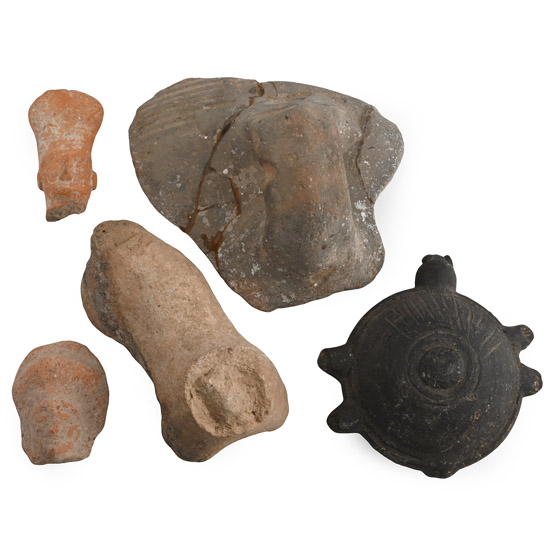
Greek Terracotta Artefact Collection
Circa 5th-3rd century B.C. and laterSold for (Inc. bp): £39
Including terracotta statue heads, amphora handle with old inked inscription on label to verso, which reads: 'AMPHORA HANDLE / PICKED UP ON SEA / BED OFF EAST SIDE / PARAMALI POINT, CYPRUS / 31 AUGUST 1968.' and other items. 739 grams total, 5.1-13 cm
From a late Hampshire gentleman's collection, formed from the 1960s.
One of the terracotta heads belongs to a votive statue, which by its shape seems to belong to Demeter or to the priestess of the Mother Goddess venerated in the Sanctuary of Arsos (Cyprus). The other one, also votive, showing a high headgear, represents most probably a Phoenician divinity, or a Levantine head of a priest. -
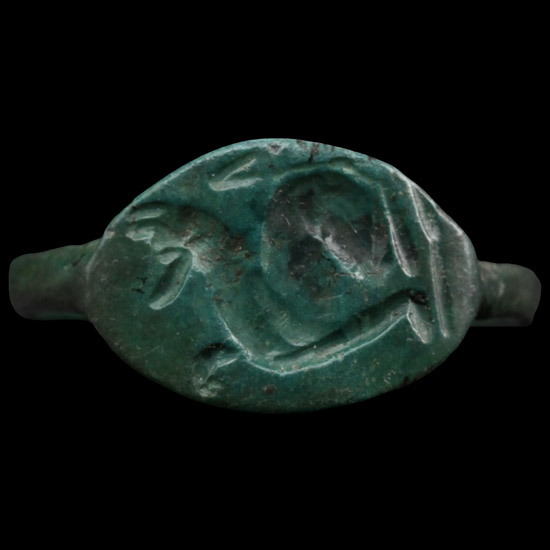
Greek Bronze Ring with Dog
3rd-2nd century B.C.Sold for (Inc. bp): £117
Comprising a slender D-section hoop and a lentoid bezel with a stylised dog. 1.24 grams, 18.82 mm overall, 17.27 mm internal diameter (approximate size British N, USA 6 1/2, Europe 13.72, Japan 13)
Ex German art market, 2000s. Acquired from an EU collector living in London. From the collection of a Surrey, UK, gentleman. -
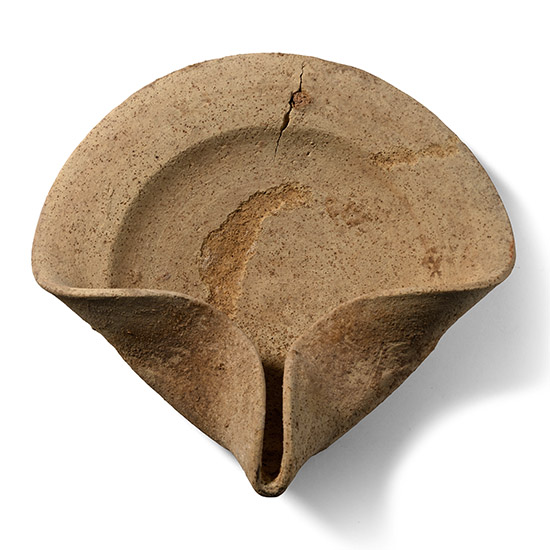
Greek Terracotta Cocked Hat Oil Lamp
Cyprus, circa 6th century B.C.Sold for (Inc. bp): £85
Wide, shallow body with folded rim. 85 grams, 12.1 cm
Private collection, Oxfordshire, UK, by direct descent from the collection of Judge George Cyril Griffith-Williams (1893-1983), Supreme Court Judge of the Colony of Cyprus; items having been collected in the 1930s and 1940s in Cyprus during his tenure there.
