
Loading, please wait...
LOT 0499
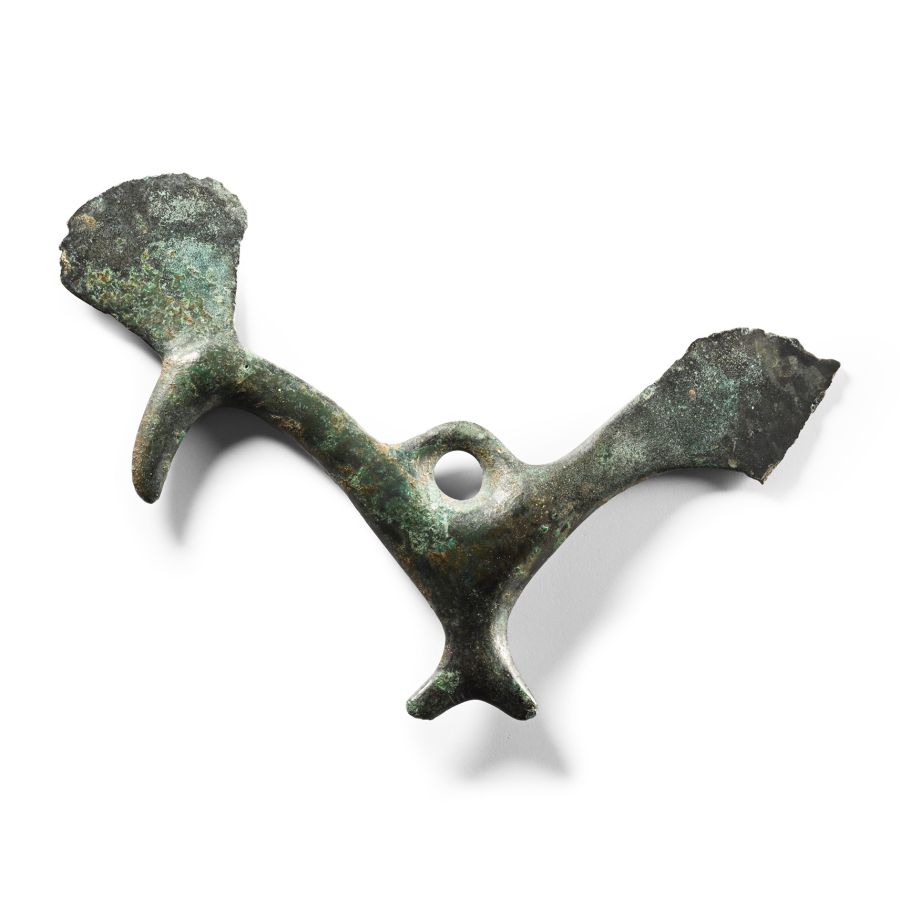
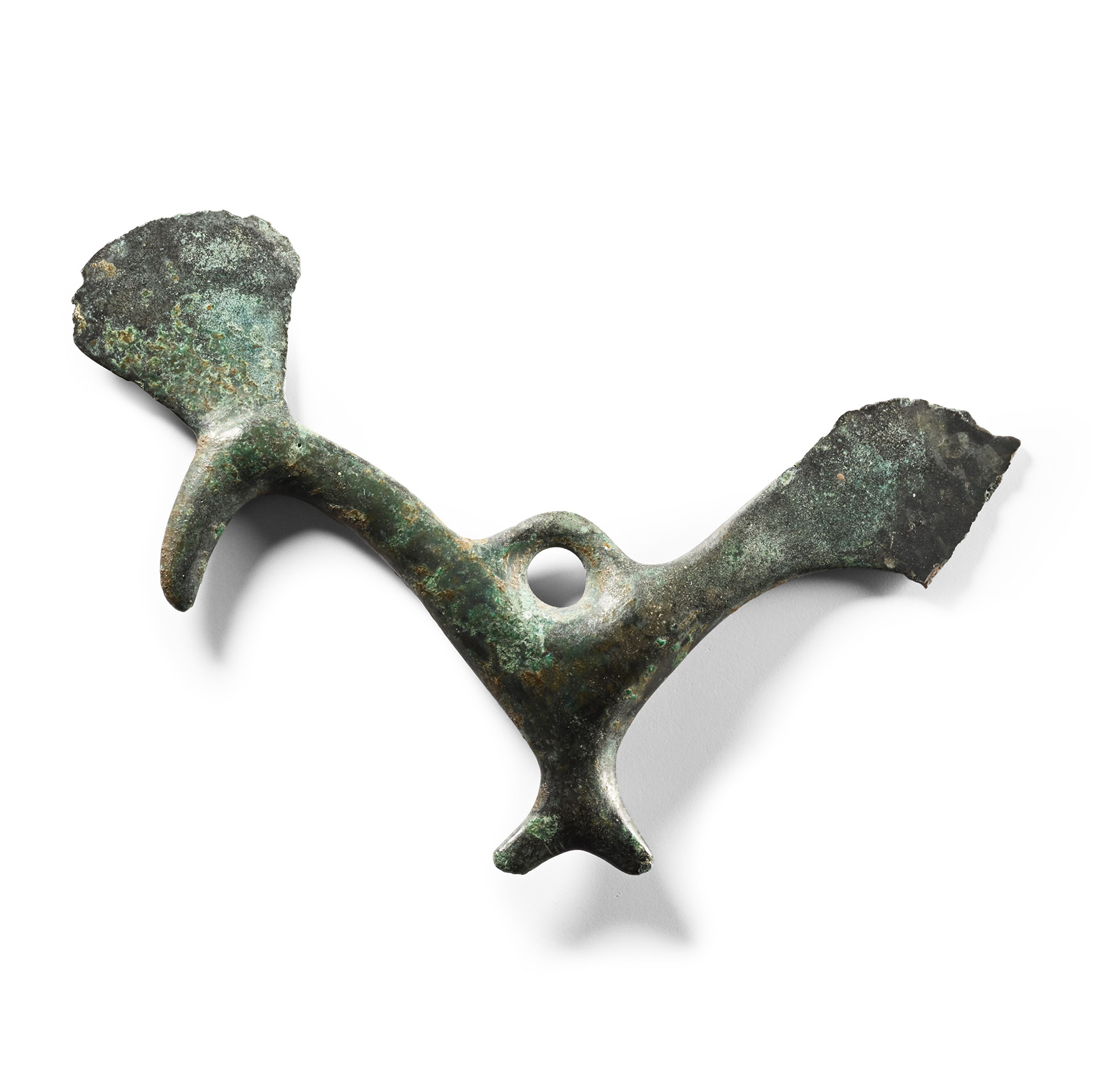
Archaic Greek Bronze Bird-Shaped Pendant
CIRCA 8TH CENTURY B.C.
3 in. (28.8 grams, 80 mm wide).
Formed as a stylised bird with elongated tail and neck, chevron-shaped foot, hooked beak, domed eye, large fan-shaped crest; loop to the back. [No Reserve]
ProvenanceAcquired from Arte Primitivo, New York City, U.S.A., circa 2010.
Private collection of Professor Kenneth Graham, London, UK.
TimeLine Auctions follows a vetting process to ensure the authenticity and legality of all items, reinforcing our commitment to integrity and responsible trading. Each antiquity, antique, and coin lot undergoes thorough examination by a vetting committee of at least ten external specialists, professional trade association members, scientists, and archaeologists: Our Vetting Process
AUCTIONS:
TimeLine is a leading auction house specialising in antiquities, ancient art, collectables, natural history, coins, medals, and books. Our auctions offer museums, collectors, historians, and enthusiasts the opportunity to acquire unique and historically significant pieces.
-
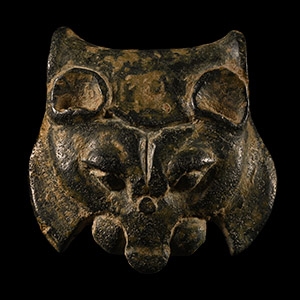
Greek Zoomorphic Bronze Hydria Handle Attachment
Circa 5th-4th century B.C.Sold for (Inc. bp): £442
Modelled as a skinned lion's head with fierce facial detailing; made for soldering to an articulated round handle. 98 grams, 51 mm high
Private collection, Germany, 1980s. Acquired on the UK art market 2010.
The handles were usually shaped as divinities or animals linked with gods (ie. lions for Herakles). A similar specimen can be seen in the Berlin Museum (inv.7491), from Athens. -
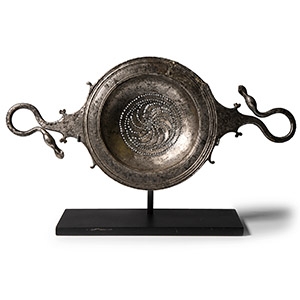
Greek Silver Wine Strainer
4th-3rd century B.C.Sold for (Inc. bp): £16,900
Composed of a shallow bowl and broad flange rim, two integral scalloped handles with scrolled flourishes, tapering to a loop handle with swan head terminals each with incised eye and beak detailing; perforated whirl within roundel to interior base; accompanied by a custom-made display stand. 160 grams, 22.2 cm wide (526 grams total including stand)
Ex private South German collection, 1980s. with Christie's, New York, 8 June 2012, lot 86. Accompanied by an academic report by Dr Raffaele D’Amato. Accompanied by copies of the relevant Christie's pages. This lot has been checked against the Interpol Database of stolen works of art and is accompanied by search certificate number no.11578-198980.
Elaborate silver strainers, such as this present example, were used at symposia and festive occasions for the purpose of preventing the dregs of wine from entering the wine cup. This and other related silver utensils became popular in the later 4th and 3rd century B.C. These highly decorated wine strainers were fitted with dual handles forming loops in the shape of twisting animals, here a swan. Usually they took the form of a shallow dish complete with four rings of perforations in the centre in order to drain the wine. Strainers of this type were used to separate out sediments which could be found in the thick Greek wine. Examples similar to this one have been found in royal tombs in northern Greece, as well as the tomb of a monarch in Sudan. -
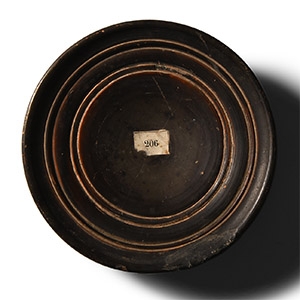
Greek Black Glazed Dish
4th century B.C.Sold for (Inc. bp): £286
With tiered foot, thick rim and ribbed upper face; old collector's ticket number '206'. 325 grams, 16 cm wide
From the collection of Louis-Gabriel Bellon (1819-1899), Saint-Nicolas-lez-Arras and Rouen, thence by descent. with Millon & Associes Auctions, Paris, 6th December 2021, lot 29.
