
Loading, please wait...
LOT 0060
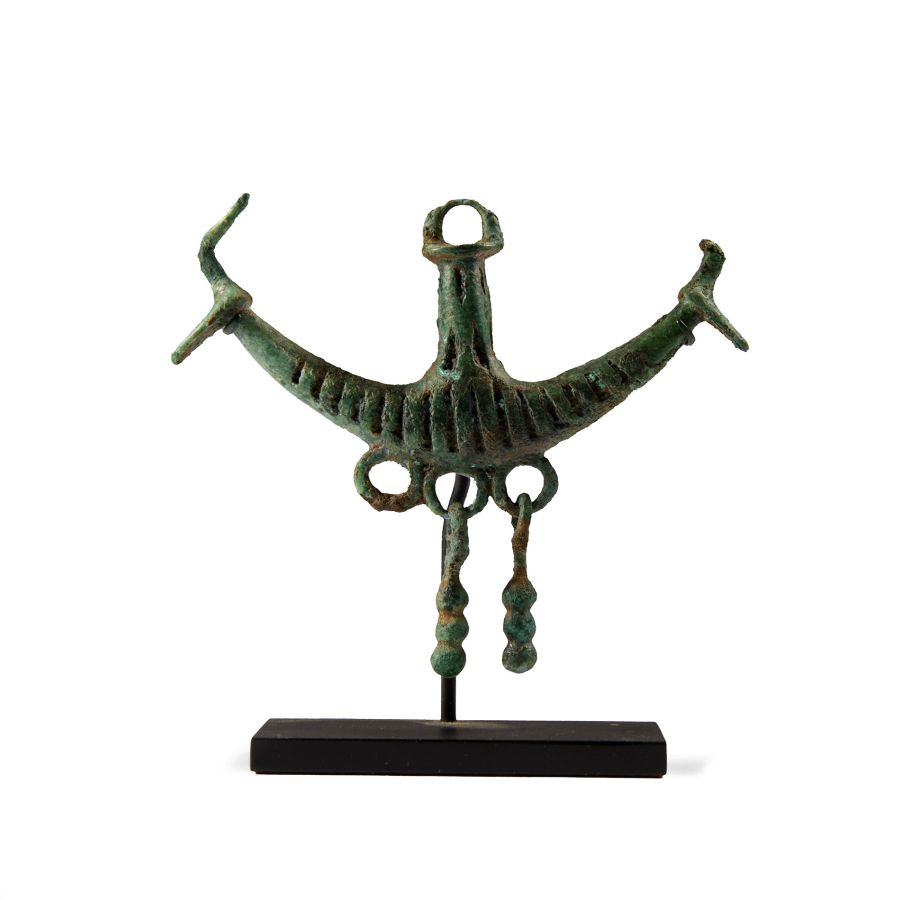
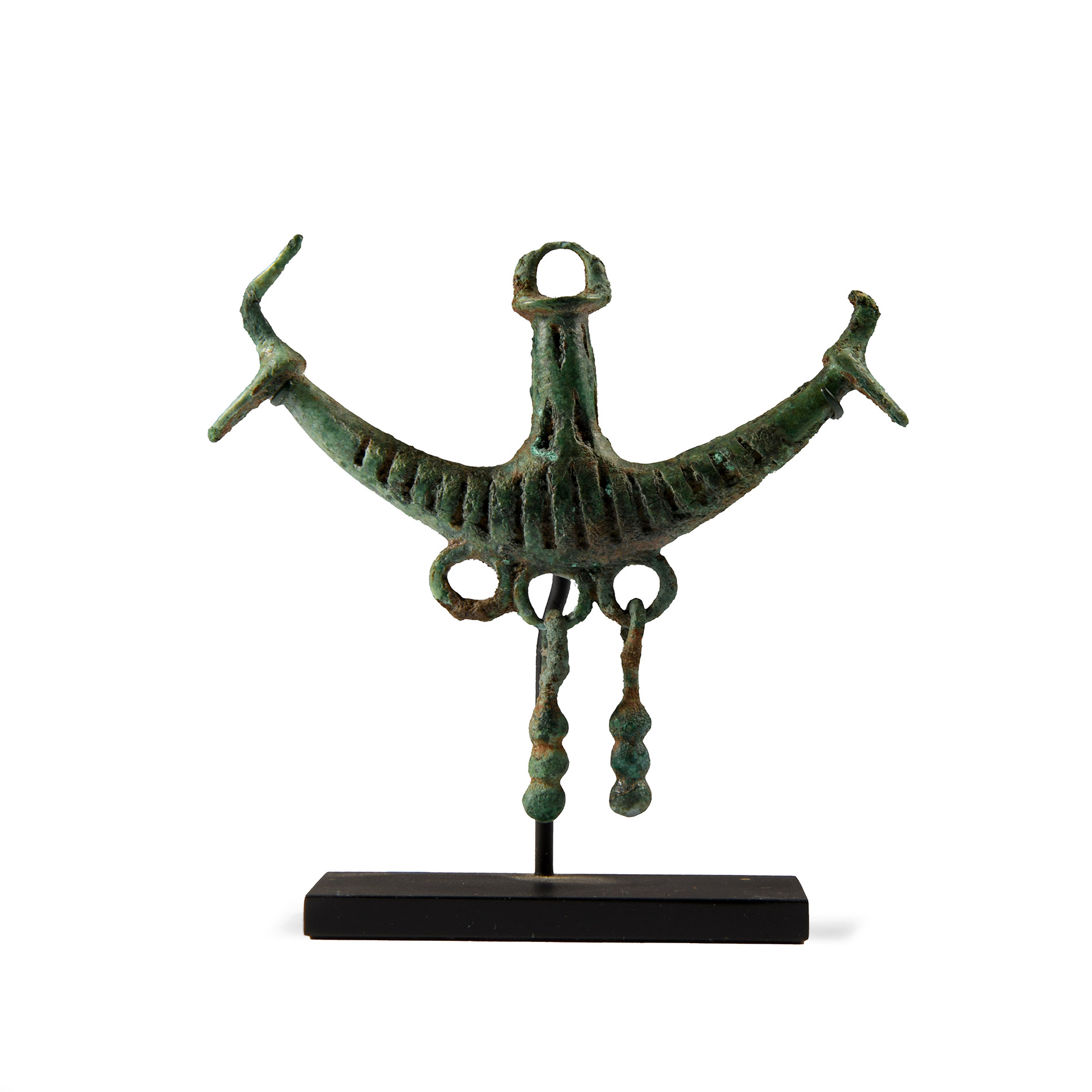
Archaic Greek Bronze Attachment with Animal Heads
CIRCA 8TH CENTURY B.C.
4 1/4 in. (188 grams total, 11 cm including stand).
Pendant with crescentic body and beast-head finials, vertical upstand with loop finial, three loops beneath with bulbous dangles; mounted on a custom-made stand.
ProvenanceEx Rosenson collection, New York, 1990s.
Acquired from Arte Primitivo, New York City, U.S.A., circa 2010.
Private collection of Professor Kenneth Graham, London, UK.
TimeLine Auctions follows a vetting process to ensure the authenticity and legality of all items, reinforcing our commitment to integrity and responsible trading. Each antiquity, antique, and coin lot undergoes thorough examination by a vetting committee of at least ten external specialists, professional trade association members, scientists, and archaeologists: Our Vetting Process
AUCTIONS:
TimeLine is a leading auction house specialising in antiquities, ancient art, collectables, natural history, coins, medals, and books. Our auctions offer museums, collectors, historians, and enthusiasts the opportunity to acquire unique and historically significant pieces.
-
.jpg)
Nuragic Bronze Head of a Tribal Chief
Circa 8th century B.C.Sold for (Inc. bp): £520
The head covered by a small low-top cap; sharp and pronounced nose, prominent eyebrows, small swollen mouth; the hair divided into two braids; mounted on a custom-made display stand. 53 grams total, 91 mm including stand
Ex Frank Sternberg collection, Zürich, Switzerland, circa 1980-1985. Property of an East Sussex, UK, private collector.
Despite being stylised representations, these bronzes detail the material culture of warriors, tribal leaders, priests, athletes, men and women of the late Bronze Age and Iron Age Sardinian society. -
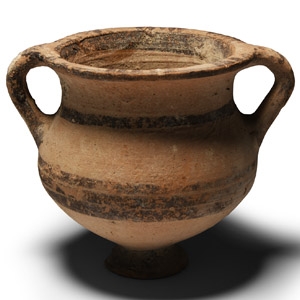
Cypriot Painted Terracotta Amphora
Circa 8th-5th century B.C.Sold for (Inc. bp): £169
In black-painted geometric buffware, with wide bands of black painted decoration on the ovoid body and on the rim, loop handles. 164 grams, 11.8 cm wide
Ex P.A., Hertfordshire, UK, specialist collection of Greek art, 1980-1990s. Accompanied by a copy of an old typed catalogue slip.
The type is well known on Cyprus from 850 B.C. The simplification of the geometric ornaments in panels on the neck and shoulder suggest that the present specimen is later than the Geometric Period. -
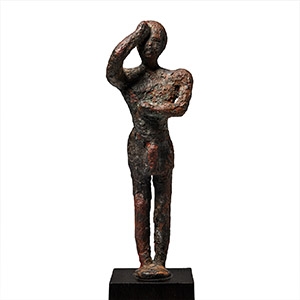
Minoan Bronze Votary Statue
Circa 3000–1100 B.C.Sold for (Inc. bp): £1,820
The figure standing on a small discoid base, wearing a short kilt, with broad chest and slender waist; the left arm bent across the chest and the right arm raised to the forehead in an act of worship; mounted on a custom-made stand. 447 grams total, 22.4 cm high including stand
British private collection, acquired by 2000. Accompanied by a copy of an old photograph showing this item on display in a display cabinet within the previous collectors home. This lot has been checked against the Interpol Database of stolen works of art and is accompanied by search certificate no.11950-210856.
