Loading, please wait...

Apulian Lekanis Lid with Ladies of Fashion Apulian Lekanis Lid with Ladies of Fashion Apulian Lekanis Lid with Ladies of Fashion
Use mousewheel to zoom in and out, click to enlarge
Details

LOT 0621

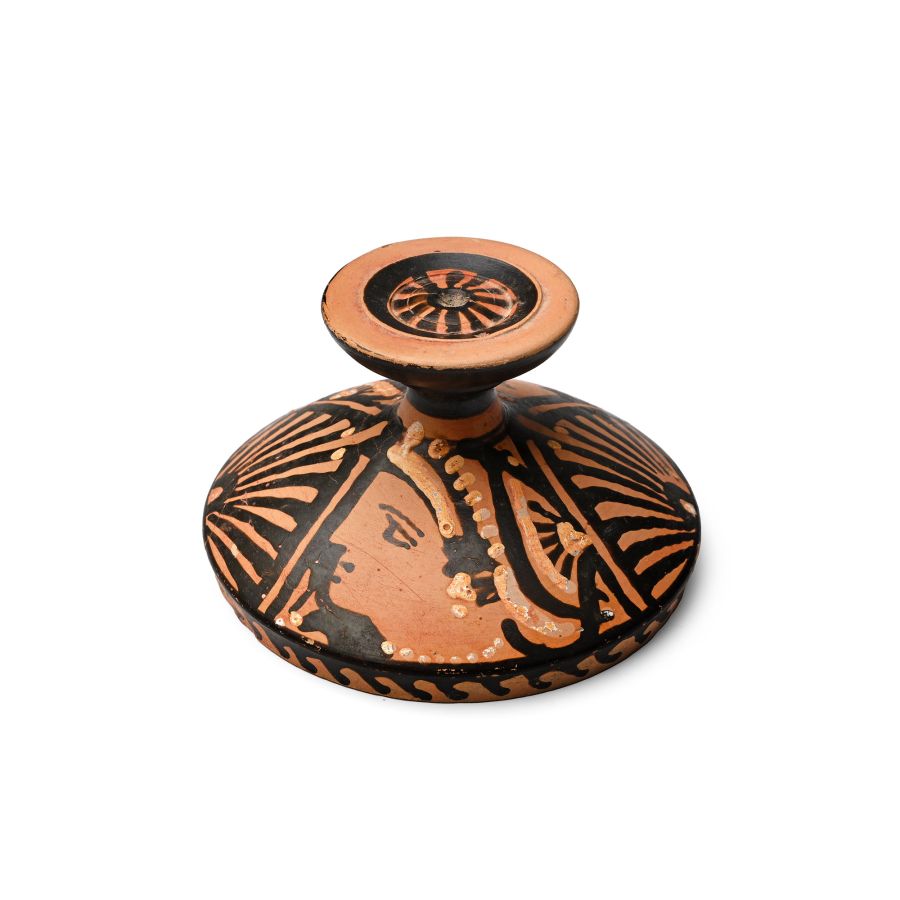
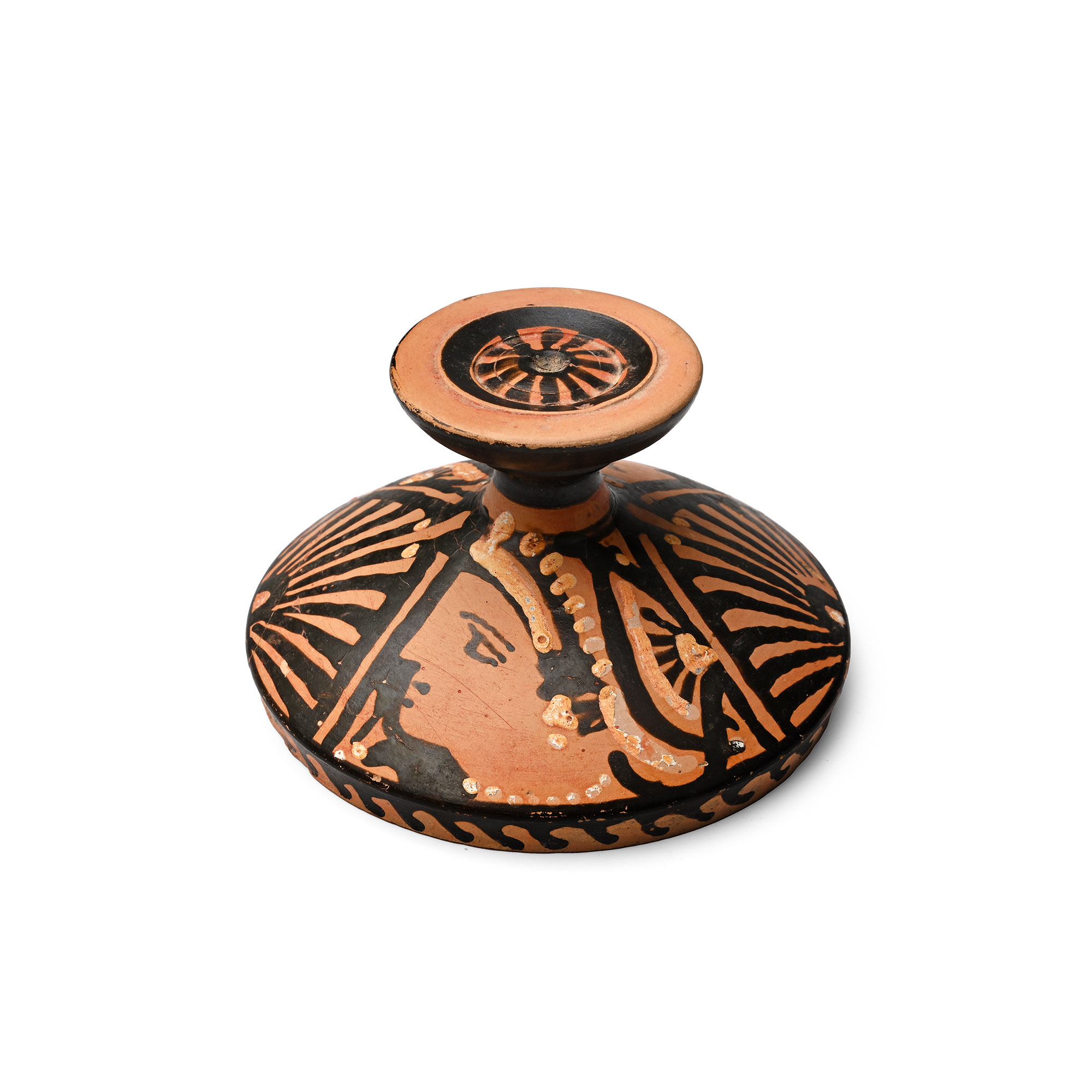
Apulian Lekanis Lid with Ladies of Fashion

4TH CENTURY B.C.

3 1/2 in. (86 grams, 91 mm wide).

Domed in profile with knop handle, painted rosette design to centre, two profile female portraits with cream and white detailing. [No Reserve]

Provenance

From the collection of a gentleman, acquired on the London art market in the 1990s.
This lot is accompanied by an illustrated lot declaration signed by the Head of the Antiquities Department, Dr Raffaele D'Amato.

CONDITION
VETTING:

TimeLine Auctions follows a vetting process to ensure the authenticity and legality of all items, reinforcing our commitment to integrity and responsible trading. Each antiquity, antique, and coin lot undergoes thorough examination by a vetting committee of at least ten external specialists, professional trade association members, scientists, and archaeologists: Our Vetting Process


AUCTIONS:

TimeLine is a leading auction house specialising in antiquities, ancient art, collectables, natural history, coins, medals, and books. Our auctions offer museums, collectors, historians, and enthusiasts the opportunity to acquire unique and historically significant pieces.

LOT 0621

Apulian Lekanis Lid with Ladies of Fashion

Sold for (Inc. bp): £182

Print page

RELATED LOTS
  • Greek Archaic Bronze Phiale with Handles
    Greek Archaic Bronze Phiale with Handles
    7th-6th century B.C.

    Estimate: £1,800 - 2,400 (‡+bp*)

    Opening Bid: £1,000

    Broad and squat in profile with thickened rim, two lateral omega-shaped drop handles each mounted below the rim on a crescentic bar surmounted by a model bird facing inwards; base fragmentary. 915 grams, 44 cm wide


    Acquired in the mid 1980s-1990s. Private collection, Switzerland, thence by descent. Private collection, since the late 1990s. This lot has been checked against the Interpol Database of stolen works of art and is accompanied by search certificate number no.12210-222327. This lot has been cleared against the Art Loss Register database, and is accompanied by an illustrated lot declaration signed by the Head of the Antiquities Department, Dr Raffaele D'Amato.

    Lot Details

  • Minoan Carnelian Stamp Seal
    Minoan Carnelian Stamp Seal
    2nd millennium B.C.

    Sold for (Inc. bp): £3,900

    Discoid type with incuse motif of two stags placed symmetrically with their horns pointing inwards to the centre; supplied with a museum-quality impression. 1.98 grams, 14 mm


    From the private collection of the late R Priday, Brookman Hall, Hertfordshire, UK; thence by descent. This lot has been checked against the Interpol Database of stolen works of art and is accompanied by search certificate number no.12808-240846. This lot has been cleared against the Art Loss Register database, and is accompanied by an illustrated lot declaration signed by the Head of the Antiquities Department, Dr Raffaele D'Amato.

    Lot Details

  • Scythian Bronze Mirror with Eagle Handle
    Scythian Bronze Mirror with Eagle Handle
    6th century B.C.

    Estimate: £5,000 - 7,000 (+bp*)

    Opening Bid: £2,250

    With one polished face; lip to rim on reverse, central disc handle mounted on two spigots, high-relief splayed eagle motif; mounted on a custom-made stand. 980 grams, 21.2 cm (1.91 kg total, 31.3 cm including stand)


    Private collection, UK. Acquired from David Aaron, 2017. Private collection, London. This lot has been checked against the Interpol Database of stolen works of art and is accompanied by a search certificate number no.12834-240718. This lot has been cleared against the Art Loss Register database, and is accompanied by an illustrated lot declaration signed by the Head of the Antiquities Department, Dr Raffaele D'Amato.

    The Scythians were a confederation of nomadic Iranian and Eurasian tribes who roamed the vast grasslands of the Eurasian Steppe and around the Black Sea from approximately the 9th to 1st centuries BC. Despite their prominence across this immense region, they left no written records and few signs of permanent settlement. Much of what is known about their culture derives from archaeological discoveries—particularly elite burial sites—where noble warriors were interred alongside horses and prized personal possessions, including mirrors such as this remarkable example. This large bronze mirror, monumental in size at just over 20 cm in diameter, is a striking artefact both in form and symbolism. Cast as a simple circular disc, its shape resonates with the mirror forms of Egyptian and Hellenistic traditions, where the round reflective surface was often associated with solar symbolism. Along the outer edge runs a raised rim, enclosing a central projection cast in the form of a bird of prey—modelled in the distinctive ‘Scythian Animal Style.’ This artistic style, which adorned objects ranging from horse trappings to belt buckles, is marked by abstracted, geometric renderings of animals—birds, stags, griffins, and horses—executed with a balance of expressive stylisation and visual economy. Here, the bird is formed from five simplified, symmetrical shapes representing the head, body, wings, and tail. Its head is shown in profile, the wings sweeping around the body to merge elegantly with the tail tips. Though minimalist in form, the result is visually dynamic and conceptually sophisticated—embodying a deep cultural understanding of abstraction and symbolism in art. The bird is positioned at the central point of the mirror where a handle would have once been attached. Two bronze prongs remain on the reverse, suggesting a now-missing extension that formed part of a longer handle. This configuration represents one of three known Scythian mirror types, often referred to as the "knob-handle" form. Its design—marked by a projecting lip and central knob—is thought to reflect cross-cultural influences from the East, particularly 6th century BC Chinese prototypes, merged with native Scythian zoomorphic iconography to create a compelling hybrid aesthetic. The surface of the bronze has developed a vivid blue patina over centuries of burial, likely resulting from an alloy of copper, tin, and other trace metals. This rich, variegated surface enhances the object's visual impact and testifies to its age and authenticity. One is naturally drawn to imagine the many faces that once gazed into this mirror, their reflections now long vanished, leaving only this enduring testament to Scythian craftsmanship and spiritual life. A comparable mirror resides in the Hermitage Museum, St. Petersburg: a cast bronze disc of similar size, featuring a central knob with a geometric four-pronged swirl. However, it lacks the deep rim, zoomorphic finial, and striking patina seen here. Together, such mirrors offer rare insight into the symbolic world of the Scythians, and how they assimilated artistic influences across porous borders—resulting in bold, hybrid forms that reflected both cultural identity and transregional dialogue.

    Lot Details

Stay up-to-date with the latest from TimeLine Auctions by joining our mailing list