
Loading, please wait...
_900x900.jpg "Anglo-Scandinavian Viking Bronze Stirrup Mount with Face")
_200x200.jpg "Anglo-Scandinavian Viking Bronze Stirrup Mount with Face")
.jpg "Anglo-Scandinavian Viking Bronze Stirrup Mount with Face")
LOT 0362
Anglo-Scandinavian Viking Bronze Stirrup Mount with Face
CIRCA 11TH CENTURY A.D.
1 5/8 in. (22.11 grams, 41 mm).
With stylised face and pierced eyes, Williams's Class B Type 4 with vestigial lower ledge.
ProvenanceFound Southern England.
Acquired on the UK art market in the 1980s.
From an East Anglian private collection.
Cf. Williams, D., Late Saxon Stirrup-Strap Mounts, York, 1997, item 566, for type.
CONDITIONTimeLine Auctions follows a vetting process to ensure the authenticity and legality of all items, reinforcing our commitment to integrity and responsible trading. Each antiquity, antique, and coin lot undergoes thorough examination by a vetting committee of at least ten external specialists, professional trade association members, scientists, and archaeologists: Our Vetting Process
AUCTIONS:
TimeLine is a leading auction house specialising in antiquities, ancient art, collectables, natural history, coins, medals, and books. Our auctions offer museums, collectors, historians, and enthusiasts the opportunity to acquire unique and historically significant pieces.
LOT 0362
Anglo-Scandinavian Viking Bronze Stirrup Mount with Face
Sold for (Inc. bp): £234
-
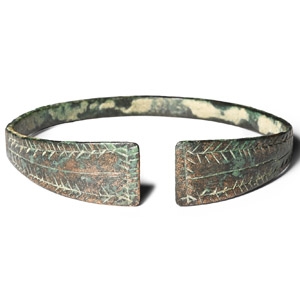
Viking Age Decorated Bronze Bracelet
Circa 9th-11th century A.D.Sold for (Inc. bp): £156
With a flat-section penannular body with expanding terminals; the upper face with incised X-motifs and herringbone pattern to the flaring terminals. 15.5 grams, 61 mm
Ex old English collection. London art market, pre 2000. Property of a London, UK, gentleman. -
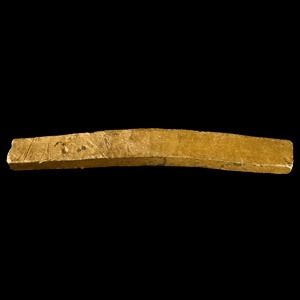
Viking Age or Earlier Hacked Gold Trade Ingot
Circa 10th century A.D. or earlierSold for (Inc. bp): £3,120
A slightly bent irregular bar of hacked gold with rectangular cross-section, showing evidence of compression and fracture to each end, some subtle transverse lines on both of the main surfaces. 14.43 grams, 51 mm
Found whilst searching with a metal detector on 1st May 2022 on a Romano-British site in Cambridgeshire, UK, by Trevor Singleton. Accompanied by a handwritten letter from the finder. Accompanied by a copy of the British Museum's Portable Antiquities Scheme (PAS) report no.CAM-D819F0 and workflow review page where it states: 'There is evidence that the bar fragment has been cut from both ends, suggesting Early Medieval (Viking Period) parallels.'
This ingot was declared under the Treasure Act and subsequently determined by the British Museum to be of 'undiagnostic' date and therefore returned to the finder. Trevor Singleton maintains that it was recovered from a known Romano-British site, while in neighbouring fields Early Medieval (Late Saxon & Viking) items have been recovered and logged with the Portable Antiquities Scheme. Ingots of gold and silver were regularly produced in the Early Medieval period when trade took place between monetised economies (Anglo-Saxon England, Francia, Frisia) and their non-monetised neighbours in southern Scandinavia (West, 1998; Blackburn, 2011). Ingots were a convenient means of storing wealth which could be converted into display items (weapon fittings, clothing fasteners, tableware) or used to gild silver and bronze items (Hårdh, 1996). -
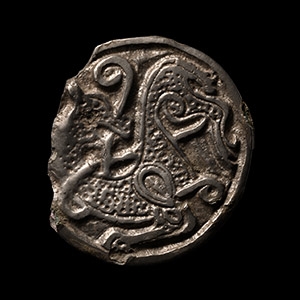
Viking Silver Mammen Style Dragon Pendant
10th-early 11th century A.D.Sold for (Inc. bp): £208
Of discoid form with central motif of a low-relief regardant beast with piriform shoulder and punced body, looped tendrils enmeshing the body. 9.1 grams, 35 mm
From the collection of a North American gentleman, formed in the 1990s.
