
Loading, please wait...
_900x900.jpg "Anglo-Saxon Tinned Bronze Openwork Horse Harness Mount")
_200x200.jpg "Anglo-Saxon Tinned Bronze Openwork Horse Harness Mount")
.jpg "Anglo-Saxon Tinned Bronze Openwork Horse Harness Mount")
LOT 0367
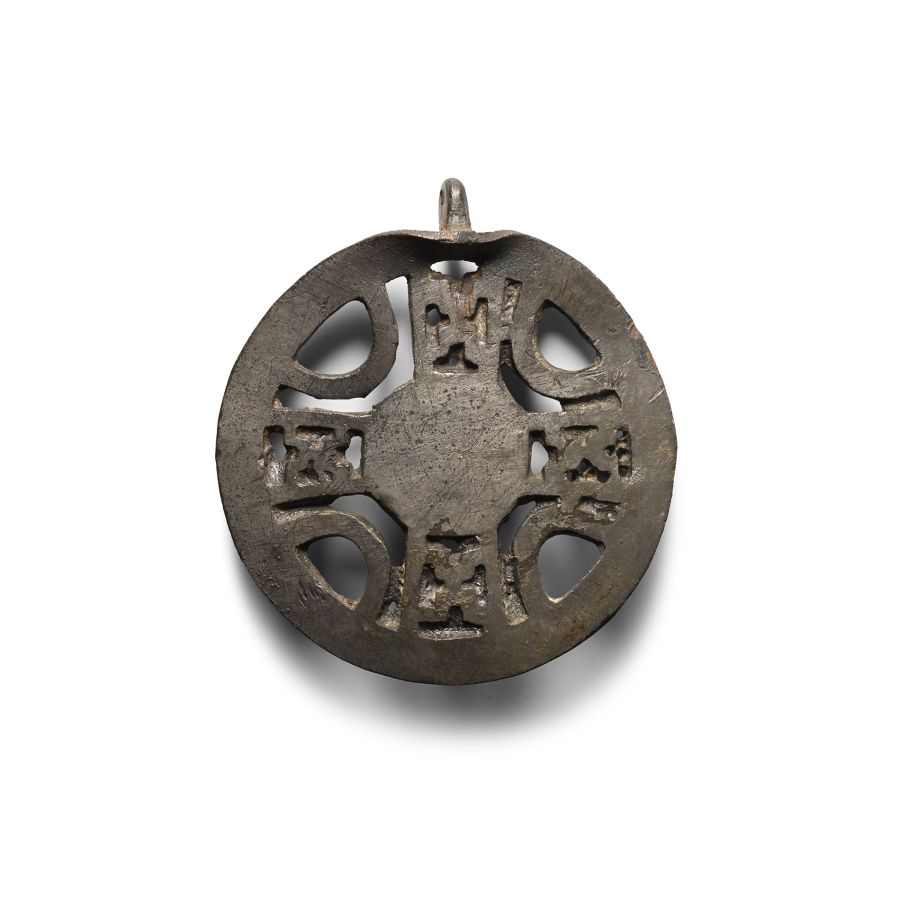
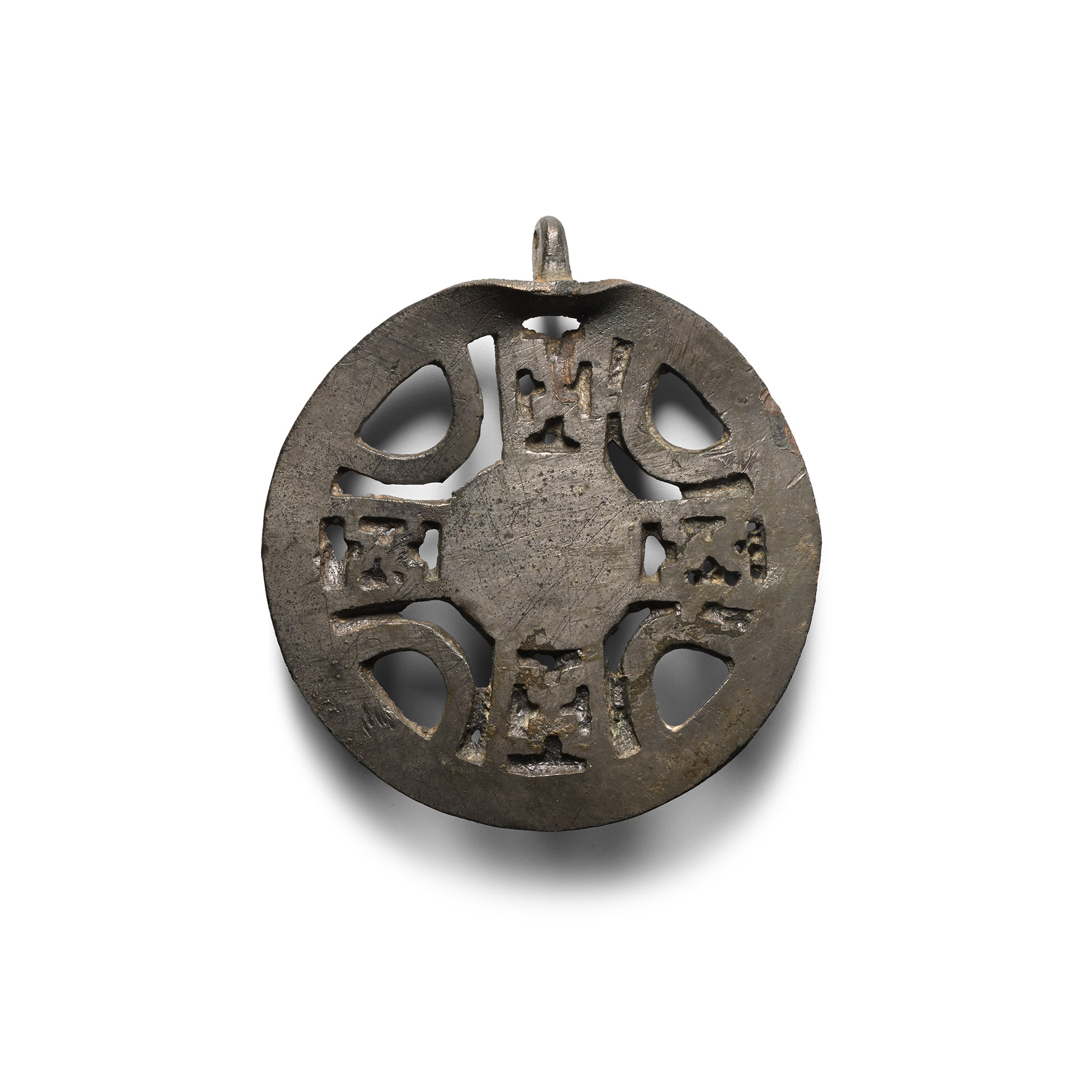
Anglo-Saxon Tinned Bronze Openwork Horse Harness Mount
LATE 5TH-EARLY 6TH CENTURY A.D.
2 1/4 in. (26.1 grams, 57 mm).
Disc mount with four pierced lugs to the reverse, openwork design with four radiating U-shaped elements between the arms of a cross with T-shaped voids.
ProvenanceFound Southern England.
Acquired on the UK art market in the 1980s.
From an East Anglian private collection.
Cf. Carver, M., Sutton Hoo. A Seventh Century Princely Burial Ground and its Context, London, 2005, p.234 and fig.115, for discussion of bridle fittings.
FootnotesThe 'zoned' layout of the piece strongly recalls some of the design elements in Kentish disc brooches, where the cells contain inlaid garnets, millefiori glass, meerschaum and other materials (see Arrhenius, B., Merovingian Garnet Jewellery, Stockholm, 1985, figs. 188-193).
CONDITIONTimeLine Auctions follows a vetting process to ensure the authenticity and legality of all items, reinforcing our commitment to integrity and responsible trading. Each antiquity, antique, and coin lot undergoes thorough examination by a vetting committee of at least ten external specialists, professional trade association members, scientists, and archaeologists: Our Vetting Process
AUCTIONS:
TimeLine is a leading auction house specialising in antiquities, ancient art, collectables, natural history, coins, medals, and books. Our auctions offer museums, collectors, historians, and enthusiasts the opportunity to acquire unique and historically significant pieces.
-
.jpg)
Anglo-Saxon Gilt Bronze Mount with Wolf-Men
6th century A.D.Estimate: £1,000 - 1,400 (+bp*)
Opening Bid: £556
The majority of a mount bearing dense and enigmatic imagery recalling half-remembered legends which were already ancient when it was made; the obverse packed with a tangled mass of bands of detailed ornament which resolves itself into human (or divine?) figures, each gripping the ankles of the other, their bodies inverted and contorted in the classic Style I chip-carved fashion; the centre with a round cell, into which a flat-cut glass cloison is set, polished to reflect the light and to shimmer with blood-red brilliance. 9.08 grams, 32 mm
Fine condition. Unique.
Found Wiltshire, UK. Wiltshire gentleman, 2011. TimeLine Originals, 2000s. Property of an East Anglia gentleman. Accompanied by a report by Anglo-Saxon and Viking specialist S. Pollington. This lot has been checked against the Interpol Database of stolen works of art and is accompanied by search certificate number no.10381-168115.
Anglo-Saxon and Viking specialist Stephen Pollington writes: '...the scene presented may illustrate a legend or myth of which no record survives. That said, the execution of the piece is consistent with high-status Anglo-Saxon metalwork of the 6th century, and the quality of the gilding is remarkably high. The iconography is at present unique but entirely within the Anglo-Saxon tradition.' -
.jpg)
Anglo-Saxon Bronze Girdle Hanger
Late 5th-early 6th century A.D.Sold for (Inc. bp): £65
A T-shaped 'key' consisting of a central stem with a flat, oval attachment loop at the upper end and a T-shaped or W-shaped terminal at the lower end, formed from two prongs. 19.6 grams, 10.3 cm
Found whilst searching with a metal detector near Garton, East Riding of Yorkshire, UK, circa 2019. Accompanied by a copy of the British Museum's Portable Antiquities Scheme (PAS) report no.YORYM-84E0BD. -
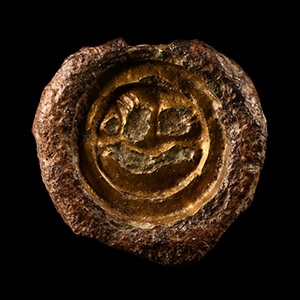
Anglo-Saxon Gilt Bronze Button Brooch with Face
Circa 6th-7th century A.D.Sold for (Inc. bp): £78
With raised border and chip-carved warrior mask motif. 3.31 grams, 19 mm
Ex David Winter collection, Kent, UK. Acquired on the UK art market in 2012. Property of a Kent lady collector.
