
Loading, please wait...
LOT 1176
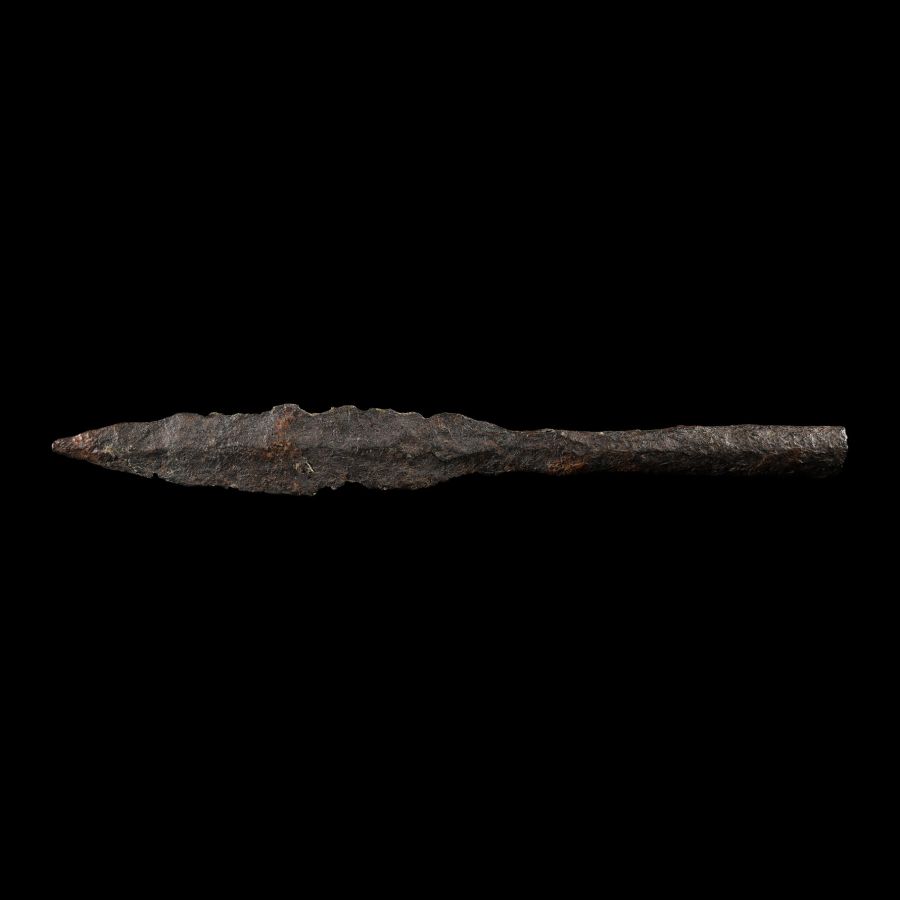
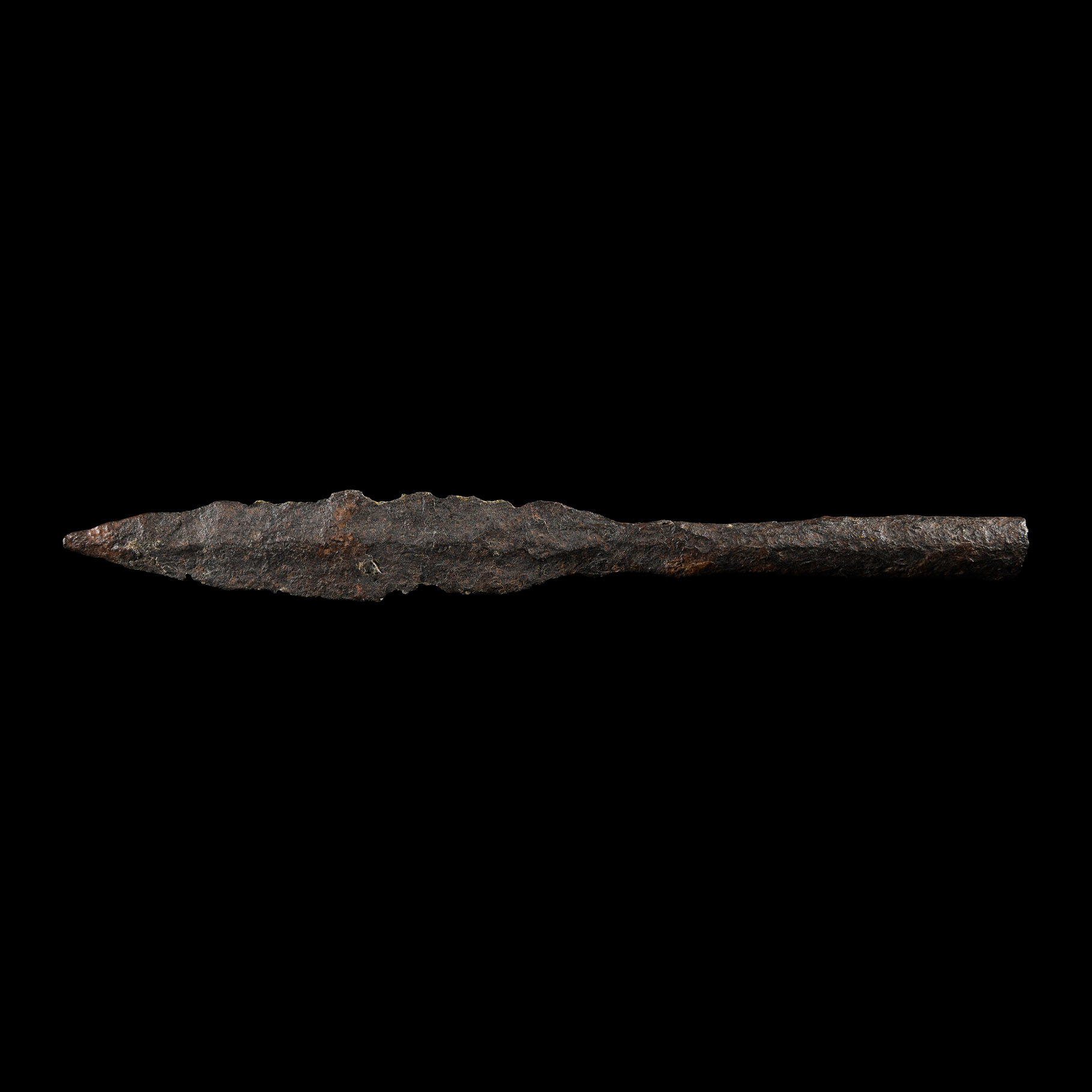
Anglo-Saxon 'Norfolk' Iron Socketted Spearhead
6TH-7TH CENTURY A.D.
10 in. (134 grams, 25.3 cm).
With lentoid-section lanceolate blade, tapering circular socket with forge-welded split. [No Reserve]
ProvenanceFound Norfolk, UK, in the 1970s.
Gary Edwards, York, UK.
Private collection, Preston, UK.
Accompanied by a certificate of authenticity and receipt from Gary Edwards, no.SN12480.
See Swanton, M.J., The Spearheads of the Anglo-Saxon Settlements, Leeds, 1973.
FootnotesThe spearhead belongs to the C2 group of the Swanton's classification, by far the commonest leaf-shaped blade found in Anglo-Saxon graves in 6th and 7th centuries A.D. These spears have their broadest part in the lower half, and are lentoid in section. Length varies between 20 and 35 cm.
CONDITIONTimeLine Auctions follows a vetting process to ensure the authenticity and legality of all items, reinforcing our commitment to integrity and responsible trading. Each antiquity, antique, and coin lot undergoes thorough examination by a vetting committee of at least ten external specialists, professional trade association members, scientists, and archaeologists: Our Vetting Process
AUCTIONS:
TimeLine is a leading auction house specialising in antiquities, ancient art, collectables, natural history, coins, medals, and books. Our auctions offer museums, collectors, historians, and enthusiasts the opportunity to acquire unique and historically significant pieces.
-
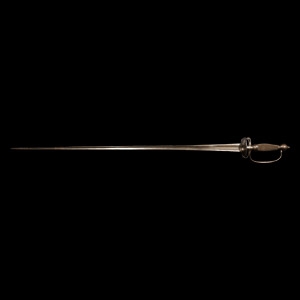
Georgian Steel Rapier Sword
Late 18th-early 19th century A.D.Sold for (Inc. bp): £208
With long triangular-section blade and narrow acute tip, shell-guard hilt with two rings to the reverse and knuckle-guard, wire-bound grip, poppyhead pommel with knop finial. 497 grams, 102.5 cm
Acquired UK market. Property of a Kent collector. -
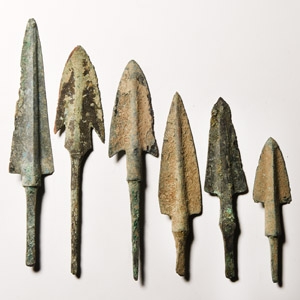
Luristan Bronze Arrowhead Group
12th-10th century B.C.Estimate: £100 - 140 (+bp*)
Opening Bid: £50
Comprising six tanged arrowheads, all with large elongated triangular blades and raised midrib, sharp central groove, cylindrical stem with handle for the shaft; three with barbed shoulders and convex or squared sides, two lanceolate with slightly rounded shoulders, one elongated triangular type. 105 grams total, 6.9-11.7 cm
Acquired 1980-2015. Ex Abelita family collection.
These arrowheads seem to belong to the type V, subcategory types A, B, C and D according to the classification of Khorasani and Negahban. In the four categories of triangular bronze arrowheads from Luristan, Marlik and Northern Iran individuated by Negahban, subtypes C and D of type V are larger arrow or javelin heads, C with barbed shoulders and D with round shoulders. -
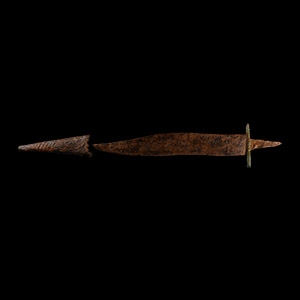
Medieval Iron Knife with Chape
Circa 14th-16th century A.D.Sold for (Inc. bp): £130
The undulating blade with a single cutting edge, guard and tang, together with a chape (belonging) with decorative incising. 159 grams, 26 cm
Acquired on the UK art market. Property of a Ruislip, UK, gentleman, by inheritance.
