
Loading, please wait...
LOT 1808
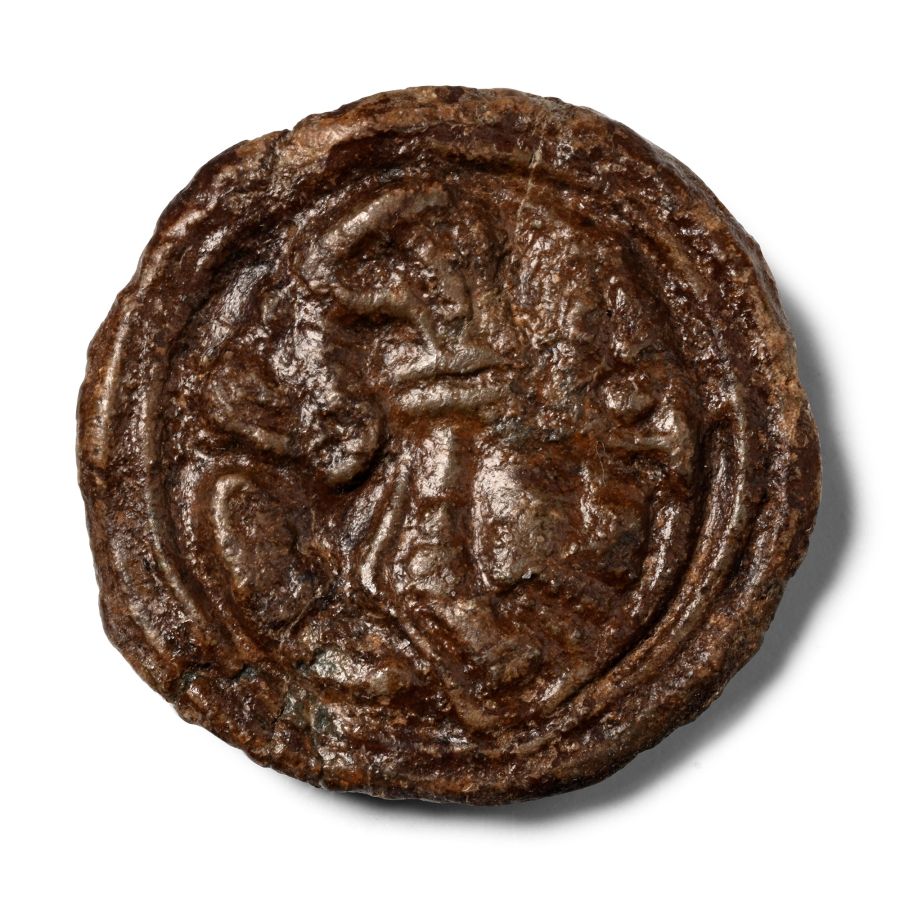
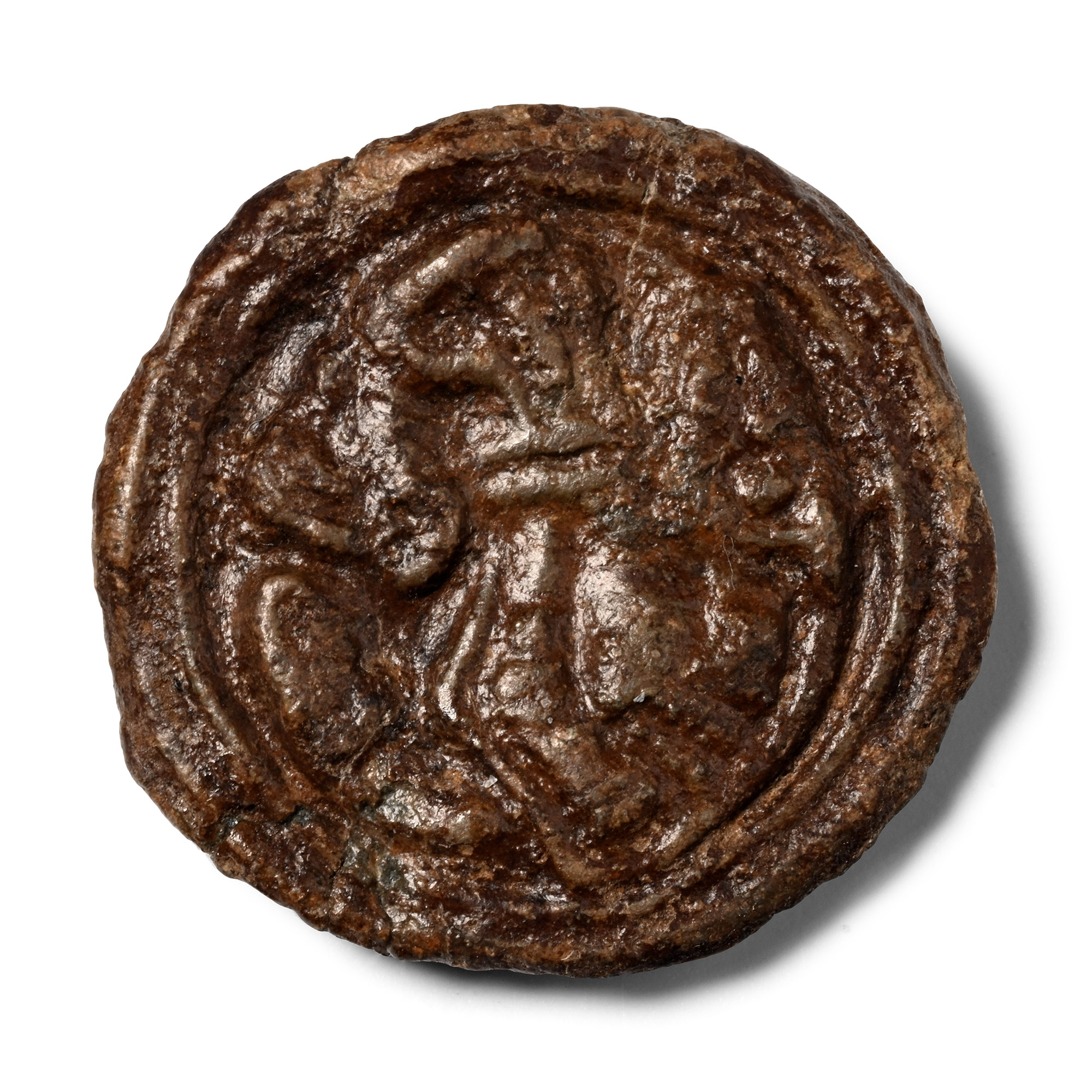
Anglo-Saxon Lead Beast Facing Back Brooch
CIRCA 6TH CENTURY A.D.
1 in. (10.3 grams, 27 mm).
Discoid brooch with bilinear frame and a low-relief motif of a beast facing back; catchplate and remains of pin lugs and base of loop for a swag of beads to the reverse. [No Reserve]
ProvenanceFound near North Kelsey, Lincoln, Lincolnshire, UK.
Acquired on the UK art market.
Property of a Lancashire, UK, collector.
Cf. Heynowski, R., Bestimmungsbuch Archaeologie: Fibeln, Munich, 2012, no.3.26 for type; MacGregor, A. & Bolick, E., A Summary Catalogue of the Anglo-Saxon Collections (Non-Ferrous Metals), Oxford, 1993, item 4.67 for lead-alloy brooches.
CONDITIONTimeLine Auctions follows a vetting process to ensure the authenticity and legality of all items, reinforcing our commitment to integrity and responsible trading. Each antiquity, antique, and coin lot undergoes thorough examination by a vetting committee of at least ten external specialists, professional trade association members, scientists, and archaeologists: Our Vetting Process
AUCTIONS:
TimeLine is a leading auction house specialising in antiquities, ancient art, collectables, natural history, coins, medals, and books. Our auctions offer museums, collectors, historians, and enthusiasts the opportunity to acquire unique and historically significant pieces.
-
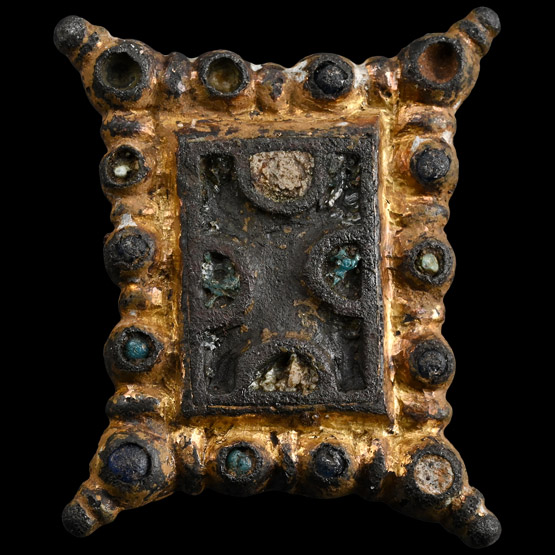
Anglo-Scandinavian Gilt Bronze Rectangular Jewelled Brooch
11th century A.D.Estimate: £150 - 200 (+bp*)
Current Winning Bid: £40
Rectangular in plan with incurved edges; the border a series of graduated lobes, the larger ones each with a cell to accept a gemstone, with some still present; central panel with a D-shaped cell to each inner edge to accept enamel; lugs and catch to reverse. 21 grams, 38.8 mm
Found Norfolk, UK. -
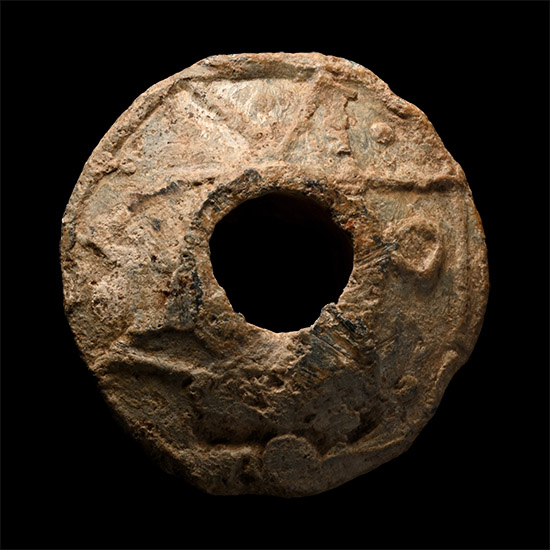
Post Saxon Decorated Lead Spindle Whorl with Runic Letter
Circa 1200 A.D.Sold for (Inc. bp): £7
Biconical in form, with flat top and bottom surfaces, central perforation measuring 9.2 mm; both surfaces decorated with raised motifs including a non-standard rune shape (but similar to the Hægel rune). 29.1 grams, 28 mm
Found near Grimsby, North East Lincolnshire, UK. Accompanied by a copy of the British Museum's Portable Antiquities Scheme (PAS) report no.LIN-5C4312.
The raised design resembles some Anglo-Saxon runes: for example, the Hægel rune with a pellet, Yr rune and others. Perhaps the motifs were designed by someone who had seen runes in a text somewhere. -
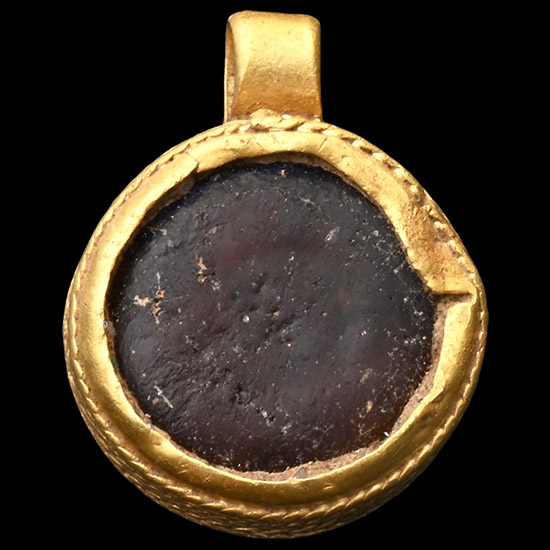
Anglo-Saxon Gold Necklace Pendant with Amber Cabochon
Circa 600-700 A.D.Sold for (Inc. bp): £1,820
Circular in plan and comprising a thin sheet backing plate with applied tall sides set perpendicular to create a mount for the stone; the sides formed from six bands of twisted wire that are set at alternating directions to create a chevron pattern; the aperture of the mount made from flat and undecorated sheet metal that folded inwards to hold the stone in place, the setting a cabochon-cut red stone, believed to be amber. 1.51 grams, 14 mm
Found whilst searching with a metal detector near Twyning, Tewkesbury, Gloucestershire, UK, on Sunday 17th August 2025 by Ben Williams; recorded as Treasure and disclaimed by the Crown with Treasure case tracking no.2025 T1597. Accompanied by a copy of the British Museum's Portable Antiquities Scheme (PAS) report no.GLO-D25ABA.
