
Loading, please wait...
LOT 0522
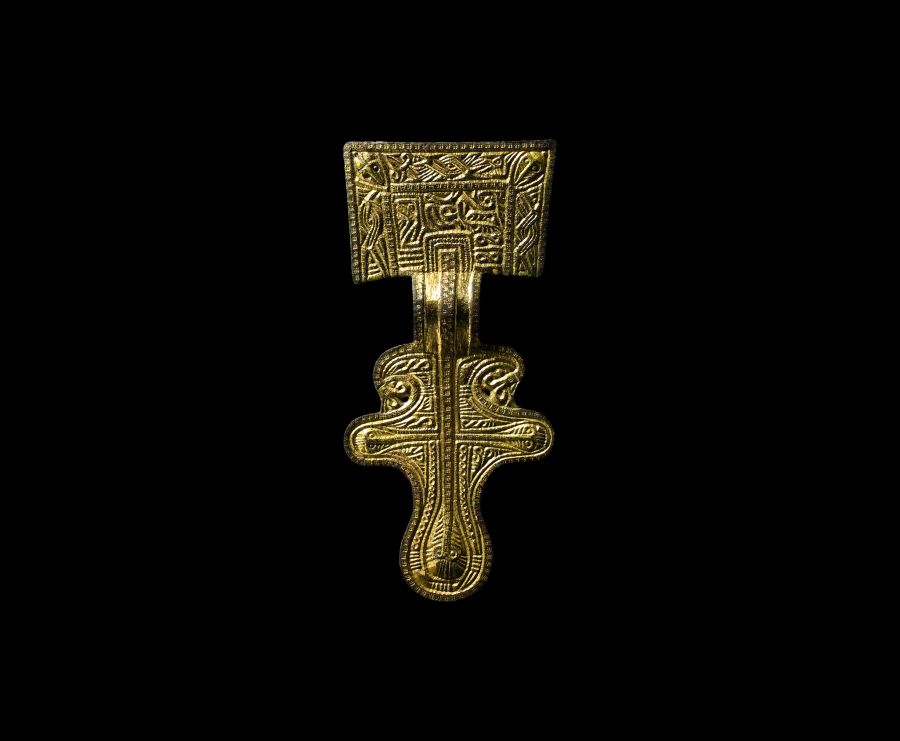
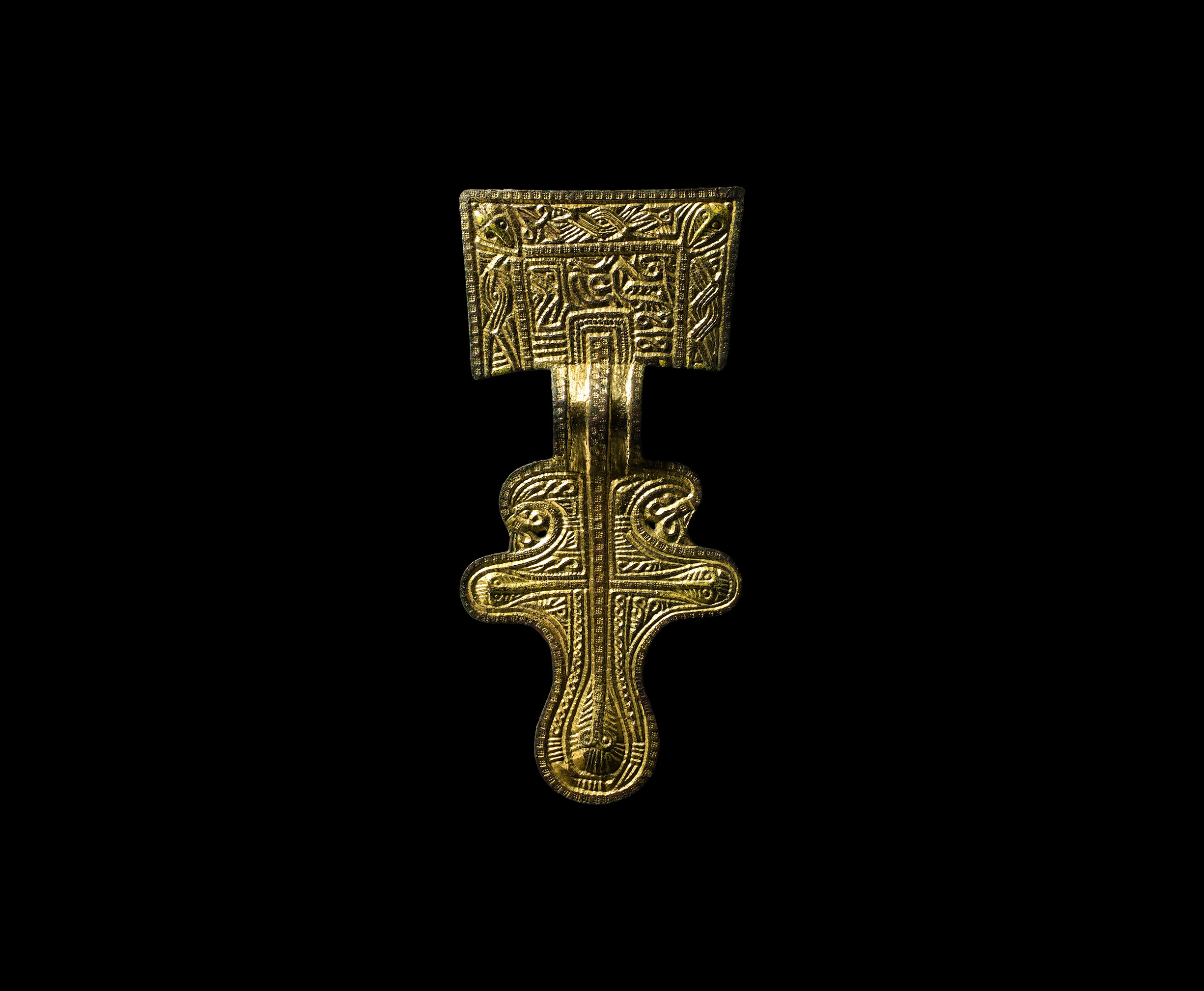
Anglo-Saxon Great Square-Headed Brooch with Faces of Odin
6TH CENTURY AD
5 1/2" (86.05 grams, 14cm).
An excessively rare gilt-bronze great square-headed brooch of Hines's Class I comprising a trapezoidal headplate with stamped and chip-carved detailing, broad bow, trefoil footplate with lappets beneath the bow, remains of the ferrous pin to the reverse of the headplate and solder scar where the catchplate was attached.
ProvenanceFrom an important English collection; found in Lincolnshire, UK; accompanied by a report by Anglo-Saxon and Viking specialist, S. Pollington.
PublishedFeatured on the front cover of Treasure Hunting magazine, June 2020; along the with story on p.10; accompanied by a copy of the Treasure Hunting Magazine pages.
LiteratureSee Hines, J., A New Corpus of Anglo-Saxon Great Square-Headed Brooches, London, 1997; MacGregor, A. and Bolick, E., A Summary Catalogue of the Anglo-Saxon Collections (Non-Ferrous Metals), Oxford, 1993; Mannering, U., Iconic Costumes, Scandinavian Late Iron Age Costume Iconography, Ancient Textiles Series vol. 25, Oxford, 2019.
FootnotesThe brooch is in remarkably good condition, thanks in large part to the quality of the mercury gilding which has retained all the ornament to the obverse surface, and to the careful cleaning and conservation which it has undergone. It has no exact parallel in the corpus of known examples of the type, but all the principal features of its design can be found on one or more other brooches in the series. Given that these brooches were relatively rare even when they were in use, and that they were individually created by craftsmen, it is likely that a unique combination of elements was considered desirable. That said, the brooch most closely resembles an example from Fairford, Gloucestershire, England (Hines's plate 8a) in some of its layout and ornament. For example, the two concentric Π-shaped bands of chip-carved Style I decoration appearing on the headplate and the presence of a facing human mask in each upper corner are features shared by both brooches. The broad bow has a shallow curvature with three raised ribs and two plain recesses - features which appear on a brooch from Laceby (Hines's plate 65b) and elsewhere. A midrib with offset punched detailing extends from the lower edge of the headplate across the bow and down the footplate as far as the chin of the lower mask; a similar feature appears also on an example from Luton, Bedfordshire (Hines's plate 23). The footplate is formed as three radiating lobes, two smaller laterals and a larger one forming the finial; each lobe contains a facing human mask similar to those on the upper corners of the headplate; each mask is piriform and slightly domed, with a vertical midrib flanked by two pellet eyes and segmented bands representing the hair and beard. Above the lateral lobes where the bow connects to the footplate are two lappets, each a stylised profile 'horse-head' with looped lips; within the curve of the lips there is a deliberate small hole. The whole obverse (apart from the lower edge of the headplate) is framed by a continuous raised border bearing stamped decoration, each stamp a grid of four squares; this design is repeated on the midrib.
Great square-headed brooches were an Anglian fashion of the early to mid-6th century AD with counterparts in southern Scandinavia and a few examples known from continental Europe - mainly from coastal areas with links to the North Sea (Mannering, 2019, especially a gold foil from Gudme, Denmark with possible brooch at the shoulder, item GU1). They are associated with high-status females, and occur in graves with other types of brooch as well as beads, girdle-hangers and other items (Hines, 1997). Due to their large size and impressive decoration, it is assumed that they were used to fasten a mantle or cloak worn over a peplos-style dress fastened by smaller brooches such as annular, button or small-long types worn in pairs at the shoulders or collar.
TimeLine Auctions follows a vetting process to ensure the authenticity and legality of all items, reinforcing our commitment to integrity and responsible trading. Each antiquity, antique, and coin lot undergoes thorough examination by a vetting committee of at least ten external specialists, professional trade association members, scientists, and archaeologists: Our Vetting Process
AUCTIONS:
TimeLine is a leading auction house specialising in antiquities, ancient art, collectables, natural history, coins, medals, and books. Our auctions offer museums, collectors, historians, and enthusiasts the opportunity to acquire unique and historically significant pieces.
LOT 0522
Anglo-Saxon Great Square-Headed Brooch with Faces of Odin
Sold for (Inc. bp): £11,250

6th-7th century AD
Lot No. 2683
Sold for (Inc. premium): £188

6th century AD
Lot No. 2700
Sold for (Inc. premium): £75

11th-12th century AD
Lot No. 2668
Sold for (Inc. premium): £19
