
Loading, please wait...

LOT 1921
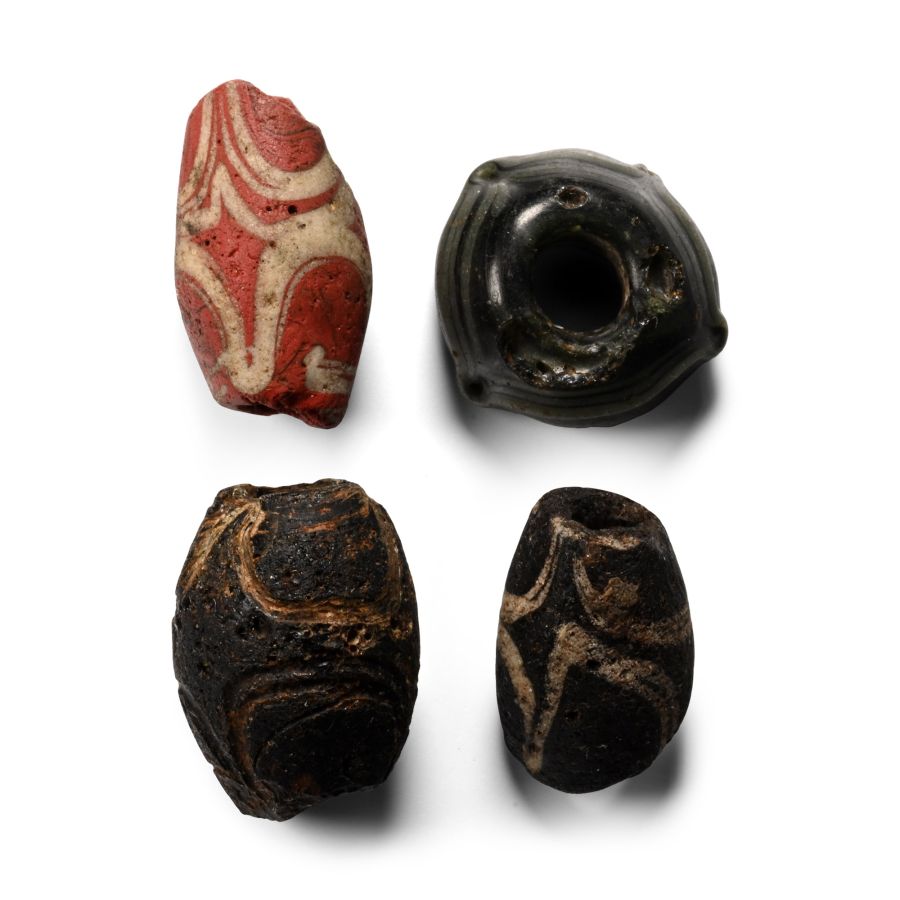
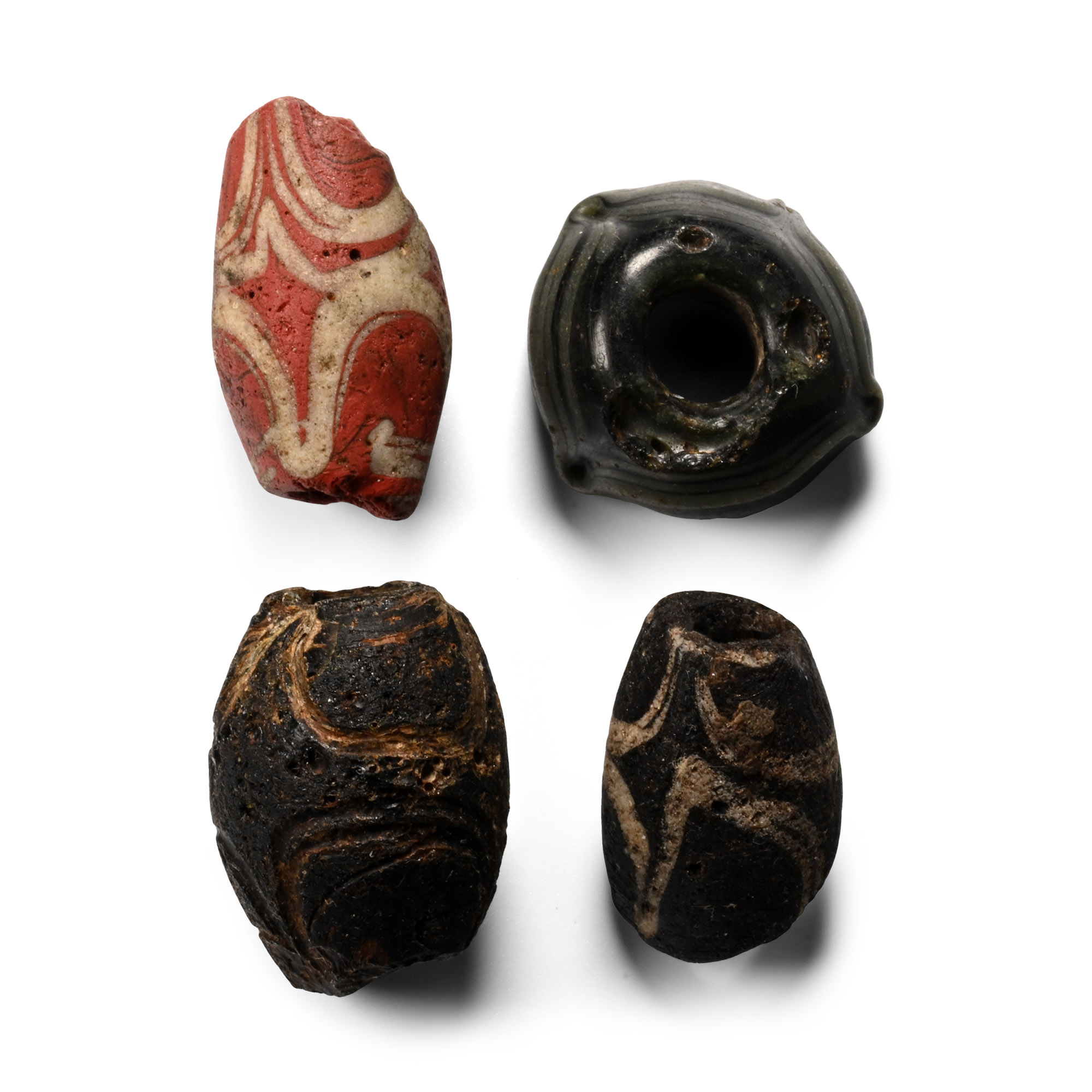
Anglo-Saxon Glass Bead Collection
CIRCA 5TH-7TH CENTURY A.D.
1 in. (31 grams total, 23-25 mm).
Mainly fusiform types with marvered trails. [4, No Reserve]
ProvenanceFound Suffolk, UK.
Acquired from Den of Antiquity, circa 2009.
Ian Wilkinson collection, Nottinghamshire, UK, formed since 1985.
Accompanied by an old handwritten dealer's ticket.
This lot is accompanied by an illustrated lot declaration signed by the Head of the Antiquities Department, Dr Raffaele D’Amato.
TimeLine Auctions follows a vetting process to ensure the authenticity and legality of all items, reinforcing our commitment to integrity and responsible trading. Each antiquity, antique, and coin lot undergoes thorough examination by a vetting committee of at least ten external specialists, professional trade association members, scientists, and archaeologists: Our Vetting Process
AUCTIONS:
TimeLine is a leading auction house specialising in antiquities, ancient art, collectables, natural history, coins, medals, and books. Our auctions offer museums, collectors, historians, and enthusiasts the opportunity to acquire unique and historically significant pieces.
-
Anglo-Saxon Human Cranium and Fragments
6th-11th century A.D. or earlierSold for (Inc. bp): £195
Fragments of the vault of a human skull, repaired and partly restored. 284 grams total, 10-15.2 cm
Found in a Peterborough clay pit, Cambridgeshire, UK. From an old English collection. Acquired from Stone Treasures, Mansfield, Nottinghamshire, UK, circa 2013. Ian Wilkinson collection, Nottinghamshire, UK, formed since 1985. This lot is accompanied by an illustrated lot declaration signed by the Head of the Antiquities Department, Dr Raffaele D’Amato.
NB: This lot is strictly for collection only. -
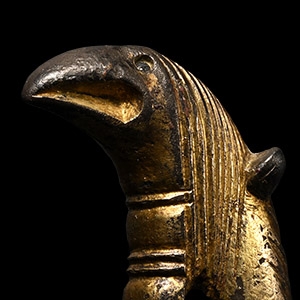
Hiberno-Saxon Gilt Bird-Headed Finial
6th-7th century A.D.Estimate: £4,000 - 6,000 (+bp*)
Opening Bid: £2,000
A zoomorphic mount with enigmatic zoomorphic ornament, ellipsoid in section with hollow rear and slot, holes for attachment curved end; the rear of the body formed with transverse twisted ribs above two panels of fine parallel lines parted at the median with D-shaped lugs projecting above; below, beneath the lateral slot, horizontal ribs and balusters with scooped edge and two holes for attachment, the scooped finial with two impressed sockets forming a beast-head; above, the forward end of the shank forming a curved beak with lateral recesses; socket eyes above, one with glass fill; mounted on a custom-made stand. 26.12 grams, 38 mm (43.6 grams total, 71 mm including stand)
with ArtAncient Ltd. Private collection, London, UK. This lot has been checked against the Interpol Database of stolen works of art and is accompanied by a search certificate number no.12438-226862. This lot has been cleared against the Art Loss Register database, and is accompanied by an illustrated lot declaration signed by the Head of the Antiquities Department, Dr Raffaele D’Amato.
The item is enigmatic and intriguing. In many respects it resembles a drinking horn finial, particularly the class of such items found in Irish and Hiberno-Saxon contexts (Youngs, items 53, 54). However, the profile of the hollow rear is elliptical rather than circular, and the lateral slots are clearly intended to accept some form of projection. The most likely interpretation is that the piece was custom-made to fit a drinking horn with carved and reserved ornament, part of which would fit into the slots. The form of the piece is superficially that of an eagle or raven-head with sturdy raptor's beak. However, behind the head are placed two small projecting ears and the sides bear a long mane, both reminiscent of a horse. Other interpretations include such elements as a boar, a caterpillar, and a rat. It seems likely that the animal is a hybrid of a mammal and bird of prey: in this case, it must be a gryphon and was possibly inspired by classical forms. -
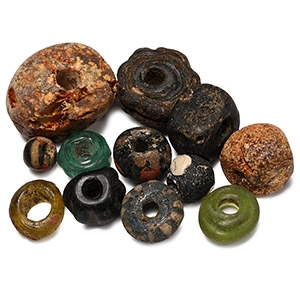
Anglo-Saxon Glass and Amber Bead Collection
Circa 5th-7th century A.D.Sold for (Inc. bp): £143
Including annular, melon and biconvex types in glass and amber. 26.6 grams total, 8-25 mm
Found Suffolk, UK. Acquired from Den of Antiquity, circa 2009. Ian Wilkinson collection, Nottinghamshire, UK, formed since 1985. This lot is accompanied by an illustrated lot declaration signed by the Head of the Antiquities Department, Dr Raffaele D’Amato.
