
Loading, please wait...
LOT 0366
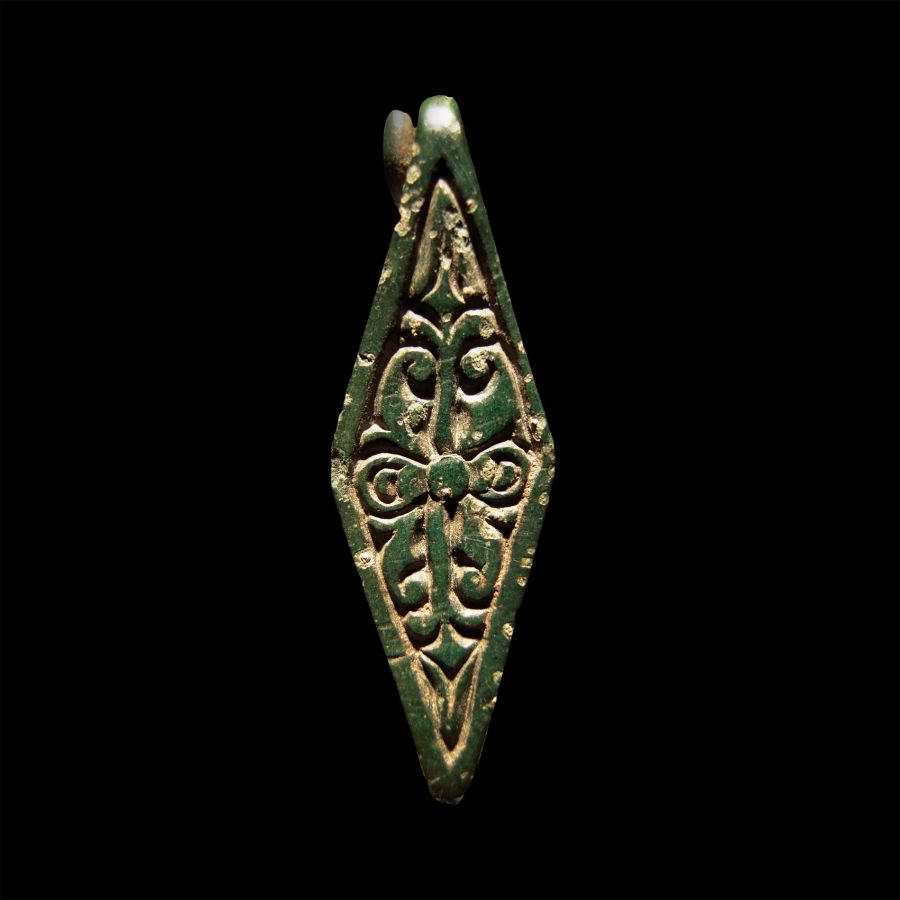
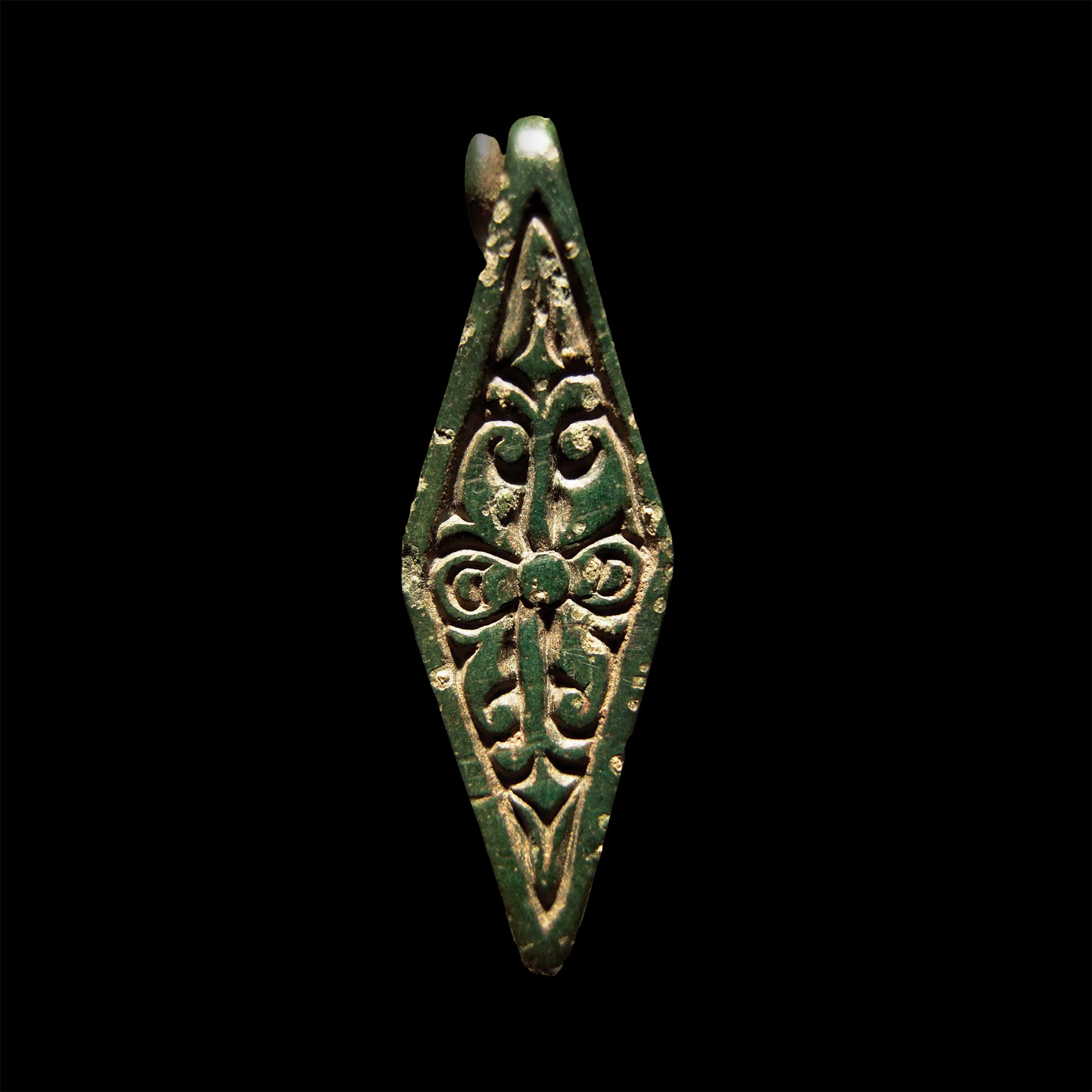
Anglo-Saxon Gilt Chip-Carved Bronze Lozengiform Brooch
EARLY 9TH CENTURY A.D.
1 5/8 in. (2.6 grams, 41 mm).
Plate brooch with integral coiled spring and stub of the pin to one end; raised border enclosing a dense panel of 'Mercian Style' foliage in high-relief with central stud.
ProvenanceEx Colchester, UK, collection, formed 1980s-1990s.
From the collection of Dirk Kennis, Belgium.
Cf. a similar lozengiform brooch in the collection of Market Hall Museum, Warwick under Accession no. 53/11726; Hammond, B., British Artefacts vol.2 - Middle Saxon & Viking, Witham, 2010 p.44-5; Weetch, R., Brooches in Late Anglo-Saxon England within a North West European Context: A Study of Social Identities Between the Eighth and Eleventh Centuries, Unpublished PhD Thesis: University of Reading, 2013.
FootnotesLozenge brooches (known as Weetch (2014) Type 31.C ) are not a frequently found type in British archaeology; the British Museum's records list only 34 such items, almost all found in the East Midlands or the Winchester area. Recorded, studied, and determined by the Secretary of State’s Expert Adviser as an object of cultural interest. The Reviewing Committee on the Export of Works of Art and Objects of Cultural Interest (RCEWA) considered an application to export this object. The Committee concluded that the object satisfied the third Waverley criterion and is therefore currently not exportable.
CONDITIONTimeLine Auctions follows a vetting process to ensure the authenticity and legality of all items, reinforcing our commitment to integrity and responsible trading. Each antiquity, antique, and coin lot undergoes thorough examination by a vetting committee of at least ten external specialists, professional trade association members, scientists, and archaeologists: Our Vetting Process
AUCTIONS:
TimeLine is a leading auction house specialising in antiquities, ancient art, collectables, natural history, coins, medals, and books. Our auctions offer museums, collectors, historians, and enthusiasts the opportunity to acquire unique and historically significant pieces.
-
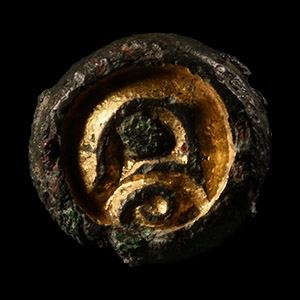
Anglo-Saxon Gilt Bronze Stud with Profile Head
Circa 6th-7th century A.D.Sold for (Inc. bp): £111
Discoid plate with rivet to the rear, chip-carved Style I head motif in profile. 2.8 grams, 13 mm
Ex David Winter collection, Kent, UK. Acquired on the UK art market in 2012. Property of a Kent lady collector. -
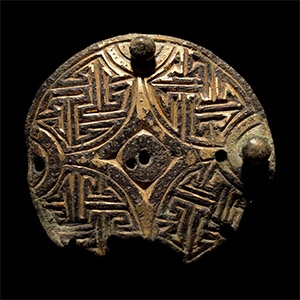
Anglo-Saxon Gilt Chip-Carved Bronze Disc Brooch
8th-early 9th century A.D.Sold for (Inc. bp): £4,680
Plate brooch with raised rim and four applied knops (two absent); central disc surrounding by four radiating arms extending to D-shaped panels at the rim where the knops are attached; the interstitial fields with dense reserved meander-pattern ornament; pierced at the centre with a second eccentrically-placed hole and another offset hole at the end of one of the 'arms'; part of the rim absent; accompanied by a custom-made display stand. 7.73 grams, 29.2 mm (29.19 grams total, 68 mm including stand)
Found Harston, Cambridgeshire, UK. Ex Essex collection formed in the 1980s. From the collection of Dirk Kennis, Belgium.
The 'key pattern' design appears in Irish and Scottish (Pictish) metalwork and carved stone such as the Nigg Stone (Ross Shire, Scotland) as well as in the borders of the Book of Kells. Recorded, studied, and determined by the Secretary of State’s Expert Adviser as an object of cultural interest. The Reviewing Committee on the Export of Works of Art and Objects of Cultural Interest (RCEWA) considered an application to export this object. The Committee concluded that the object satisfied the third Waverley criterion and is therefore currently not exportable. -
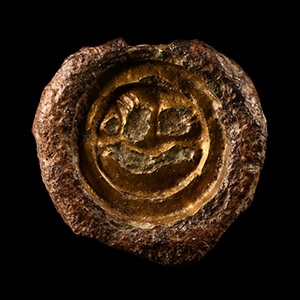
Anglo-Saxon Gilt Bronze Button Brooch with Face
Circa 6th-7th century A.D.Sold for (Inc. bp): £78
With raised border and chip-carved warrior mask motif. 3.31 grams, 19 mm
Ex David Winter collection, Kent, UK. Acquired on the UK art market in 2012. Property of a Kent lady collector.
