
Loading, please wait...
_900x900.jpg "Anglo-Saxon Gilt Bronze Pin Terminal")
_200x200.jpg "Anglo-Saxon Gilt Bronze Pin Terminal")
.jpg "Anglo-Saxon Gilt Bronze Pin Terminal")
LOT 0408
Anglo-Saxon Gilt Bronze Pin Terminal
8TH-9TH CENTURY A.D.
1 3/4 in. (10.2 grams, 46 mm).
Lozengiform in profile with voids in the spandrels and central cross with pelta finial, overlapping scaled developing to scrolls, applied stud at the central junction; lateral lugs pierced to accept connecting chains; vesica-shaped leaves to the base above bulbous junction with the pin (absent). [No Reserve]
ProvenanceFound near Cambridge, Cambridgeshire, UK.
From an old private collection of Norfolk, UK, gentleman, formed since 1998.
Accompanied by a copy of UK Detector Finds Database (UKDFD) report no.57990.
Cf. Webster, L. & Backhouse, J., The Making of England. Anglo-Saxon Art and Culture AD 600-900, London, 1991, item 184, for full set.
FootnotesDress pins of this type were worn in sets of three connected with chains or thongs.
CONDITIONTimeLine Auctions follows a vetting process to ensure the authenticity and legality of all items, reinforcing our commitment to integrity and responsible trading. Each antiquity, antique, and coin lot undergoes thorough examination by a vetting committee of at least ten external specialists, professional trade association members, scientists, and archaeologists: Our Vetting Process
AUCTIONS:
TimeLine is a leading auction house specialising in antiquities, ancient art, collectables, natural history, coins, medals, and books. Our auctions offer museums, collectors, historians, and enthusiasts the opportunity to acquire unique and historically significant pieces.
-
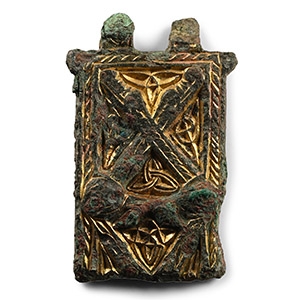
Hiberno-Saxon Gilt Bronze Buckle Plate
8th century A.D.Sold for (Inc. bp): £2,210
Rectangular in plan with hinge knuckle to one short end; ropework outer edges and raised saltires, on a field of chip-carved triskeles and other motifs; low socket to reverse. 6.62 grams, 34 mm
Found North Yorkshire, UK.
The style of decoration is typical of Hiberno-Saxon metalwork associated with the influence of Irish missionaries in England. -
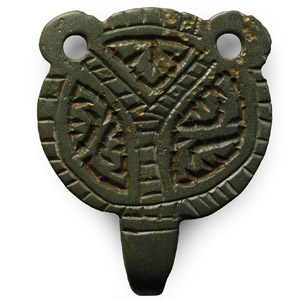
Saxon Bronze Clothes Fastener
Circa 8th century A.D.Sold for (Inc. bp): £39
Discoid plaque with lateral attachment loops, sturdy hook, Y-shaped Trewhiddle Style ornament. 1.91 grams, 23 mm
Acquired on the European art market since the early 2000s. From the private Northern Ireland collection of R.M. -
.jpg)
High-Status 'Ryedale' Anglo-Saxon Bronze Hanging Bowl with Enamelled Chip-Carved Mounts
Ryedale, North Yorkshire, 550-570 A.D.Sold for (Inc. bp): £15,600
An excessively rare and almost complete copper-alloy hanging bowl and associated fittings, comprising: (i) the bowl with three attached matching hooked escutcheons and suspension rings; (ii) the basal disc with separate frame; (iii) a body fragment (or repair patch); (iv) a curved bronze fragment; (iv) a curved copper-alloy strip (v) four skeletal fragments from a sheep or similar; accompanied by a high quality custom-made display stand. 303 grams, 19 cm (720 grams total, 23 cm including stand)
Found whilst searching with a metal detector in Ryedale, North Yorkshire, UK, on Sunday 5th February 2023 by Chris Ulliott. Accompanied by a copy of the British Museum's Portable Antiquities Scheme report no.YORYM-59523A. Accompanied by a handwritten signed letter from the finder explaining the circumstances of finding. Accompanied by a copy of a signed Art Loss Register declaration no.S00236559, dated 18th September 2023, and an Interpol search certificate dated 3 October 2023. This lot has been checked against the Interpol Database of stolen works of art and is accompanied by a search certificate number no.12441-225438.
Hanging-bowls are high-status vessels with origins in the Roman period which continued in use only in Britain and Ireland. They appear in burial contexts which date them to the sixth to late seventh century. The form of this example is paralleled by the bowl from Hadleigh Road, Ipswich, Suffolk (British Museum accession number 1984,0103.9) which has a similar shape and kite-shaped escutcheons secured by three rivets (Bruce-Mitford, 2005, Corpus No. 86).
