
Loading, please wait...
_900x900.jpg "Anglo-Saxon Gilt Bronze Pin Head with Animals")
_200x200.jpg "Anglo-Saxon Gilt Bronze Pin Head with Animals")
.jpg "Anglo-Saxon Gilt Bronze Pin Head with Animals")
LOT 1769
Anglo-Saxon Gilt Bronze Pin Head with Animals
7TH-8TH CENTURY A.D.
1 1/2 in. (4.38 grams, 37 mm).
Comprising a flat discoid head and narrow round-section shank; the head with low-relief cruciform design, zoomorphic scroll in each spandrel and central piercing to accept a stud. [No Reserve]
ProvenanceFound Weston Colville, Cambridgeshire, UK.
Acquired on the UK art market.
Cf. Webster, L. & Backhouse, J., The Making of England. Anglo-Saxon Art and Culture AD 600-900, London, 1991, item 184.
CONDITIONTimeLine Auctions follows a vetting process to ensure the authenticity and legality of all items, reinforcing our commitment to integrity and responsible trading. Each antiquity, antique, and coin lot undergoes thorough examination by a vetting committee of at least ten external specialists, professional trade association members, scientists, and archaeologists: Our Vetting Process
AUCTIONS:
TimeLine is a leading auction house specialising in antiquities, ancient art, collectables, natural history, coins, medals, and books. Our auctions offer museums, collectors, historians, and enthusiasts the opportunity to acquire unique and historically significant pieces.
-
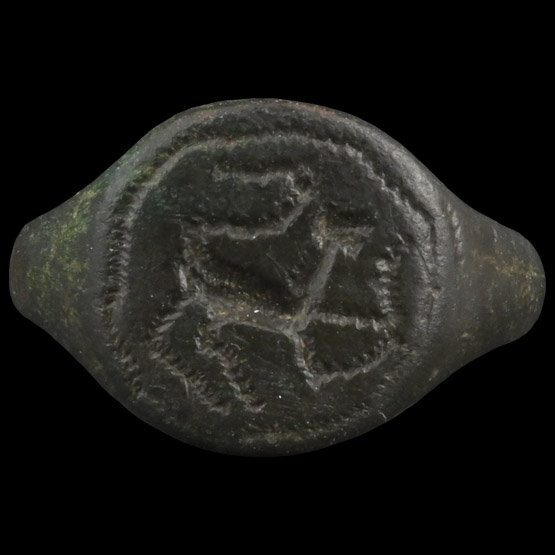
Saxon Bronze Ring with Lion
7th-8th century A.D.Sold for (Inc. bp): £111
Comprising a D-section hoop and discoid bezel with incuse lion walking right, similar to Anglo-Saxon coins of King Eadberht of Northumbria. 3.38 grams, 19.76 mm overall, 16.40 mm internal diameter (approximate size British L, USA 5 3/4, Europe 11.24, Japan 10)
Acquired on the UK and EU art market before 2000. From the private collection of a Surrey, UK, gentleman.
Although the main themes represented on the bezels of Dark Ages rings were inspired by Christian themes, sometimes images of animals were also depicted. The lions were connected with Biblical interpretations and episodes in Byzantium as well as in the West. -
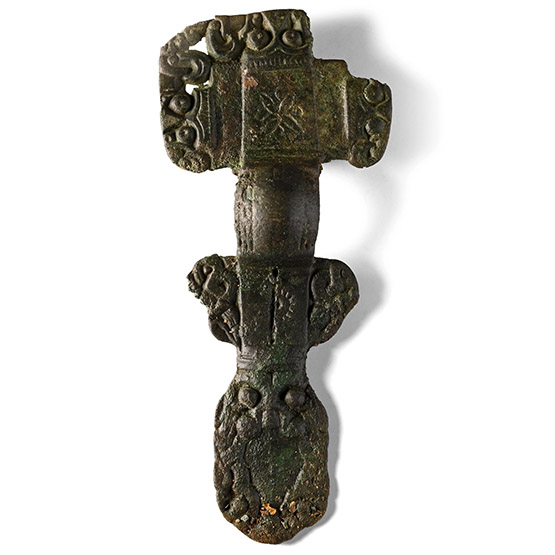
Large Anglo-Saxon Bronze Florid Cruciform Brooch
Late 5th-6th century A.D.Estimate: £600 - 800 (+bp*)
Opening Bid: £300
With highly decorative openwork border of Style I ornament to the headplate formed as a rectangular median plate with lateral wings, enhanced with punched-pellet detail to the sides and top edge of each; raised central square panel with incised rosette; to the middle of each edge a Style I human mask in plan, formed as a T-shaped brow-and-nasal with two pellet eyes, with pairs of Style I profile bird-heads with curved beaks; the bow deep with facetting at each end; the footplate rectangular with Style I lappets; transverse collar above a finial Style I human mask with complex beard below; pin-lugs and scar for catchplate to reverse. 52 grams, 12.3 cm
Found Seaham, Co Durham, UK. Property of a Durham private collector. -
.jpg)
Anglo-Saxon Bronze Applied Disc Brooch
Circa 5th-6th century A.D.Sold for (Inc. bp): £293
Discoid in plan with pin-lug, chord, pin and catch to the reverse; applied rim secured by four domed rivets; low-relief hexafoil motif with interstitial ring-and-dot motifs, segmented border. 16.9 grams, 48 mm
Found Cambridgeshire, UK. Acquired on the UK art market in the 1980s. From the private collection of an Essex gentleman.
Applied brooches are a recognised form of early Anglo-Saxon costume, associated mostly with Saxon areas such as Sussex and the Thames valley. The majority of such brooches are made up from a plain backplate with the pin and catch attached, and a thin front plate with repoussé ornament. The present example appears to be formed as a decorative body with an applied rim; there is evidence for this construction technique in the form of two unassociated rims from a grave at Fairford (Gloucestershire) (MacGregor & Bolick, item 1.39).
