
Loading, please wait...
LOT 1428
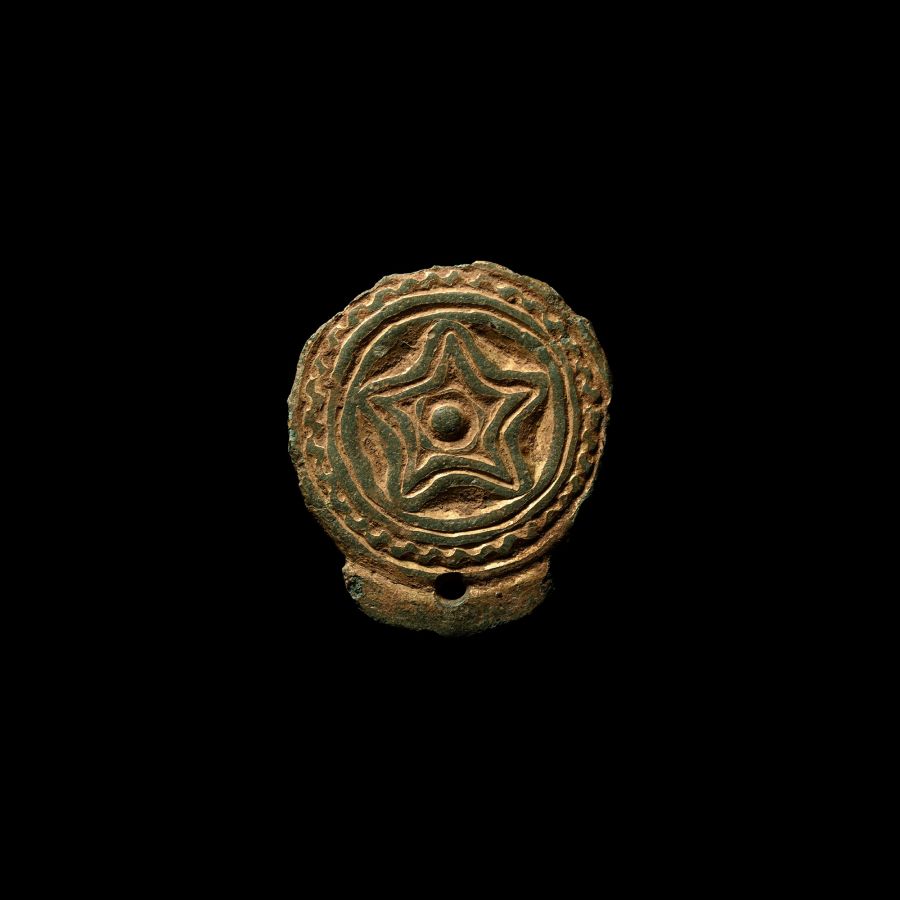
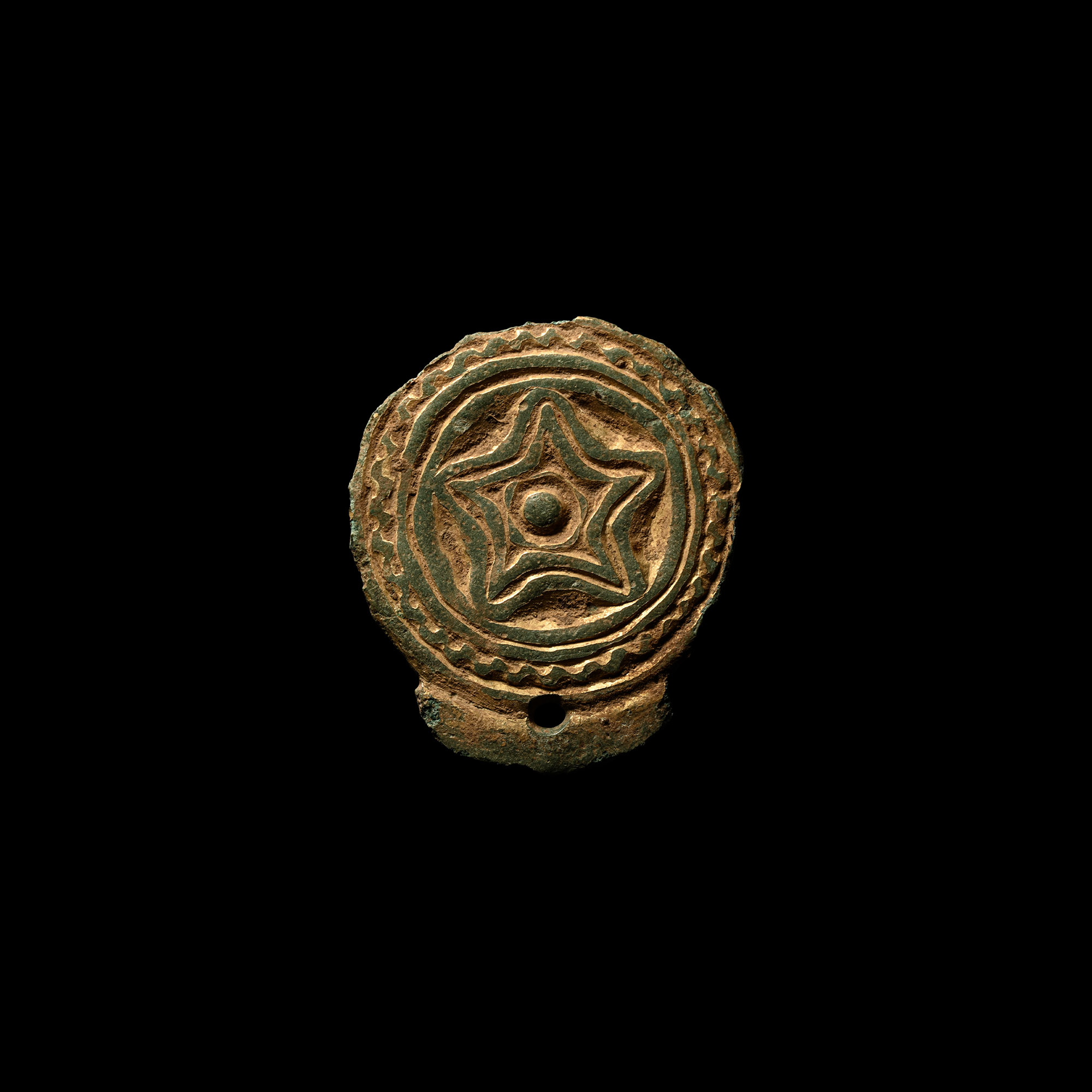
Anglo-Saxon Gilt Bronze Pendant with Star
CIRCA 6TH CENTURY A.D.
1 1/2 in. (10.4 grams, 37 mm).
Formed from a reused saucer brooch, discoid in plan with pierced lobe to apex for use as a pendant; decorated with a geometric scheme composed of a central raised boss enclosed by a five-point star, concentric circles and waves. [No Reserve]
ProvenanceFound Berkshire, UK.
Accompanied by a copy of the British Museum's Portable Antiquities Scheme (PAS) report no.BERK-72DAE0.
TimeLine Auctions follows a vetting process to ensure the authenticity and legality of all items, reinforcing our commitment to integrity and responsible trading. Each antiquity, antique, and coin lot undergoes thorough examination by a vetting committee of at least ten external specialists, professional trade association members, scientists, and archaeologists: Our Vetting Process
AUCTIONS:
TimeLine is a leading auction house specialising in antiquities, ancient art, collectables, natural history, coins, medals, and books. Our auctions offer museums, collectors, historians, and enthusiasts the opportunity to acquire unique and historically significant pieces.
-
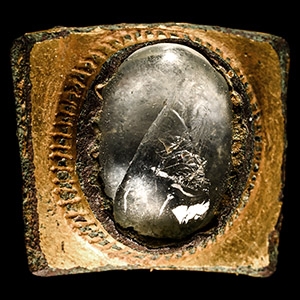
Anglo-Saxon Gilt Mount with Crystal Cabochon
6th-9th century A.D.Sold for (Inc. bp): £156
Sub-rectangular in form with raised oval cell with decoratively notched rim, set with a polished rock crystal cabochon (chipped). 15.2 grams, 23 mm
Found Lincolnshire, UK. Acquired on the UK market, 1990s. Property of a retired academic. -
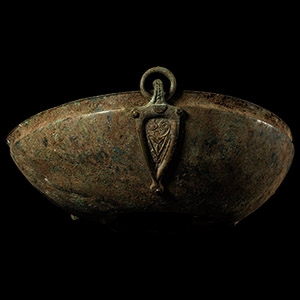
The High-Status 'Ryedale' Anglo-Saxon Bronze Hanging Bowl Complete with all Four Chip-Carved Mounts
550-700 A.D.Sold for (Inc. bp): £36,400
An excessively rare and almost complete copper-alloy hanging bowl and associated fittings comprising: (i) the bowl with three attached matching hooked escutcheons and suspension rings (ii) the basal disc (iii) a body fragment (or possible repair patch) (iv) a curved bronze fragment (ii) the basal disc with separate frame (iii) fragment of copper-alloy sheet, possibly forming part of a repair to the base of the bow (iv) a curved copper-alloy strip (iv) four skeletal fragments from a sheep or similar. 381 grams total, 3.6-20 cm
Found whilst searching with a metal detector in Ryedale, North Yorkshire, UK, on Sunday 5th February 2023 by Chris Ulliott. Accompanied by a copy of the British Museum's Portable Antiquities Scheme report no.YORYM-59523A. Accompanied by a hand written signed letter from the finder explaining the circumstances of finding. This lot has been checked against the Interpol Database of stolen works of art and is accompanied by search certificate no.11897-207827.
Hanging-bowls are high-status vessels with origins in the Roman period which continued in use only in Britain and, later, in Ireland. They appear in burial contexts which date them to the sixth to late seventh century. The form of this example is paralleled by the bowl from Hadleigh Road, Ipswich, Suffolk (British Museum accession number 1984,0103.9) which has a similar shape and kite-shaped escutcheons secured by three rivets (Bruce-Mitford, 2005, Corpus No. 86). -
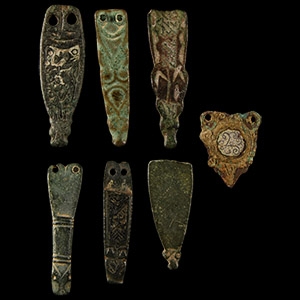
Saxon Bronze Strap End Group
7th-9th century A.D.Sold for (Inc. bp): £72
Mainly zoomorphic in form, including examples with remains of niello and enamel inlay, together with a mount displaying a central roundel featuring a geometric motif in silver inlay. 22.1 grams, 21-38 mm
Acquired on the UK market, 1990s. Property of a retired academic.
