
Loading, please wait...
_900x900.jpg "Anglo-Saxon Gilt Bronze Horse Harness Mount")
_200x200.jpg "Anglo-Saxon Gilt Bronze Horse Harness Mount")
.jpg "Anglo-Saxon Gilt Bronze Horse Harness Mount")
LOT 1173
Anglo-Saxon Gilt Bronze Horse Harness Mount
6TH-7TH CENTURY A.D.
2 in. (15.9 grams, 49 mm).
Formed with a pelta-shaped body, two attachment studs to the reverse, reserved border with raised triangular panel, beaded inner rim enclosing a chip-carved design of Style I Tiermensch motifs. [No Reserve]
ProvenanceFound near Diss, Suffolk, UK.
LiteratureCf. Carver, M., Sutton Hoo. A Seventh Century Princely Burial Ground and its Context, London, 2005, item 25a(ii), for type.
CONDITIONTimeLine Auctions follows a vetting process to ensure the authenticity and legality of all items, reinforcing our commitment to integrity and responsible trading. Each antiquity, antique, and coin lot undergoes thorough examination by a vetting committee of at least ten external specialists, professional trade association members, scientists, and archaeologists: Our Vetting Process
AUCTIONS:
TimeLine is a leading auction house specialising in antiquities, ancient art, collectables, natural history, coins, medals, and books. Our auctions offer museums, collectors, historians, and enthusiasts the opportunity to acquire unique and historically significant pieces.
LOT 1173
Anglo-Saxon Gilt Bronze Horse Harness Mount
Estimate £200 - 300€230 - 350 (for guidance only)$270 - 410 (for guidance only)
-
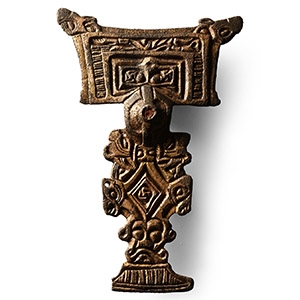
Anglo-Saxon Great Square-Headed Brooch
6th century A.D.Sold for (Inc. bp): £1,430
Comprising: trapezoidal headplate with beast-head spurs to the upper angles and concentric panels of Style I ornament; shallow bow with central cell and garnet insert; long footplate with lateral lappets and central lozenge; facing mask above a trapezoidal bar finial; pin-lugs and catch to the reverse. 82 grams, 11.5 cm
Found U.K. British private collection, acquired by 2000.
The meaning of the 'facing mask' motif is probably related to the profile masks so frequently used in Style I art, where the 'pellet' eye is enclosed by an arched frame: the 'facing mask' repeats this motif to produce a pair of eyes in a doubled 'bow'. An element of visual 'riddling' is no doubt present: the design is neither one thing nor the other, but includes elements of both. Distribution of great square-headed brooches was initially concentrated along the valleys of the Rivers Trent, Thames and Severn, though it was later confined to the East Midlands and East Anglia (Hines, 1997, figs. 101, 102). -
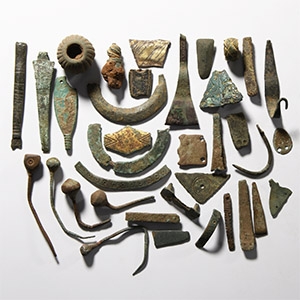
Anglo-Saxon Bronze Artefact Collection
6th-9th century A.D.Sold for (Inc. bp): £98
Comprising pins, strap ends, mounts, tweezers, brooches and others; mostly fragmentary. 117 grams total, 13-59 mm
Found Thwing, Yorkshire Wolds, UK. Acquired from the finder in 2009. Property of a Nottinghamshire gentleman. -
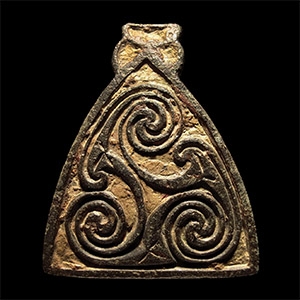
Anglo-Saxon Gilt Chip-Carved Bronze Hanging Bowl Mount
Early 9th century A.D.Sold for (Inc. bp): £2,600
Triangular mount with applied rim forming a cell and interlocking La Tène spirals to the face; hook to the apex with recesses; accompanied by a custom-made display stand. 9.11 grams, 34 mm (29.8 grams total, 59 mm including stand)
Found Haddenham near Ely, Cambridgeshire, UK. From the collection of Dirk Kennis, Belgium.
The cells on the mount were intended to be filled with coloured enamel to produce a rich polychrome effect. Recorded, studied, and determined by the Secretary of State’s Expert Adviser as an object of cultural interest. The Reviewing Committee on the Export of Works of Art and Objects of Cultural Interest (RCEWA) considered an application to export this object. The Committee concluded that the object satisfied the third Waverley criterion and is therefore currently not exportable.
