
Loading, please wait...
LOT 0326
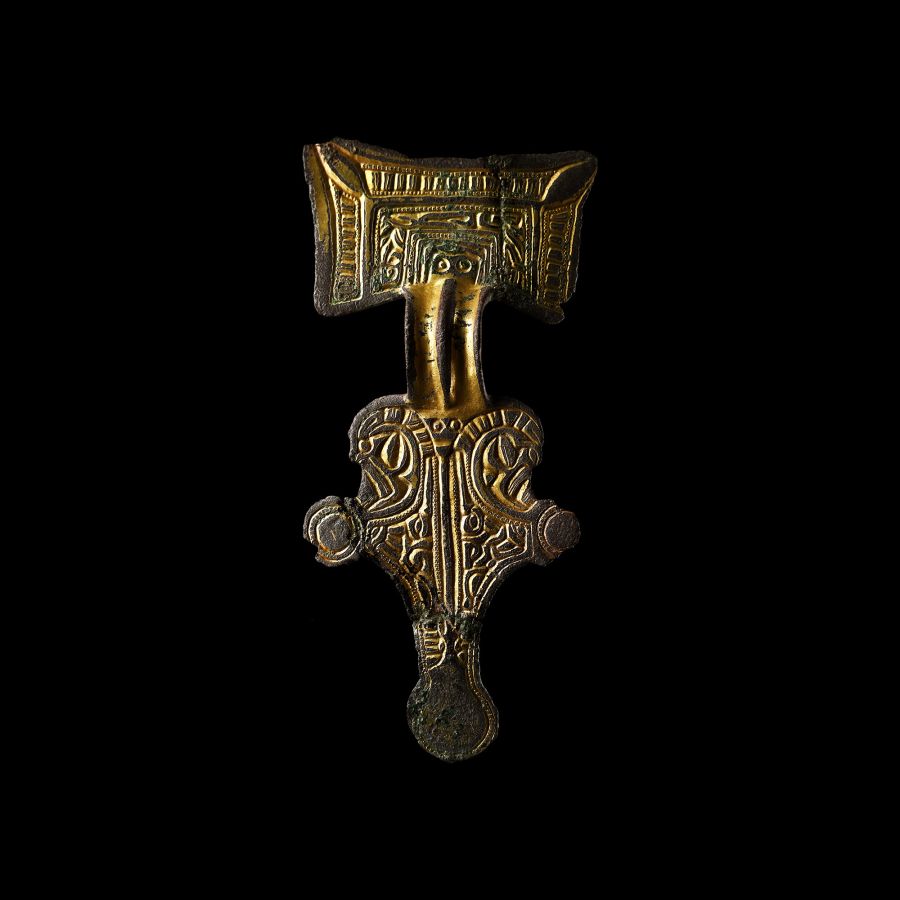
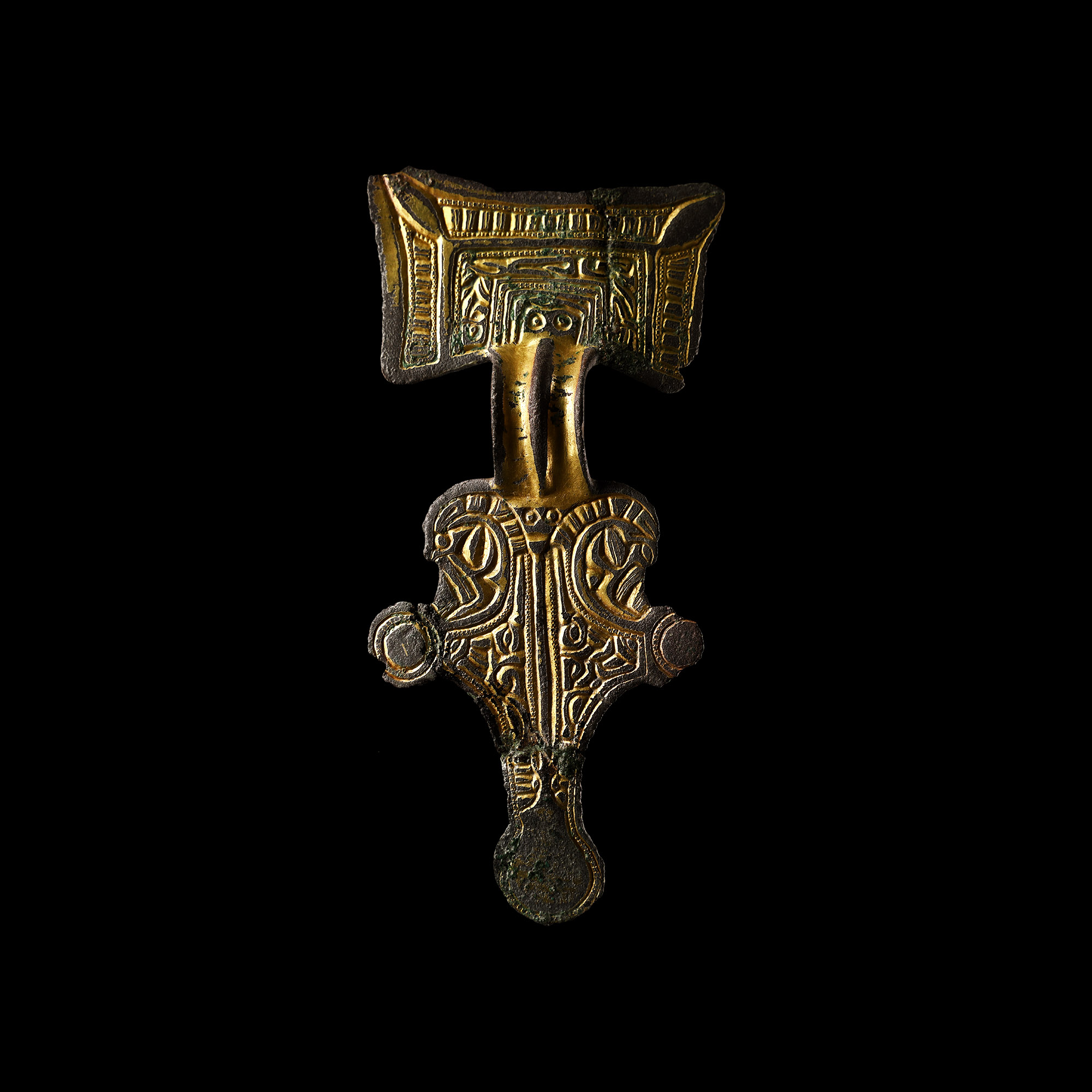
Anglo-Saxon Gilt Bronze Great Square-Headed Brooch
6TH CENTURY A.D.
5 7/8 in. (75 grams, 15 cm).
With trapezoidal headplate, shallow bow, narrow triangular foot and disc finial, pin-lugs in ferrous accretion and catch to the reverse; the headplate with angled scaphoid panels to the upper corners and band of billets enclosing a band of guilloche with Salin's Style I facing mask at the end of the bow; broad ribbed bow; lappets of Salin's Style I profile horse-heads flanking the junction of the bow with the footplate with small facing mask between the necks; vertical bar running to the finial, bisecting a cruciform panel with Salin's Style I zoomorphic forms; lateral plain lobes; finial comprising a disc connected to the vertical rib. [No Reserve]
ProvenanceFound Weston Colville, Cambridgeshire, UK.
This lot has been checked against the Interpol Database of stolen works of art and is accompanied by search certificate no.12780-239463.
This lot has been cleared against the Art Loss Register database, and is accompanied by an illustrated lot declaration signed by the Head of the Antiquities Department, Dr Raffaele D'Amato.
See Hines, J., A New Corpus of Anglo-Saxon Great Square-Headed Brooches, London, 1997, items 1(b) Alveston Manor, 32(a) Lakenheath IX (layout of headplate), 35(b) Little Wilbraham, 97a-b (Market Overton II and Beckford A11).
FootnotesThis magnificent brooch finds parallels with specimens derived from the group XVI-XVIII, according to Hines classification, from Market Overton II and Beckford A11. They represent, according to Hines, a transitional stage in the introduction of relief ornament into the headplate frame of brooches associated with group XVI.
CONDITIONTimeLine Auctions follows a vetting process to ensure the authenticity and legality of all items, reinforcing our commitment to integrity and responsible trading. Each antiquity, antique, and coin lot undergoes thorough examination by a vetting committee of at least ten external specialists, professional trade association members, scientists, and archaeologists: Our Vetting Process
AUCTIONS:
TimeLine is a leading auction house specialising in antiquities, ancient art, collectables, natural history, coins, medals, and books. Our auctions offer museums, collectors, historians, and enthusiasts the opportunity to acquire unique and historically significant pieces.
-
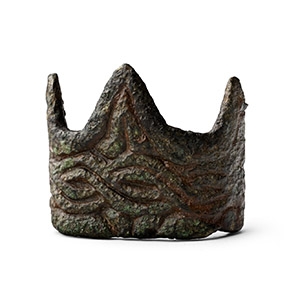
Anglo-Saxon Bronze Dagger Fitting with Interlaced Design
8th century A.D.Sold for (Inc. bp): £20
Baluster from a knife with straight lower edge and three vandykes above, low-relief knotwork motif. 9.58 grams, 26 mm
Formerly from a collection of a Berkshire gentleman, 1990s onwards. Property of a private collector, West London, UK. This lot is accompanied by an illustrated lot declaration signed by the Head of the Antiquities Department, Dr Raffaele D'Amato. -
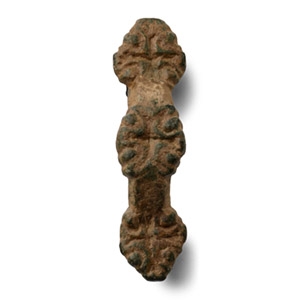
Anglo-Saxon Bronze Ansate Brooch
800-900 A.D.Sold for (Inc. bp): £33
Comprising two lozengiform feet joined by an arched bow with median plate; feet and bow decorated with raised saltire and pellets in the spandrel; pierced pin-lug and catch to reverse. 12.8 grams, 48 mm
Found Little Blakenham, Suffolk, UK. Accompanied by a copy of the British Museum's Portable Antiquities Scheme (PAS) report no.SF-4BC3AB. This lot is accompanied by an illustrated lot declaration signed by the Head of the Antiquities Department, Dr Raffaele D'Amato. -
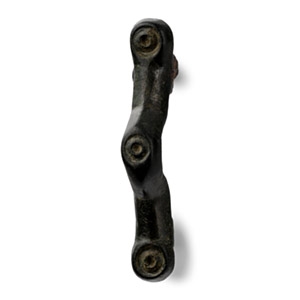
Anglo-Saxon Bronze Ansate 'Caterpillar' Brooch
8th century A.D.Sold for (Inc. bp): £39
Ansate type with U-section shank, three ring-and-dot motifs to the obverse, ferrous pin stub and catch to underside. 10.1 grams, 45 mm
Found North Yorkshire, UK. Ex UK collection. From the private collection of a Leicestershire, UK, gentleman. This lot is accompanied by an illustrated lot declaration signed by the Head of the Antiquities Department, Dr Raffaele D'Amato.
