
Loading, please wait...
LOT 0333
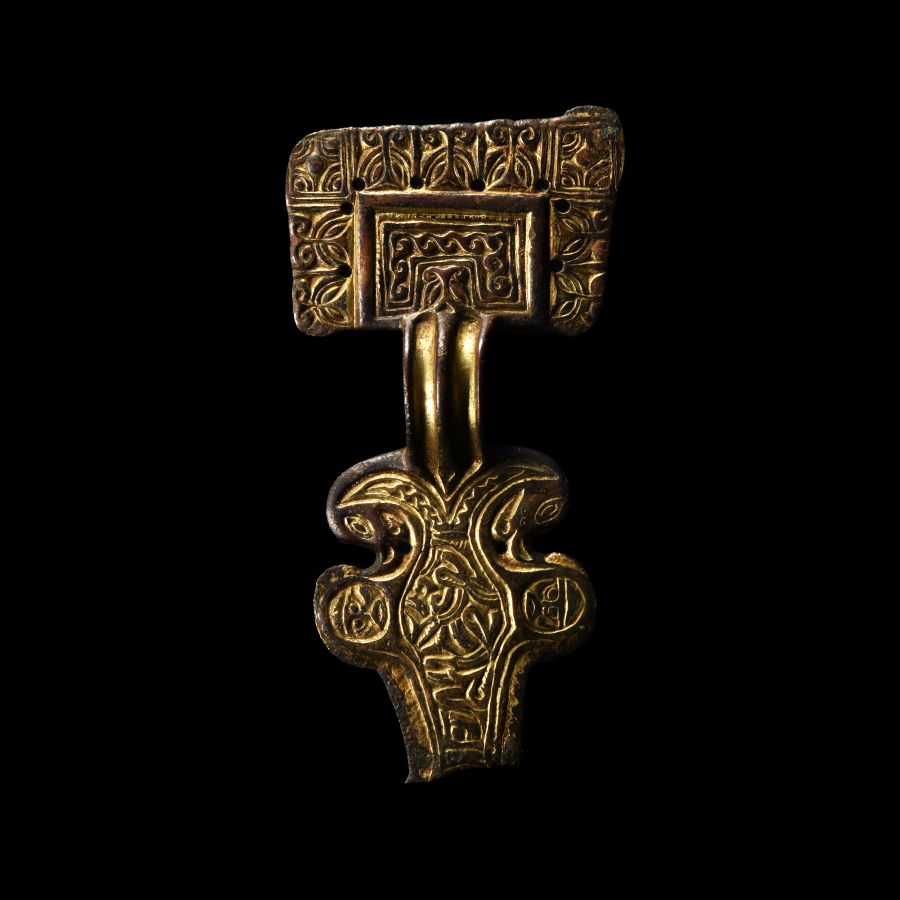
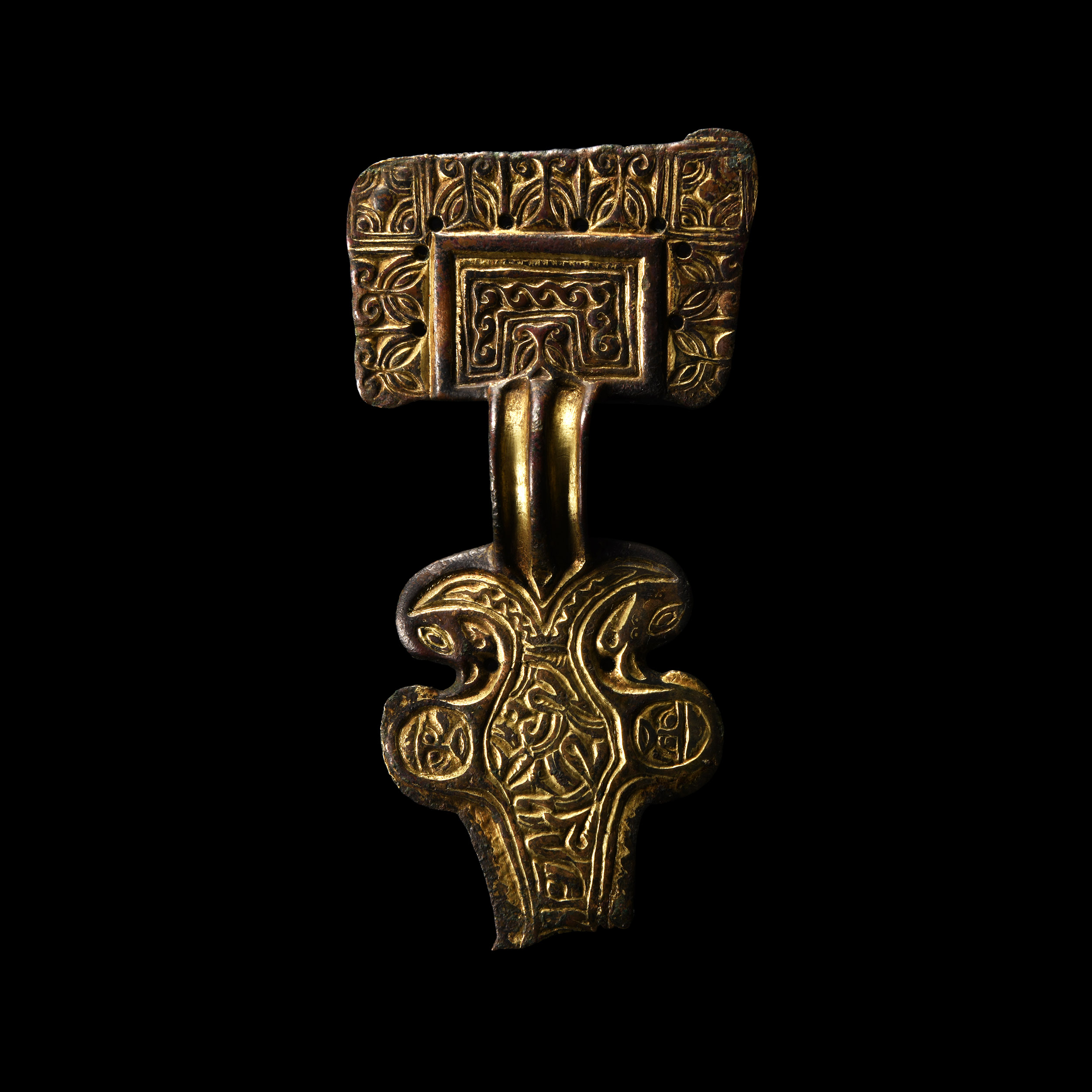
Anglo-Saxon Gilt Bronze Great Square-Headed Brooch
6TH CENTURY A.D.
4 1/2 in. (77.9 grams, 11.5 cm).
Of Hines's Group XIII with running scrolls on the headplate surrounded by a border of beast-masks, deep bow with raised ribs, curved horse-head lappets and lateral lobes with facing masks, median panel of Style I ornament; remains of ferrous pin to the reverse and deep catch; some silver detailing; finial absent.
ProvenanceFound near Thetford, Norfolk, UK, circa 2010.
LiteratureCf. Hines, J., A New Corpus of Anglo-Saxon Great Square-Headed Brooches, London, 1997, pl.42(a).
FootnotesThis brooch falls within Hines's Group XIII and shares many features with an example from Nassington, Northamptonshire. The headplate bears a raised rectangular frame (possibly silvered) separating the inner scroll motif from the outer band of animal-masks which are pierced along the inner edge; the lappets are also pierced at the point of junction with the footplate. The lateral lobes feature facing masks of a helmetted type similar to those featured on contemporary button brooches.
CONDITIONTimeLine Auctions follows a vetting process to ensure the authenticity and legality of all items, reinforcing our commitment to integrity and responsible trading. Each antiquity, antique, and coin lot undergoes thorough examination by a vetting committee of at least ten external specialists, professional trade association members, scientists, and archaeologists: Our Vetting Process
AUCTIONS:
TimeLine is a leading auction house specialising in antiquities, ancient art, collectables, natural history, coins, medals, and books. Our auctions offer museums, collectors, historians, and enthusiasts the opportunity to acquire unique and historically significant pieces.
-
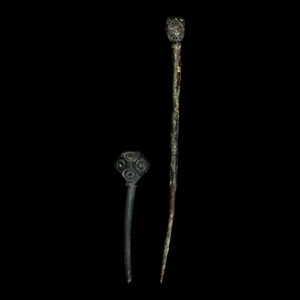
Saxon Bronze Dress Pin Group
6th-8th century A.D.Sold for (Inc. bp): £39
One complete with facetted head punched-decorated with ring-and-dot motifs; bulbous facetted pin head punch-decorated with ring-and-dot motifs, partial remains of stem. 8.2 grams total, 38-77 mm
From the collection of a North American gentleman, formed in the 1990s. -
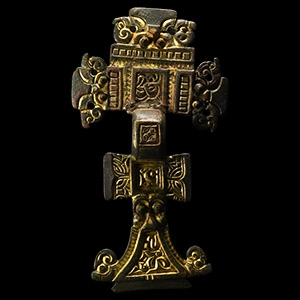
'The Scampton' Published Anglo-Saxon Gilt Bronze Florid Cruciform Brooch
6th century A.D.Sold for (Inc. bp): £11,050
Of Martin's Group 4 with rectangular headplate and florid face-masks to the three edges and conical eyes, deep bow with with square central panel, footplate with square lateral lappets, triangular face-mask finial with conical eyes; pin-lug and catchplate to the reverse; gilded surface abraded. 182 grams, 17 cm
Found Scampton, Lincolnshire, UK. From the private collection of Alan Harrison, circa 2000. This lot has been checked against the Interpol Database of stolen works of art and is accompanied by search certificate no.11898-204375.
The florid type of cruciform brooch stands at the end of the series and probably dates to the middle of the 6th century according to the most recent discussion (Martin, 2015). The present example has a close parallel in the find from Duston, Northamptonshire, which Martin assigns to his Type 4.7.1, among the very last (or most fully developed) group in the seriation. The headplate, bow and footplate each have a square panel of Style I zoomorphic ornament within a thick frame; the headplate features blocks of billeting to three edges and punched triangular ornament on the frame, which also appears on the lateral edges of the finial. The conical eyes on the facing masks are an unusual and very distinctive feature which would have made casting the brooch a technical challenge. There is some evidence for silvering on the flat rectangular surfaces (T-shaped on the headplate and rectangular on the lappets and finial). The openwork masks on the headplate develop into profile bird-heads. This brooch was recovered by a metal-detectorist in several pieces over a period of some years, and re-assembled. It was published by Leahy in his authoritative work on the Kingdom of Lindsey. -
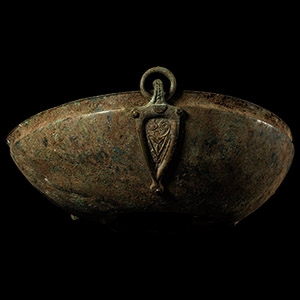
The High-Status 'Ryedale' Anglo-Saxon Bronze Hanging Bowl Complete with all Four Chip-Carved Mounts
550-700 A.D.Sold for (Inc. bp): £36,400
An excessively rare and almost complete copper-alloy hanging bowl and associated fittings comprising: (i) the bowl with three attached matching hooked escutcheons and suspension rings (ii) the basal disc (iii) a body fragment (or possible repair patch) (iv) a curved bronze fragment (ii) the basal disc with separate frame (iii) fragment of copper-alloy sheet, possibly forming part of a repair to the base of the bow (iv) a curved copper-alloy strip (iv) four skeletal fragments from a sheep or similar. 381 grams total, 3.6-20 cm
Found whilst searching with a metal detector in Ryedale, North Yorkshire, UK, on Sunday 5th February 2023 by Chris Ulliott. Accompanied by a copy of the British Museum's Portable Antiquities Scheme report no.YORYM-59523A. Accompanied by a hand written signed letter from the finder explaining the circumstances of finding. This lot has been checked against the Interpol Database of stolen works of art and is accompanied by search certificate no.11897-207827.
Hanging-bowls are high-status vessels with origins in the Roman period which continued in use only in Britain and, later, in Ireland. They appear in burial contexts which date them to the sixth to late seventh century. The form of this example is paralleled by the bowl from Hadleigh Road, Ipswich, Suffolk (British Museum accession number 1984,0103.9) which has a similar shape and kite-shaped escutcheons secured by three rivets (Bruce-Mitford, 2005, Corpus No. 86).
