
Loading, please wait...
_900x900.jpg "Anglo-Saxon Gilt Bronze Double-Axe Shield Mount")
_200x200.jpg "Anglo-Saxon Gilt Bronze Double-Axe Shield Mount")
.jpg "Anglo-Saxon Gilt Bronze Double-Axe Shield Mount")
LOT 1339
Anglo-Saxon Gilt Bronze Double-Axe Shield Mount
6TH-7TH CENTURY A.D.
1 3/4 in. (7.5 grams, 45 mm).
With lozengiform central element and T-shaped 'axe' extensions; the lozenge with three-band collars, punched bands to the edges and central quatrefoil motif with pellets to the ends; two thick mounting lugs to the reverse, one with its mounting rove in place.
ProvenanceFound Hertfordshire, UK.
LiteratureSee Dickinson, T.M., 'Symbols of Protection: The Significance of Animal-Ornamented Shields in Early Anglo-Saxon England' in Med.Arch. vol. XLIX, 2005, pp.109-163, fig.13,e; Hammond, B., British Artefacts vol.1 - Early Anglo-Saxon, Witham, 2009, p.75-81, for discussion.
FootnotesThe mount belongs to the typology of symmetrically-shaped fittings with lozengiform or ovoid body. Comparisons might be made with a pair of bichrome fittings from a shield in Sleaford 136. Their ridged, gilded and punched bodies are not unlike that of the Sutton Hoo 018, 868 aquatic mount, but both their originally terminals are triangular or trapezoidal. They are therefore purely geometric, though it is a moot point whether a zoomorphic (aquatic) appearance was intended or given.
CONDITIONTimeLine Auctions follows a vetting process to ensure the authenticity and legality of all items, reinforcing our commitment to integrity and responsible trading. Each antiquity, antique, and coin lot undergoes thorough examination by a vetting committee of at least ten external specialists, professional trade association members, scientists, and archaeologists: Our Vetting Process
AUCTIONS:
TimeLine is a leading auction house specialising in antiquities, ancient art, collectables, natural history, coins, medals, and books. Our auctions offer museums, collectors, historians, and enthusiasts the opportunity to acquire unique and historically significant pieces.
-
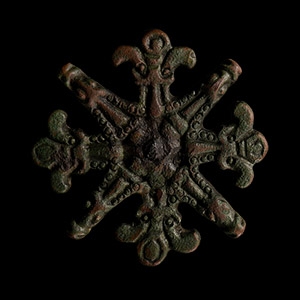
Anglo-Saxon Bronze Shield Mount with Animal Masks and Beast Heads
6th century A.D.Estimate: £800 - 1,000 (+bp*)
Opening Bid: £320
The eight arms arranged with alternating trefoil and tapering terminals, the trilobate arms formed as animal masks, the tapering arms as dragon-heads, all with stylised detailing in relief; punched circlets to the field; some remains of mounting lug to reverse centre. 68 grams, 54 mm
Found Norfolk, UK. From an East Anglian private collection. -
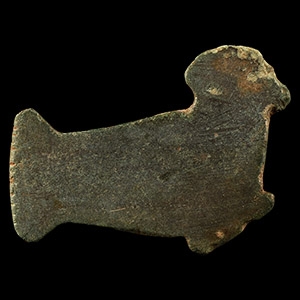
Anglo-Saxon Tinned Bronze Bird Brooch
5th-6th century A.D.Sold for (Inc. bp): £78
Displayed in profile facing right; remains of tinning; remains of pin lug and catchplate to reverse. 5.9 grams, 29 mm
Found Berkshire, UK. Accompanied by a copy of the British Museum's Portable Antiquities Scheme (PAS) report no.BERK-9B6095. -
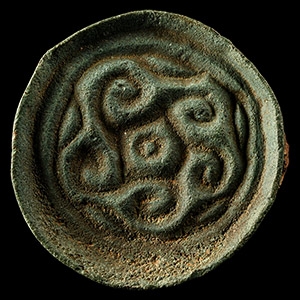
Anglo-Saxon Bronze Saucer Brooch
5th-6th century A.D.Sold for (Inc. bp): £91
Decorated with five spirals emanating from a central ring-and-dot motif, enclosed within a circumferential border; remains of catchplate to reverse. 12 grams, 26 mm
Found Berkshire, UK. Accompanied by a copy of the British Museum's Portable Antiquities Scheme (PAS) report no.BERK-A6EC93.
