
Loading, please wait...
_900x900.jpg "Anglo-Saxon Gilt-Bronze Button Brooch")
_200x200.jpg "Anglo-Saxon Gilt-Bronze Button Brooch")
.jpg "Anglo-Saxon Gilt-Bronze Button Brooch")
LOT 1910
Anglo-Saxon Gilt-Bronze Button Brooch
6TH CENTURY A.D.
3 7/8 in. (20.9 grams total, 98 mm including satand).
Gilt disc brooch of Avent & Evison's Class Ai with carinated inner border and mask, pin-lug and catch to the reverse; mounted on a custom-made display stand.
ProvenanceEx Kai Schmidt, Cologne, Germany, 1960s-1980s.
Accompanied by a copy of an Art Loss Register certificate no.S00086755.
This lot is accompanied by an illustrated lot declaration signed by the Head of the Antiquities Department, Dr Raffaele D’Amato.
Cf. Avent, R. & Evison, V.I., Anglo-Saxon Button Brooches in Archaeologia, vol.CVII, 1982, p.78.
CONDITIONTimeLine Auctions follows a vetting process to ensure the authenticity and legality of all items, reinforcing our commitment to integrity and responsible trading. Each antiquity, antique, and coin lot undergoes thorough examination by a vetting committee of at least ten external specialists, professional trade association members, scientists, and archaeologists: Our Vetting Process
AUCTIONS:
TimeLine is a leading auction house specialising in antiquities, ancient art, collectables, natural history, coins, medals, and books. Our auctions offer museums, collectors, historians, and enthusiasts the opportunity to acquire unique and historically significant pieces.
-
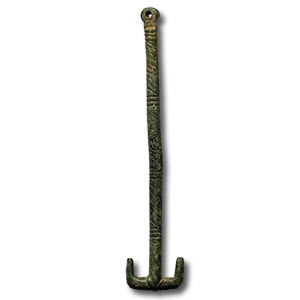
Anglo-Saxon Bronze Miniature Girdle Hanger Pendant
Circa 6th century A.D.Sold for (Inc. bp): £20
With round-section hatched shank and T-shaped finial with swept wings. 6.19 grams, 71 mm
Found Lincolnshire, UK. From an old private collection of Norfolk, UK, gentleman, formed since 1998. From a Leicestershire, UK, collection. This lot is accompanied by an illustrated lot declaration signed by the Head of the Antiquities Department, Dr Raffaele D’Amato. -
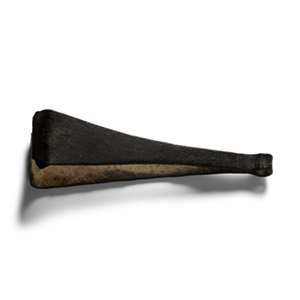
Large Anglo-Saxon Bronze Tweezers
6th-8th century A.D.Sold for (Inc. bp): £20
With tapering arms and inturned blades. 14.5 grams, 78 mm
Found Southern England. Acquired from Alan Cherry, Bournemouth, UK, circa 2003. Ian Wilkinson collection, Nottinghamshire, UK, formed since 1985. This lot is accompanied by an illustrated lot declaration signed by the Head of the Antiquities Department, Dr Raffaele D’Amato. -
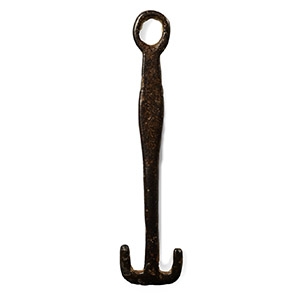
Anglo-Saxon Bronze Girdle Hanger Pendant
Late 5th-early 6th century A.D.Sold for (Inc. bp): £7
A T-shaped 'key' comprising a shank with flat, oval attachment loop at the upper end and a T-shaped terminal with swept wings at the lower end. 19.6 grams, 10.2 cm
Found whilst searching with a metal detector near Garton, East Riding of Yorkshire, UK, circa 2019. From a Leicestershire, UK, collection. Accompanied by a copy of the British Museum's Portable Antiquities Scheme (PAS) report no.YORYM-84E0BD. This lot is accompanied by an illustrated lot declaration signed by the Head of the Antiquities Department, Dr Raffaele D’Amato.
