
Loading, please wait...
LOT 1233
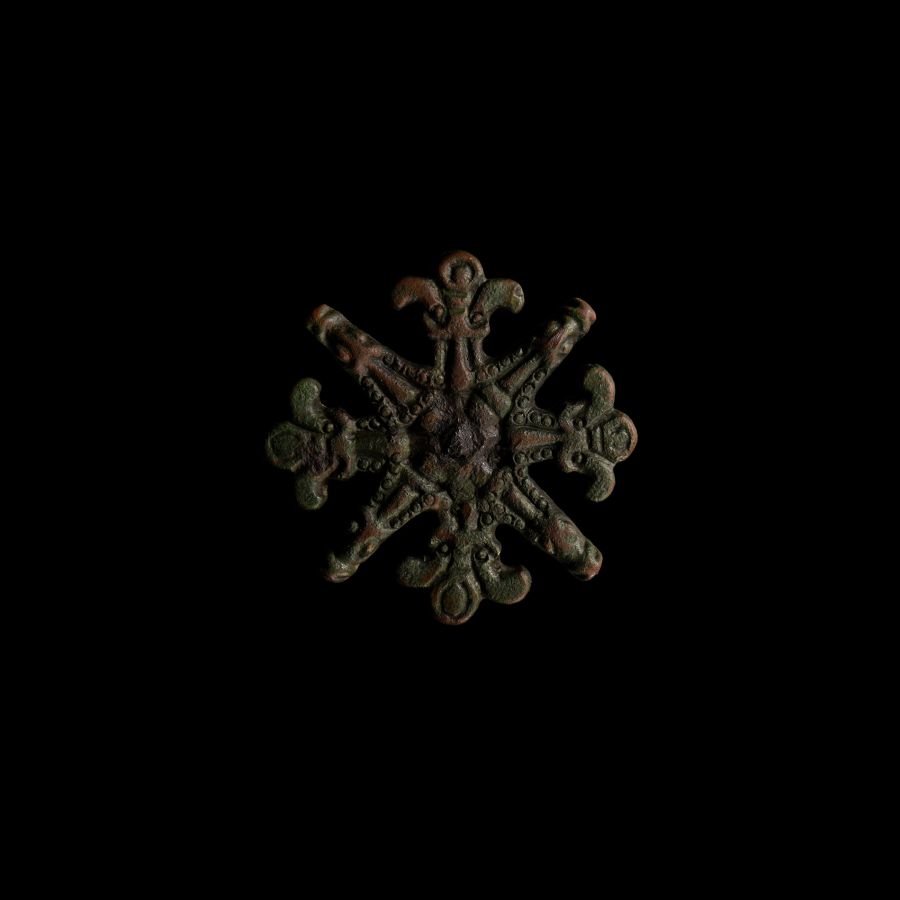
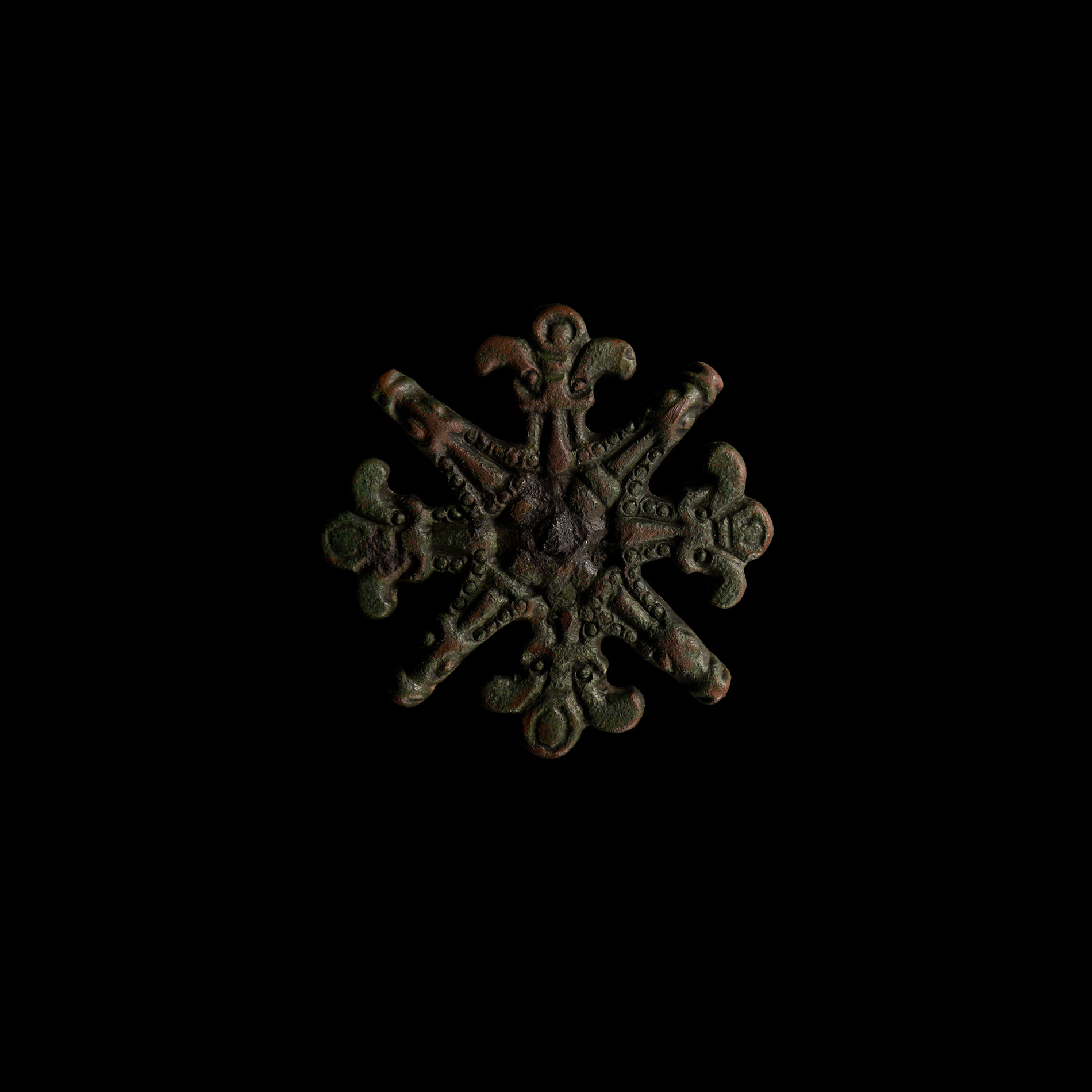
Anglo-Saxon Bronze Shield Mount with Animal Masks and Beast Heads
6TH CENTURY A.D.
2 1/8 in. (68 grams, 54 mm).
The eight arms arranged with alternating trefoil and tapering terminals, the trilobate arms formed as animal masks, the tapering arms as dragon-heads, all with stylised detailing in relief; punched circlets to the field; some remains of mounting lug to reverse centre.
ProvenanceFound Norfolk, UK.
From an East Anglian private collection.
TimeLine Auctions follows a vetting process to ensure the authenticity and legality of all items, reinforcing our commitment to integrity and responsible trading. Each antiquity, antique, and coin lot undergoes thorough examination by a vetting committee of at least ten external specialists, professional trade association members, scientists, and archaeologists: Our Vetting Process
AUCTIONS:
TimeLine is a leading auction house specialising in antiquities, ancient art, collectables, natural history, coins, medals, and books. Our auctions offer museums, collectors, historians, and enthusiasts the opportunity to acquire unique and historically significant pieces.
LOT 1233
Anglo-Saxon Bronze Shield Mount with Animal Masks and Beast Heads
Estimate £600 - 800€700 - 930 (for guidance only)$810 - 1,080 (for guidance only)
-
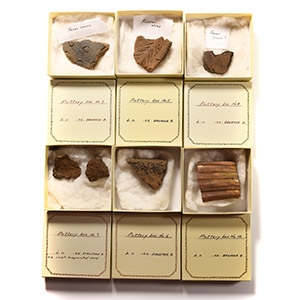
Anglo-Saxon Pottery Sherd Group
6th century A.D. and laterSold for (Inc. bp): £104
Group comprising six numbered and annotated card boxes each with a sherd from Bagmoor or Dialstone; each piece with inked reference number. 264 grams total, 36-48 mm
Found Bagmoor, Lincolnshire and Dialstone, near Stockport, UK. -
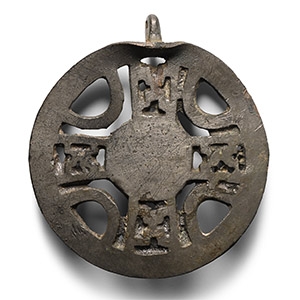
Anglo-Saxon Tinned Bronze Openwork Horse Harness Mount
Late 5th-early 6th century A.D.Sold for (Inc. bp): £234
Disc mount with four pierced lugs to the reverse, openwork design with four radiating U-shaped elements between the arms of a cross with T-shaped voids. 26.1 grams, 57 mm
Found Southern England. Acquired on the UK art market in the 1980s. From an East Anglian private collection.
The 'zoned' layout of the piece strongly recalls some of the design elements in Kentish disc brooches, where the cells contain inlaid garnets, millefiori glass, meerschaum and other materials (see Arrhenius, B., Merovingian Garnet Jewellery, Stockholm, 1985, figs. 188-193). -
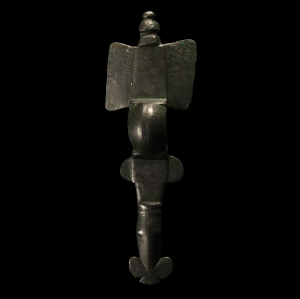
Large Anglo-Saxon Bronze Cruciform Bow Brooch
Late 5th-early 6th century A.D.Estimate: £180 - 240 (+bp*)
Opening Bid: £100
Of Martin's Type 3.2.4 (Holywell Row) featuring a trapezoidal headplate with lateral trapezoidal panels, domed knop above; deep bow with facetted ends, T-shaped footplate with lateral lappets, horse-head finial with discoid nostrils; complete ferrous pin and catchplate to the reverse, hollowed reverse to the horse-head. 71 grams, 13.5 cm
Acquired circa 1995. From an East Anglian private collection.
The Holywell Row type in Martin's analysis extends from the northern shore of the Thames Estuary as far as Yorkshire, but with a cluster in the Cambridge area. The edges of the headplate show the faintest traces of punched detailing, if this is not the result of the original clean-up when the brooch was taken from its mould; similar marks can be discerned on the footplate below the junction with the bow. The finial shows little zoomorphic detailing but the nostrils are characteristic of the type. The presence of the pin is remarkable.
