
Loading, please wait...
LOT 0319
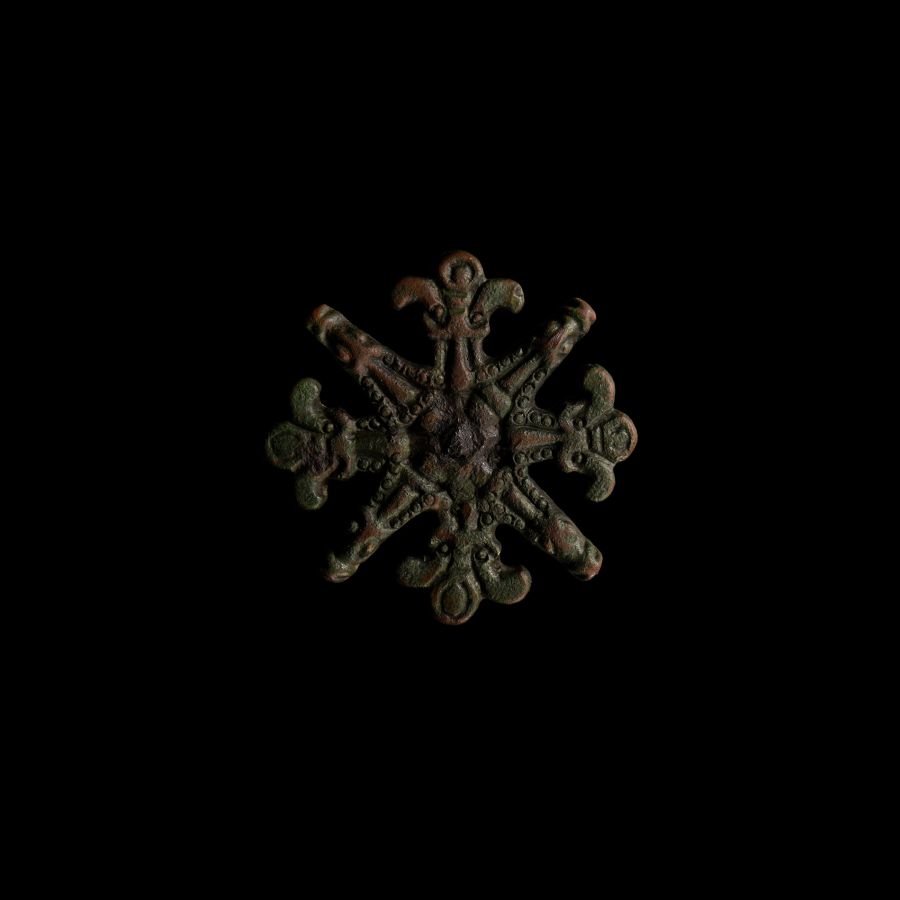
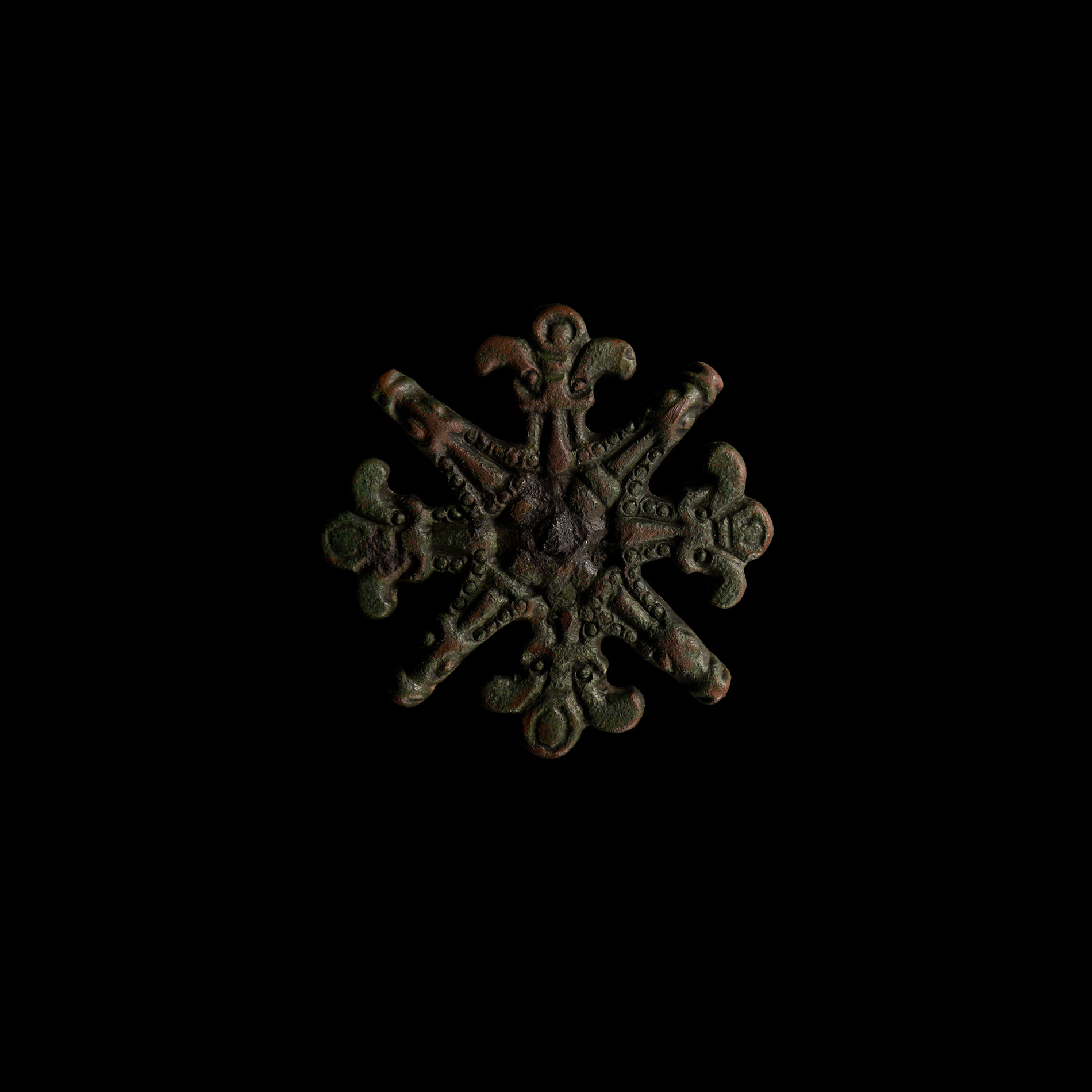
Anglo-Saxon Bronze Shield Mount with Animal Masks and Beast Heads
6TH CENTURY A.D.
2 1/8 in. (68 grams, 54 mm).
The eight arms arranged with alternating trefoil and tapering terminals, the trilobate arms formed as animal masks, the tapering arms as dragon-heads, all with stylised detailing in relief; punched circlets to the field; some remains of mounting lug to reverse centre.
ProvenanceFound Norfolk, UK.
From an East Anglian private collection.
TimeLine Auctions follows a vetting process to ensure the authenticity and legality of all items, reinforcing our commitment to integrity and responsible trading. Each antiquity, antique, and coin lot undergoes thorough examination by a vetting committee of at least ten external specialists, professional trade association members, scientists, and archaeologists: Our Vetting Process
AUCTIONS:
TimeLine is a leading auction house specialising in antiquities, ancient art, collectables, natural history, coins, medals, and books. Our auctions offer museums, collectors, historians, and enthusiasts the opportunity to acquire unique and historically significant pieces.
LOT 0319
Anglo-Saxon Bronze Shield Mount with Animal Masks and Beast Heads
Estimate £800 - 1,000€930 - 1,160 (for guidance only)$1,080 - 1,350 (for guidance only)
-
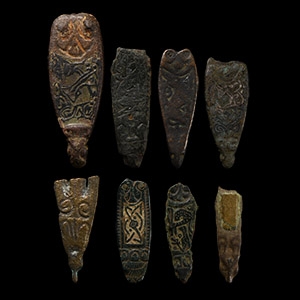
Saxon Bronze Strap End Collection
Circa 8th century A.D.Sold for (Inc. bp): £124
Comprising mainly Thomas's Class A Type 1, some with beast-head finial. 45 grams total, 30-49 mm
From the collection of a North American gentleman, formed in the 1990s. -
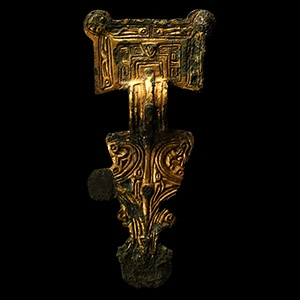
Anglo-Saxon Gilt Bronze Great Square-Headed Brooch
6th century A.D.Sold for (Inc. bp): £910
Of Hines's Group X with rectangular headplate featuring low-relief bird-heads and a raised piriform mask to each upper corner; shallow bow with raised ribs and a stud to the centre; triangular footplate with coiled horse-head lappets forming the shoulders, lateral lobes (one detached) with sheet-silver surface, inverted facing mask to the finial; remains of ferrous pin and catch to the reverse. 100 grams, 14.5 cm
Found near March, Cambridgeshire, UK, circa 2015.
A close match to the features of the March brooch is not recorded in Hines's corpus, but the very distinctive isosceles triangle footplate with sharp shoulders appears on the example from Little Wilbraham, Cambridgeshire (Hines's pl.33(b). The facing masks in the upper corners of the headplate also appear on an example from Driffield (Hines, 1997, pl.82(a). -
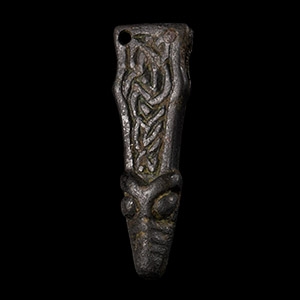
Anglo-Saxon Bronze Zoomorphic Strap End
9th century A.D.Sold for (Inc. bp): £182
Split along the upper edge of the plate; two slight flared lobes below the piercings for the attachment rivets; central panel ornamented with a length of tight interlaced knotwork and a zoomorphic terminal with triangular ears, bulbous eyes and a ribbed square snout. 8.44 grams, 37 mm
Found Sheffield, South Yorkshire, UK.
Both the interlace and the animal-head are drawn from the 7th-8th century manuscript tradition. This is a standard 9th century typology, seeming a nice version of the Trewhiddle style, closely allied to the early 9th century 'Tiberius' group of manuscripts, characterised by exuberant animals which are the descendants of the winged creatures and other sprightly beasts common in 8th century metalworks.
