Loading, please wait...

Use mousewheel to zoom in and out, click to enlarge

Details

LOT 1412

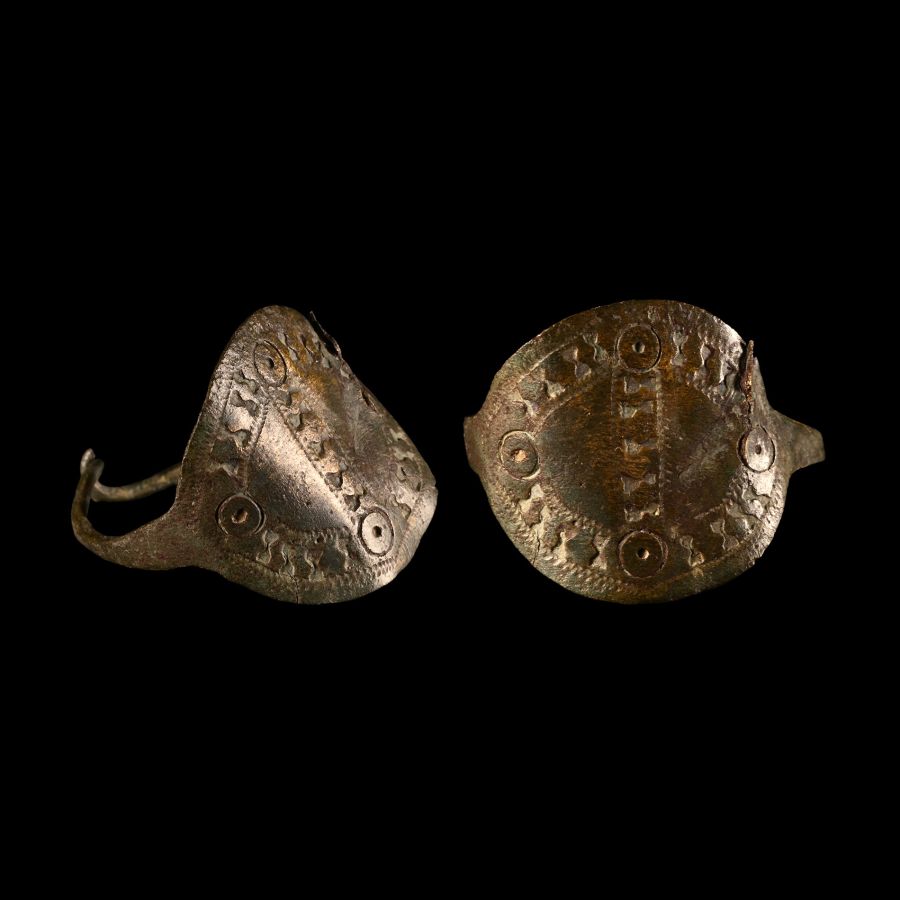
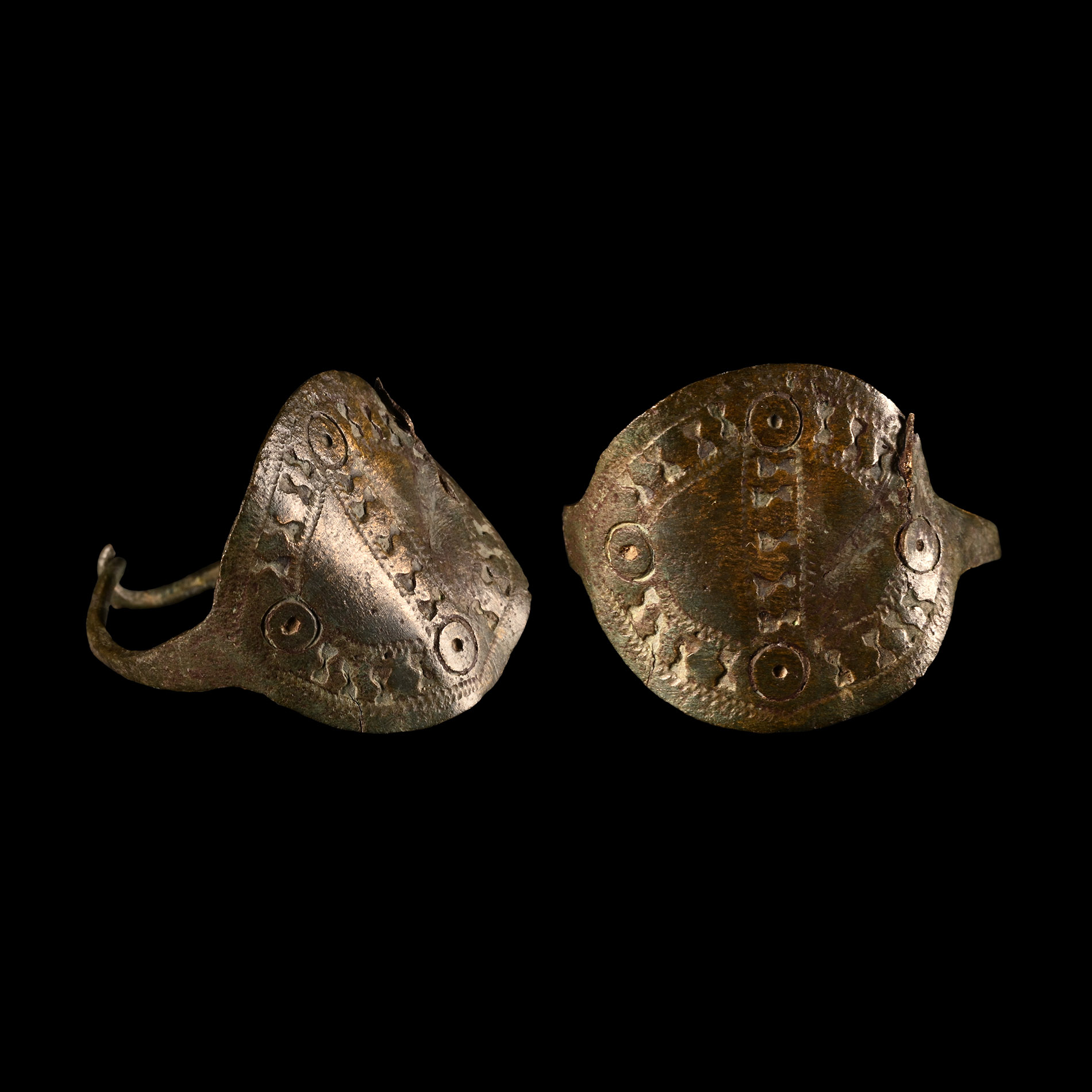
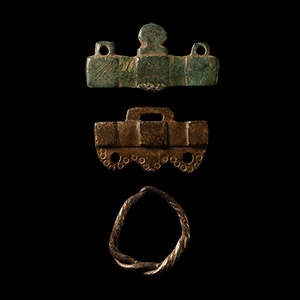
Anglo-Saxon Bronze Ring with Punched Motifs

6TH CENTURY A.D.

1 in. (1.77 grams, 23.99 mm overall, 19.50 mm internal diameter (approximate size British P, USA 7 1/2, Europe 16.23, Japan 15)).

Formed with a slender hoop overlapping and coiled at the centre, the discoid bezel with punched bow tie and ring-and-dot motifs. [No Reserve]

Provenance

From a Norfolk excavation in the late 19th century.
Ex property of a Nottingham gentleman by descent.

CONDITION

VETTING:

TimeLine Auctions follows a vetting process to ensure the authenticity and legality of all items, reinforcing our commitment to integrity and responsible trading. Each antiquity, antique, and coin lot undergoes thorough examination by a vetting committee of at least ten external specialists, professional trade association members, scientists, and archaeologists: Our Vetting Process


AUCTIONS:

TimeLine is a leading auction house specialising in antiquities, ancient art, collectables, natural history, coins, medals, and books. Our auctions offer museums, collectors, historians, and enthusiasts the opportunity to acquire unique and historically significant pieces.

LOT 1412

Anglo-Saxon Bronze Ring with Punched Motifs

Sold for (Inc. bp): £59

Print page

RELATED LOTS

  • Saxon Iron Artefact Collection
    Saxon Iron Artefact Collection
    Circa 6th-7th century A.D.

    Sold for (Inc. bp): £65

    Comprising a straight cutting edge battle knife with a short tang; a shorter slender cutting edge battle knife with long tang; three small hunting knives; an iron ring and a possible javelin head. 708 grams total, 8.7-38 cm


    UK gallery, early 2000s.

    Battle knives are common in 6th -7th century Anglo-Saxon graves. They were, when not used, kept in their sheath and suspended from the belt by a detachable strap with a buckle.

    Lot Details

  • Anglo-Saxon Large Bronze Cruciform Bow Brooch
    Anglo-Saxon Large Bronze Cruciform Bow Brooch
    Late 5th-early 6th century A.D.

    Estimate: £350 - 450 (+bp*)

    Opening Bid: £140

    Of Martin's Type 3.2.4 (Holywell Row) featuring a trapezoidal headplate with lateral trapezoidal panels, domed knop above; deep bow with facetted ends, T-shaped footplate with lateral lappets, horse-head finial with discoid nostrils; complete ferrous pin and catchplate to the reverse, hollowed reverse to the horse-head. 71 grams, 13.5 cm


    Acquired circa 1995. From an East Anglian private collection.

    The Holywell Row type in Martin's analysis extends from the northern shore of the Thames Estuary as far as Yorkshire, but with a cluster in the Cambridge area. The edges of the headplate show the faintest traces of punched detailing, if this is not the result of the original clean-up when the brooch was taken from its mould; similar marks can be discerned on the footplate below the junction with the bow. The finial shows little zoomorphic detailing but the nostrils are characteristic of the type. The presence of the pin is remarkable.

    Lot Details

  • Published Anglo-Saxon Gilt Bronze Great Square-Headed Brooch
    Published Anglo-Saxon Gilt Bronze Great Square-Headed Brooch
    6th century A.D.

    Sold for (Inc. bp): £3,640

    Of Hines's Group I with border of facing masks to the headplate, two discs within incised frames and raised mask between; shallow bow with three ribs, the median one with a central boss and extending to a small beast-head between the curled horse-head lappets; lozenge-shaped footplate with ropework border and facing bearded mask, lateral lobes and lobe finial with an inverted facing mask; applied silver-sheet detailing to the edges of the footplate; remains of pin-lugs and catch to the reverse. 114 grams, 14.5 cm


    Found Scampton, Lincolnshire, UK. From the private collection of Alan Harrison, circa 2000. This lot has been checked against the Interpol Database of stolen works of art and is accompanied by search certificate no.11900-204376.

    An exact parallel for the Scampton brooch is not known, as is typical for these hand-items made by lost-wax casting processes in one-piece moulds. The brooch falls within Hines's Group I and shares many features with an example from Bidford-on-Avon, Warwickshire (Hines, 1997, no.13) although the latter has a Style I panel on the headplate whereas the Scampton example features two raised discs within incised squares, a feature also found on finds from Duston (and Linton Heath (Hines, 1997, pl.11)). This brooch was recovered by a metal-detectorist in several pieces over a period of some years, and re-assembled. It was published by Leahy in his authoritative work on the Kingdom of Lindsey.

    Lot Details

Stay up-to-date with the latest from TimeLine Auctions by joining our mailing list