
Loading, please wait...
_900x900.jpg "Anglo-Saxon Bronze Girdle Hanger")
_200x200.jpg "Anglo-Saxon Bronze Girdle Hanger")
.jpg "Anglo-Saxon Bronze Girdle Hanger")
LOT 1195
Anglo-Saxon Bronze Girdle Hanger
LATE 5TH-EARLY 6TH CENTURY A.D.
4 in. (19.6 grams, 10.3 cm).
A T-shaped 'key' consisting of a central stem with a flat, oval attachment loop at the upper end and a T-shaped or W-shaped terminal at the lower end, formed from two prongs. [No Reserve]
ProvenanceFound whilst searching with a metal detector near Garton, East Riding of Yorkshire, UK, circa 2019.
Accompanied by a copy of the British Museum's Portable Antiquities Scheme (PAS) report no.YORYM-84E0BD.
Cf. Hammond, Brett, British Artefacts, Volume 1 - Early Anglo-Saxon, Witham, 2009, p.97, fig1.9-c to g.
CONDITIONTimeLine Auctions follows a vetting process to ensure the authenticity and legality of all items, reinforcing our commitment to integrity and responsible trading. Each antiquity, antique, and coin lot undergoes thorough examination by a vetting committee of at least ten external specialists, professional trade association members, scientists, and archaeologists: Our Vetting Process
AUCTIONS:
TimeLine is a leading auction house specialising in antiquities, ancient art, collectables, natural history, coins, medals, and books. Our auctions offer museums, collectors, historians, and enthusiasts the opportunity to acquire unique and historically significant pieces.
-
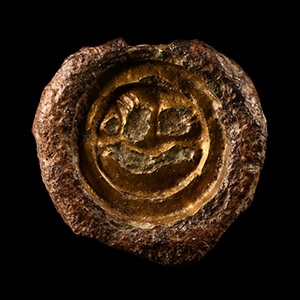
Anglo-Saxon Gilt Bronze Button Brooch with Face
Circa 6th-7th century A.D.Sold for (Inc. bp): £78
With raised border and chip-carved warrior mask motif. 3.31 grams, 19 mm
Ex David Winter collection, Kent, UK. Acquired on the UK art market in 2012. Property of a Kent lady collector. -
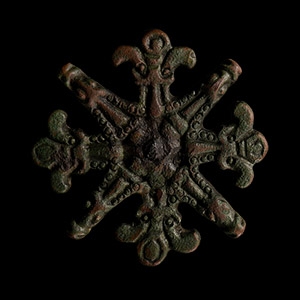
Anglo-Saxon Bronze Shield Mount with Animal Masks and Beast Heads
6th century A.D.Estimate: £600 - 800 (+bp*)
Opening Bid: £300
The eight arms arranged with alternating trefoil and tapering terminals, the trilobate arms formed as animal masks, the tapering arms as dragon-heads, all with stylised detailing in relief; punched circlets to the field; some remains of mounting lug to reverse centre. 68 grams, 54 mm
Found Norfolk, UK. From an East Anglian private collection. -
.jpg)
Anglo-Saxon Artefact Collection
6th-9th century A.D.Sold for (Inc. bp): £33
A mixed group of artefacts comprising: two annular brooch frames with worn remains of geometric motif and remains of pin; a zoomorphic strap end with beast head finial and geometric interlace motifs to the body, remains of enamel inlay, two piercings for attachment. 23.8 grams, 40-44 mm
Fair condition.
Found Yorkshire, UK.
