
Loading, please wait...
LOT 1782
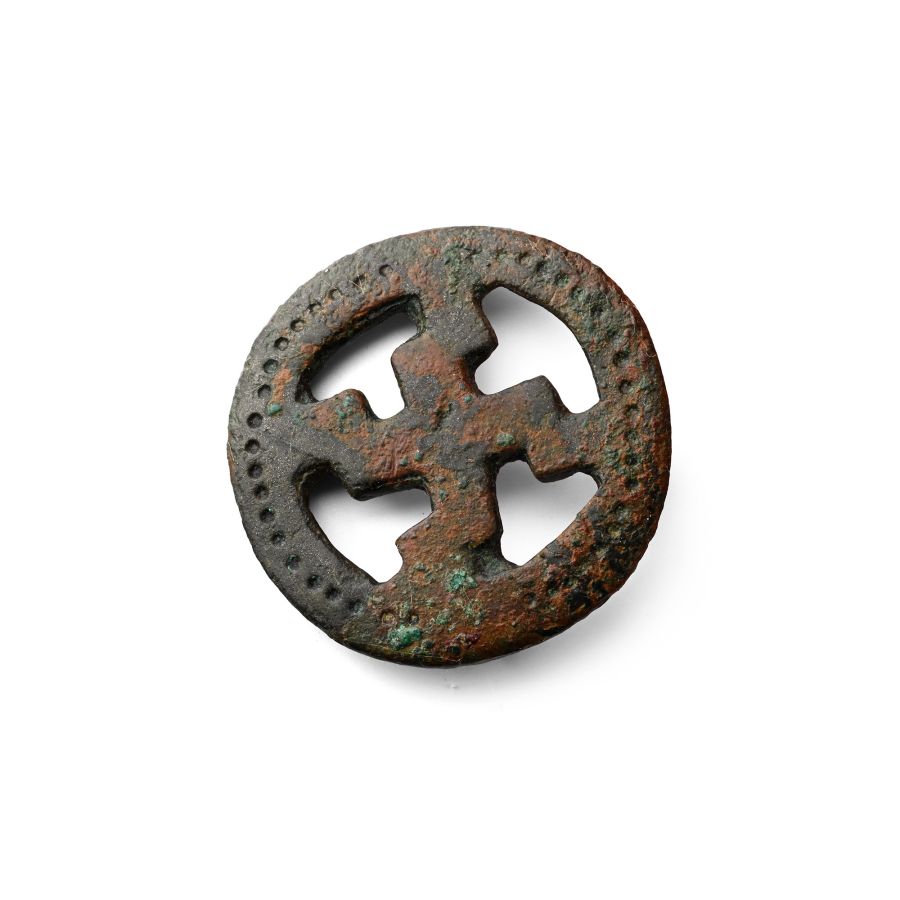
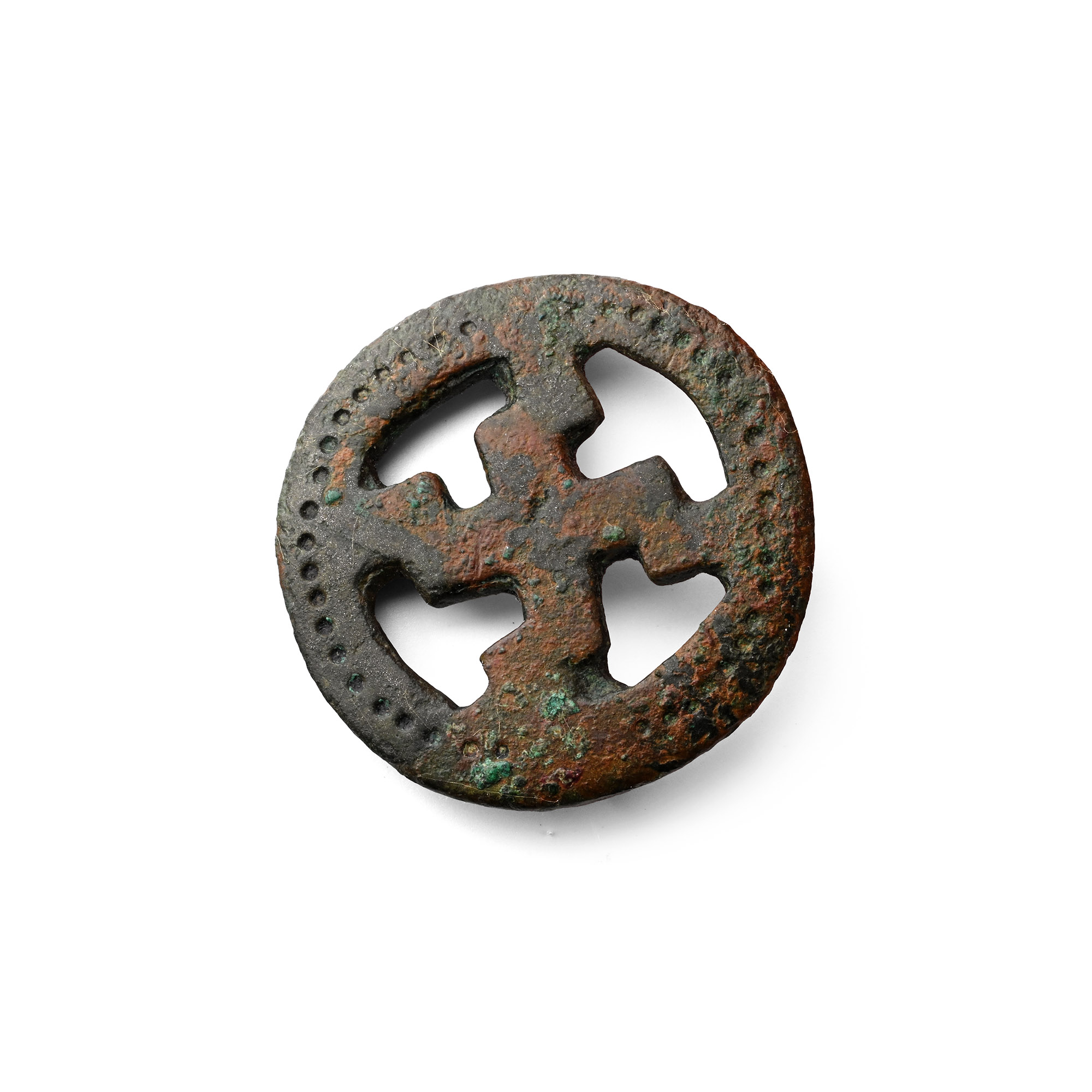
Anglo-Saxon Bronze Gammadion Disc Brooch
6TH CENTURY A.D.
1 5/8 in. (20 grams, 41 mm).
Disc brooch with four L-shaped voids spaced to form a reserved swastika motif, band of punched pellets to the rim, remains of the pin-lug and catchplate to the reverse. [No Reserve]
ProvenanceFound East Anglia, UK.
This lot is accompanied by an illustrated lot declaration signed by the Head of the Antiquities Department, Dr Raffaele D'Amato.
Cf. MacGregor, A. & Bolick, E., A Summary Catalogue of the Anglo-Saxon Collections (Non-Ferrous Metals), Oxford, 1993, item 5.1.
FootnotesThe swastika, also known as a gammadion, was an ancient sun symbol that is commonly found in many cultures across the Northern hemisphere. In the Viking period it was associated with Thor and is commonly found on rune-stones and amulets connected to him.
CONDITIONTimeLine Auctions follows a vetting process to ensure the authenticity and legality of all items, reinforcing our commitment to integrity and responsible trading. Each antiquity, antique, and coin lot undergoes thorough examination by a vetting committee of at least ten external specialists, professional trade association members, scientists, and archaeologists: Our Vetting Process
AUCTIONS:
TimeLine is a leading auction house specialising in antiquities, ancient art, collectables, natural history, coins, medals, and books. Our auctions offer museums, collectors, historians, and enthusiasts the opportunity to acquire unique and historically significant pieces.
-
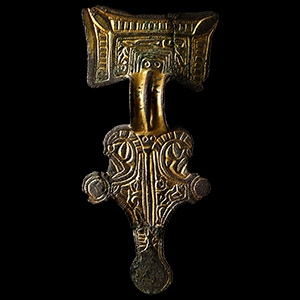
Anglo-Saxon Gilt Bronze Great Square-Headed Brooch
6th century A.D.Sold for (Inc. bp): £1,560
With trapezoidal headplate, shallow bow, narrow triangular foot and disc finial, pin-lugs in ferrous accretion and catch to the reverse; the headplate with angled scaphoid panels to the upper corners and band of billets enclosing a band of guilloche with Salin's Style I facing mask at the end of the bow; broad ribbed bow; lappets of Salin's Style I profile horse-heads flanking the junction of the bow with the footplate with small facing mask between the necks; vertical bar running to the finial, bisecting a cruciform panel with Salin's Style I zoomorphic forms; lateral plain lobes; finial comprising a disc connected to the vertical rib. 75 grams, 15 cm
Found Weston Colville, Cambridgeshire, UK. This lot has been checked against the Interpol Database of stolen works of art and is accompanied by search certificate no.12780-239463. This lot has been cleared against the Art Loss Register database, and is accompanied by an illustrated lot declaration signed by the Head of the Antiquities Department, Dr Raffaele D'Amato.
This magnificent brooch finds parallels with specimens derived from the group XVI-XVIII, according to Hines classification, from Market Overton II and Beckford A11. They represent, according to Hines, a transitional stage in the introduction of relief ornament into the headplate frame of brooches associated with group XVI. -
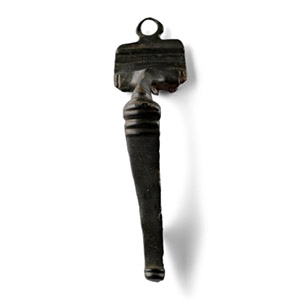
Anglo-Saxon Bronze Looped Square-Headed Bow Brooch
Late 5th century A.D.Sold for (Inc. bp): £91
With rectangular headplate and carinated bow; transverse ribbing with tremolier detailing; with remains of the iron pin, loop to chain together the pair. 19.9 grams, 94 mm
Found East Stoke, Nottinghamshire, UK. This lot is accompanied by an illustrated lot declaration signed by the Head of the Antiquities Department, Dr Raffaele D'Amato. -
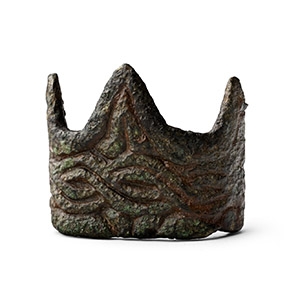
Anglo-Saxon Bronze Dagger Fitting with Interlaced Design
8th century A.D.Sold for (Inc. bp): £20
Baluster from a knife with straight lower edge and three vandykes above, low-relief knotwork motif. 9.58 grams, 26 mm
Formerly from a collection of a Berkshire gentleman, 1990s onwards. Property of a private collector, West London, UK. This lot is accompanied by an illustrated lot declaration signed by the Head of the Antiquities Department, Dr Raffaele D'Amato.
