
Loading, please wait...

LOT 1777
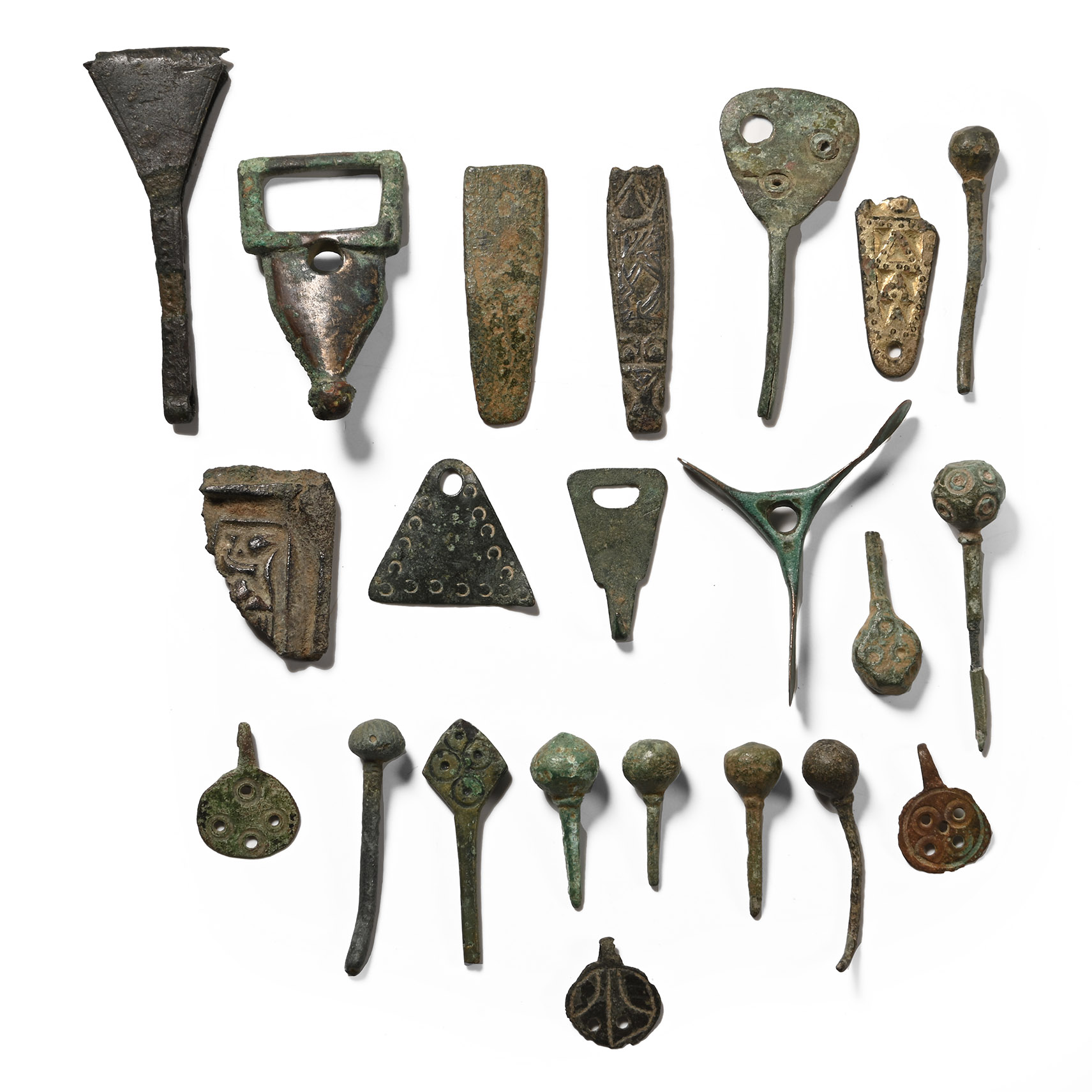
Anglo-Saxon Bronze Artefact Collection
6TH CENTURY A.D.
1/2 - 1 7/8 in. (52 grams total, 13-48 mm).
Including strap-ends, dress-pin parts, book page-marker and other items. [22, No Reserve]
ProvenanceFrom a private Barnsley, UK, family collection.
CONDITIONTimeLine Auctions follows a vetting process to ensure the authenticity and legality of all items, reinforcing our commitment to integrity and responsible trading. Each antiquity, antique, and coin lot undergoes thorough examination by a vetting committee of at least ten external specialists, professional trade association members, scientists, and archaeologists: Our Vetting Process
AUCTIONS:
TimeLine is a leading auction house specialising in antiquities, ancient art, collectables, natural history, coins, medals, and books. Our auctions offer museums, collectors, historians, and enthusiasts the opportunity to acquire unique and historically significant pieces.
-
Saxon and Viking Bronze Artefact Group
6th-11th century A.D.Sold for (Inc. bp): £27
Comprising: a stirrup mount; two fragments of footplate, each from a cruciform brooch; bronze fitting (from a harp?) with addorsed beast-heads. 45 grams total, 23-50 mm
Acquired on the UK art market before 2000. Property of an Essex, UK, gentleman. -
Anglo-Saxon Gilt Great Square-Headed Brooch with Garnet
6th century A.D.Sold for (Inc. bp): £3,380
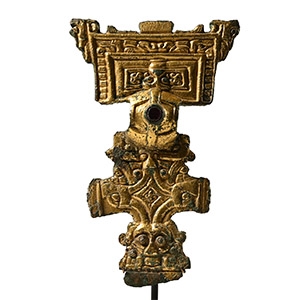
Comprising: trapezoidal headplate with beast-head spurs to the upper angles and concentric panels of Style I ornament with flanking billets; shallow bow with central cell and garnet cloison insert; short footplate with lateral lappets featuring profile masks and central lozenge; facing mask above a trapezoidal bar finial; pin-lugs and catch to the reverse; mounted on a custom-made stand. 74 grams, 11 cm (126 grams total, 13 cm high including stand)
with ArtAncient Ltd. Private collection, London. This lot has been checked against the Interpol Database of stolen works of art and is accompanied by a search certificate number no.12440-226863.
The meaning of the 'facing mask' motif on the footplate is probably related to the profile masks frequently used in Style I art, where the 'pellet' eye is enclosed by an arched frame: the 'facing mask' repeats this motif to produce a pair of eyes in a doubled 'bow'. An element of visual 'riddling' is no doubt present: the design is neither one thing nor the other, but includes elements of both. Distribution of great square-headed brooches was initially concentrated along the valleys of the Rivers Trent, Thames and Severn, though it was later confined to the East Midlands and East Anglia (Hines, 1997, figs. 101, 102). -
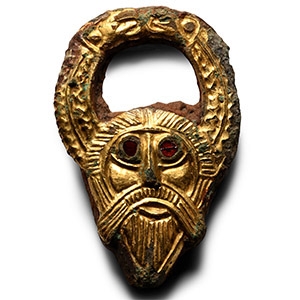
The 'Kingsworthy' Anglo-Saxon Gilt-Bronze Horned Woden's Head Appliqué
6th-7th century A.D.Sold for (Inc. bp): £14,040
A spectacular appliqué in the form of a facing male head with horned headgear; piriform face, discoid eyes with garnet (?) cloison inserts, the nose covered by the nasal of the headgear, the beard triangular and the ends of the moustache extending beyond the cheeks; hair covered by a helmet or mask with hatched texture extending around the upper face and developing to two crescent extensions from the temples which meet above the crown of the head; the terminals formed as birds' heads; possible remains of attachment stud to the reverse. 9.82 grams, 38 mm
Found Kingsworthy, Winchester, Hampshire, UK, in 2017. Accompanied by a copy of the Portable Antiquities Scheme report number BERK-DB4E15. Accompanied by a copy of the article in The Searcher magazine, number 389, January 2019, where it is featured on the front cover. This lot has been checked against the Interpol Database of stolen works of art and is accompanied by a search certificate number no.12439-225587.
The headgear with bird-head terminals is restricted to the 6th-7th centuries in England, although there are parallels from the material culture of both Anglian England and southern Scandinavia at this time. A pair of comparable bird-helmeted human faces can be found on the reconstructed frontal plates on the helmet found in Mound 1 at Sutton Hoo (Suffolk) depicting dancing warriors, and the male face shown on a foil fragment recovered from the barrow at Caenby (Lincolnshire). Similar also is the figure on one of the dies found at Torslunda (Öland, Sweden) showing a male wearing a helmet with a pair of bird-headed horns. A long, triangular male face is shown on the vandyke designs on the foil horn mounts from the barrow at Taplow (Berkshire). A male figure wearing a helmet with horns and bird-head terminals is the central design on a long triangular buckle found in grave 95 at Finglesham (Kent), and also from Finglesham (grave 138) is a mount in the form of a long, triangular human head with vertical radiating bands from the top of the head, and two crescentic horns emerging from the crown, terminating in opposed birds’ heads which meet above. A similar mount was found at Rempstone (Nottinghamshire) and privately published in Raynor (2010) while others were found more recently at Attleborough (Norfolk) and Soberton (Hampshire, PAS ref. HAMP2432). A mount depicting a similar figure, showing the upper body with hands gripping spears, was published in Hammond (2010). The significance of the headgear has not been fully explored but the coincidence of the birds and the head recall the later myths of Oðinn and his bird messengers, and suggest that these mythic characters were familiar in early Anglo-Saxon England. Kevin Leahy, National Adviser, Early Medieval Metalwork of the PAS commented: "This striking mount is Early Anglo-Saxon and dates from the 6th to 7th century. Faces like this, wearing a horned headdress (or sporting horns of their own) are well known, appearing on some of the foils decorating the Sutton Hoo helmet, where the warriors carry swords and spears and appear to be dancing. A similar foil was found in a burial at Caenby, Lincolnshire and the horned warrior carrying two spears appears on a gold buckle from Finglesham, Kent. Horned warriors are not restricted to England and appear on a die for making foils found at Torslunda, Sweden, and on a die from Ayton in the Scottish Borders region. The question is: who do these mounts represent? It has been suggested that they depict the god Woden, one of whose attributes was a spear and that the birds' heads on the ends of the horns represent the the god's two ravens. However, these birds often have hooked eagles' beaks not the pointed beaks of ravens. We also see multiple depictions of the horned warrior on the same foil suggesting that it was not the god, although it is possible that the god's image was duplicated to emphasise his power. Woden is sometimes shown with only one eye as he gave up his other eye in exchange for wisdom. The two garnet-inlaid eyes seen here do not preclude the face being that of Woden but it would have been helpful if it had only one eye. Finally, what was this mount used for? Other examples like the one from Rempstone, Notts., has mounting pins on its back as does a mount from Finglesham, Kent. Many of the other mounts, however, lack any signs of a fixing. It is clear that the mount described here was attached to an iron object but we are left guessing what it was: a helmet or a buckle? Unless you find one still attached we are going to be left to wonder. Recorded and assessed by the Secretary of State’s Expert Adviser as an object of cultural interest. The RCEWA reviewed an export application and determined that it meets the third Waverley criterion, making it currently non-exportable.
