
Loading, please wait...
LOT 1350
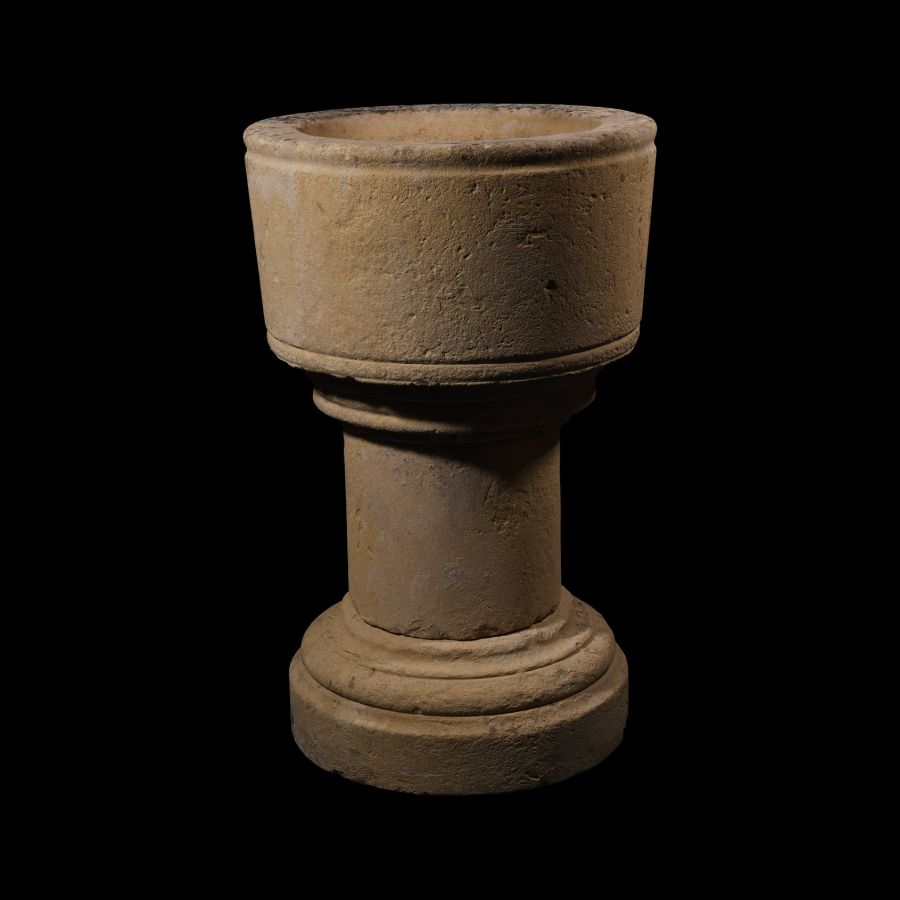
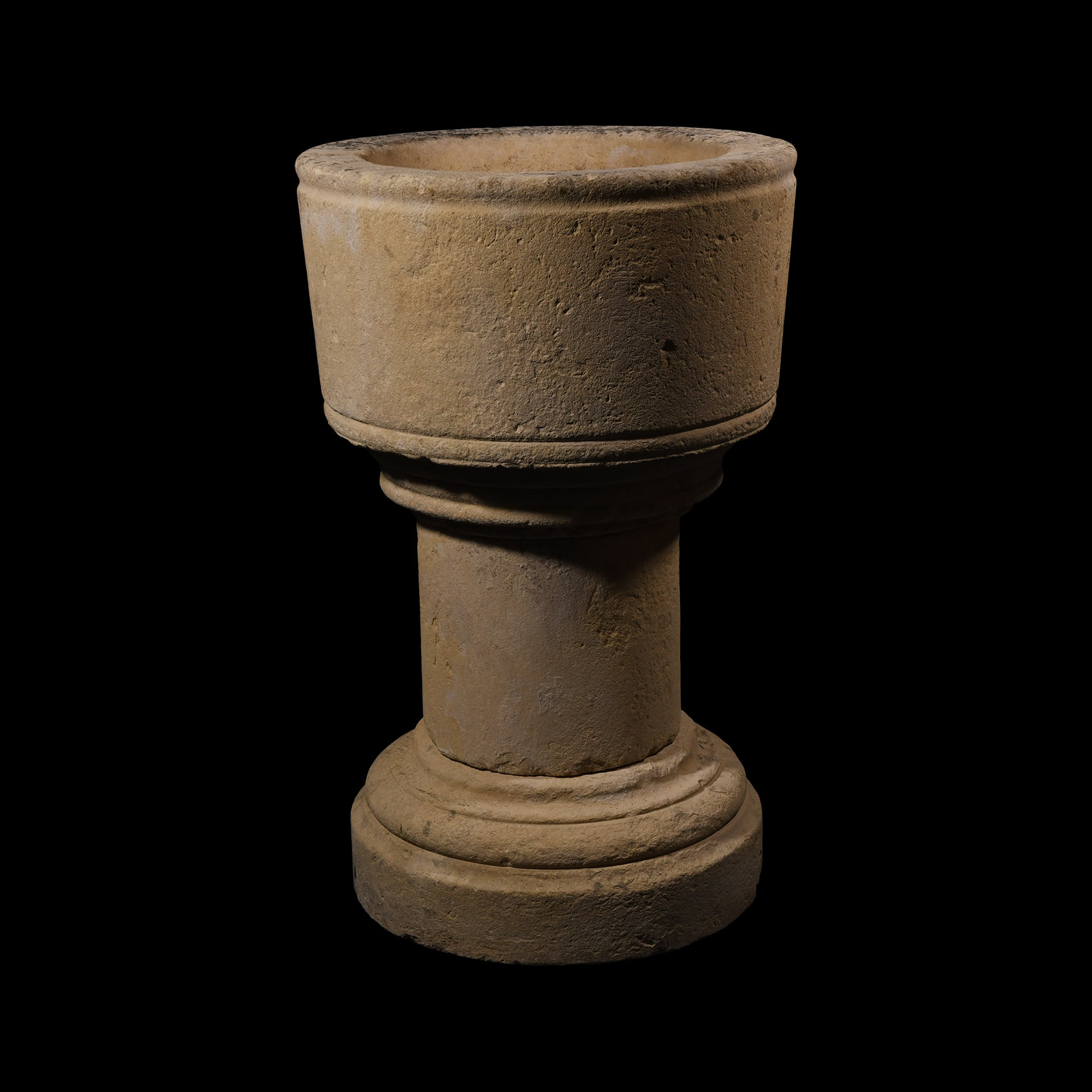
Anglo-Norman Limestone Font
CIRCA 12TH CENTURY A.D.
37 1/2 in. (299 kg total, 95 cm).
A large carved pale ochre limestone font in three sections comprising: a discoid stepped base, plain columnar shaft, and barrel-shaped bowl with incised circumferential rings to the outer face; available to view at our Harwich head office only.
ProvenanceFrom Sussex, UK.
Private collection formed in the 1960s.
Oswestry, Shropshire, UK, collection.
Ex Howell collection.
Accompanied by an off-print: McClain, Aleksandra Baptism and Burial in Stone: Materializing Pastoral Care in Anglo-Norman England, Volume 7, 2018, p.10, fig.4, where it shows a very similar example of 12th century in date from Ellerburn Church.
Accompanied by an Art Loss Register certificate no.S00156424.
This lot has been checked against the Interpol Database of stolen works of art and is accompanied by search certificate no.11412-193070.
Cf. a very similar 12th century font from Ellerburn, Ryedale, North Yorkshire in McClain, A., Baptism and Burial in Stone: Materializing Pastoral Care in Anglo-Norman England, Volume 7, 2018, p.10, fig.4; and a circular font bowl in Tollerton St. Peter, Southwell and Nottingham Church; another round font believed to be Norman or Anglo-Saxon in Lydford Church of St. Pedrock, Okehampton, West Devon; also see Zarnecki, G., Holt, J. & Holland, T., English Romanesque Art 1066-1200, London, 1984, for discussion.
CONDITIONTimeLine Auctions follows a vetting process to ensure the authenticity and legality of all items, reinforcing our commitment to integrity and responsible trading. Each antiquity, antique, and coin lot undergoes thorough examination by a vetting committee of at least ten external specialists, professional trade association members, scientists, and archaeologists: Our Vetting Process
AUCTIONS:
TimeLine is a leading auction house specialising in antiquities, ancient art, collectables, natural history, coins, medals, and books. Our auctions offer museums, collectors, historians, and enthusiasts the opportunity to acquire unique and historically significant pieces.
-
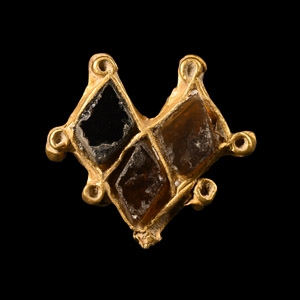
Medieval Gold and Garnet Necklace Element
14th-16th century A.D.Sold for (Inc. bp): £156
A necklace element comprising a gold frame with seven cylindrical loops to accept threads; three lozengiform cells each with an inset garnet cloison. 1.48 grams, 14 mm
Acquired 1970-2010. Collection of a late Japanese gentleman. -

Medieval 'Thames' Pewter Ring with Hand on Quatrefoil Bezel with Annulets
14th-16th century A.D.Sold for (Inc. bp): £72
A pewter ring composed of a slender, convex hoop and quatrefoil bezel, displaying a raised annulet to each arm and hand extended right; repaired. 1.85 grams, 22.27 mm overall, 19.33 mm internal diameter (approximate size British N, USA 6 1/2, Europe 13.72, Japan 13)
Found on the Thames foreshore, London, UK. Acquired 1960s-1990s. From the late Alison Barker collection, a retired London barrister. -
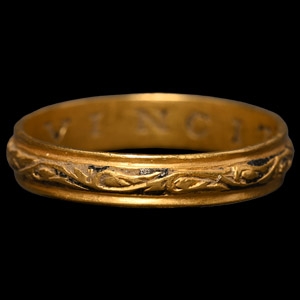
Tudor Gold '+Amor Vincit' Decorated Posy Ring
Circa 16th century A.D.Sold for (Inc. bp): £1,235
A gold posy ring with raised foliate band externally, inscribed '+AMOR VINCIT' for 'Love Conquers' in Roman capitals. 1.72 grams, 17.46 mm overall, 15.47 mm internal diameter (approximate size British I, USA 4 1/4, Europe 7.44, Japan 7)
Acquired on the UK antiques market between 1974-1985. Albert Ward collection, Essex, UK.
Omnia vincit amor, translating to 'Love Conquers All' and abbreviated on this ring, is one of the most famous of all Latin expressions. It is still used today, in the original Latin, in translation and in its alternative version ‘Amor vincit omnia’; the expression originally comes from the Roman poet Virgil, (Publius Vergilius Maro) most famous for his epic Aenid; the phrase appears in his first work, Eclogues.
