Loading, please wait...

Use mousewheel to zoom in and out, click to enlarge

Details

LOT 0196

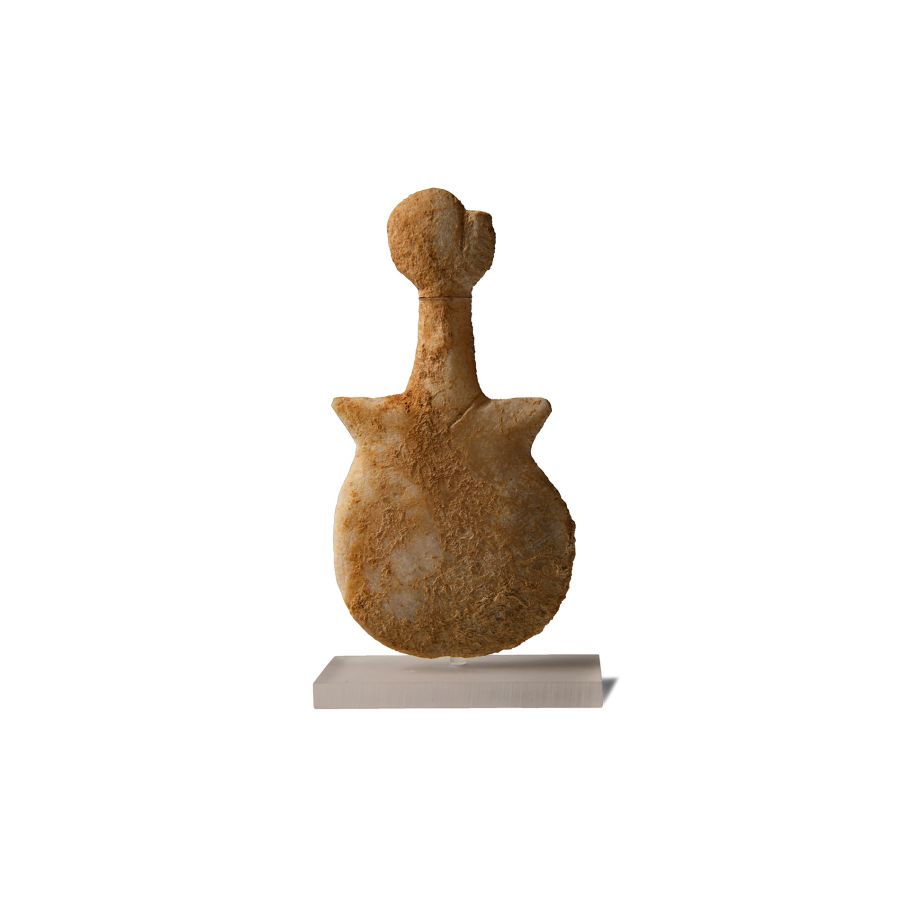
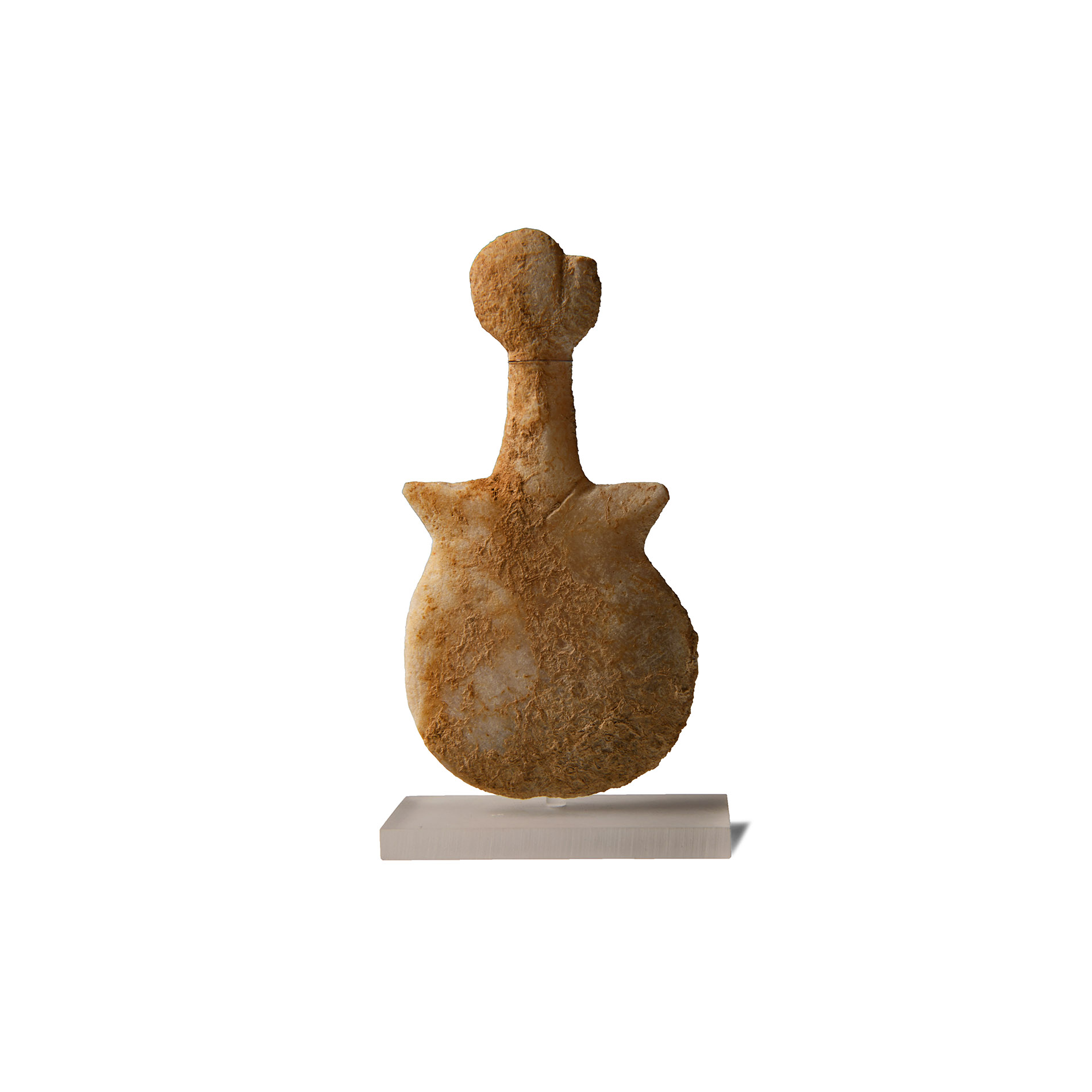
Anatolian Marble Violin Type Idol

2500-2300 B.C.

3 3/4 in. (36 grams total, 94 mm high including stand).

The schematic figure with a shallow lentoid-shaped cross-section; mounted on a custom-made display base.

Provenance

Acquired in Europe before 1995.

This lot has been checked against the Interpol Database of stolen works of art and is accompanied by search certificate number no.11866-206514.

Literature

Cf. Harvard Art Museums, object number 1965.519, for type.

CONDITION

VETTING:

TimeLine Auctions follows a vetting process to ensure the authenticity and legality of all items, reinforcing our commitment to integrity and responsible trading. Each antiquity, antique, and coin lot undergoes thorough examination by a vetting committee of at least ten external specialists, professional trade association members, scientists, and archaeologists: Our Vetting Process


AUCTIONS:

TimeLine is a leading auction house specialising in antiquities, ancient art, collectables, natural history, coins, medals, and books. Our auctions offer museums, collectors, historians, and enthusiasts the opportunity to acquire unique and historically significant pieces.

LOT 0196

Anatolian Marble Violin Type Idol

Estimate £3,000 - 4,000€3,480 - 4,640 (for guidance only)$4,050 - 5,400 (for guidance only)

Print page

RELATED LOTS

  • Large Western Asiatic Shell Cylinder Seal with Two Registers
    Large Western Asiatic Shell Cylinder Seal with Two Registers
    Circa 3rd millennium B.C.

    Sold for (Inc. bp): £1,560

    With linear and ropework borders, frieze in two registers: the upper with seated and standing figures wearing tiered robes, the lower with antelopes, human figures and fronds. 54.6 grams, 52 mm


    Acquired 1970s-1996. Property of a North American collector, collection no.077. London collection, 2016.

    Lot Details

  • Uruk Clay Pictographic Tablet with Economic Text Relating to Farm Produce
    Uruk Clay Pictographic Tablet with Economic Text Relating to Farm Produce
    Mid 2nd millennium B.C.

    Sold for (Inc. bp): £4,160

    Written on two faces; lentoid cross-section. 43.6 grams, 66 mm


    Specialised collection of cuneiform texts, the property of a London gentleman and housed in London before 1992. Thence by descent to family members. Examined by Professor Wilfrid George Lambert FBA (1926-2011), historian, archaeologist, and specialist in Assyriology and Near Eastern archaeology, in the late 1980s and early 1990s. The collection is exceptional for the variety of types, including some very rare and well preserved examples. This lot has been checked against the Interpol Database of stolen works of art and is accompanied by search certificate number no.11870-201160.

    Lot Details

  • Early Achaemenid Bronze Temple Plaque
    Early Achaemenid Bronze Temple Plaque
    Mid 7th-6th century B.C.

    Estimate: £4,000 - 6,000 (+bp*)

    Opening Bid: £2,000

    Holes close to the rim for attachment of a lining; the surface executed in repoussé technique, filled by scenes horizontally divided with guilloche of two interlaced serpents; in the lower register two opposed lions (an antithetic pair, a lion and a lioness), both in profile, attacking a boar; the lions with open jaws and prominent muscles; the mane marked, and the tails forming a reverse S-curved between the hind legs; the anterior part of the boar collapsing under the lion's attack; rosettes filling the field and in the upper register, two large bosses separating three semi-human figures, maybe representing evil spirits, advancing in crouching pose with elbows bent and hands palm-upwards, rosettes and fungi in the field, their arms elevated in prayer; restored. 495 grams, 42 x 25 cm

    Fine condition, with a beautiful greenish patina.

    From the collection of a West London businessman, formed in the late 1980s-early 1990s. Property of an important West London collector. Accompanied by an academic report by Dr Raffaele D'Amato. Accompanied by a metallurgic analytical report, written by metallurgist Dr Brian Gilmour of the Research Laboratory for Archaeology and the History of Art, University of Oxford, report number 618/129067.

    Our specimen is a well preserved decorative votive plaque of Early Achaemenid Age, although some elements could induce to consider the plaque as belonging to the late Elamite period. Usually these plaques are rectangular in shapes and contain one or more figures. One of the predominant figures is the lion, an old symbol of power in Ancient Mesopotamia. It appears often in a similar shape, for example in the Achaemenid seals (Schmidt, 1957, pp.42-44), as a hunter. The king of the beasts was considered a worthy foe, but sometimes was used as a symbol of the dynasty. Boars are also visible in seal patterns (Rawlinson, 1881, p. 240; Schmidt, 1957, pp.12,15,40,41,49). The rosette motive is well known in the Achaemenid art, like on the Miho's Artaxerxes plate (Soudavar, 1999, p.11) or in decorated architectural fragments left on the ground in Persepolis (Soudavar, 1999, p.20 fig.14), and, more important, in the famous Otane's plaque (Soudavar, 1999, p.29 fig.32; p. 42 fig. 41a-b-c) or on the plaque reporting the Behistun text (Soudavar, 1999, p. 56 fig. 45). The rosette is a representation of the solar emblems, and it is already visible in works of the first millennium B.C. (Muscarella, 2013, pp. 682-683, 781), and on the diadems of the Elamite rulers represented in the Achaemenid art. The representation of the Anshānite sun flower under a rosette vary in shapes and it is not always clear whether it predates the Darian Persepolitan style. Here, the presence of convex more than concave rosettes are pointing more to a date anterior to Darius' kingdom (522-486 B.C.). The representation of the snakes is singular, considering that there is a general negativity in the Persian ancient culture associated with the word kerm/kirm (snake) and the animosity that Zoroastrianism developed towards snakes. However, according to the Shāhnāmeh, the discovery of fire was ushered by the appearance of a magical snake, at which the legendary king Hushang threw a stone; it missed its mark but hit another stone and produced sparks that lit a fire. The Achaemenid Empire dominated the Near East and the eastern Mediterranean for about two centuries, from the mid-sixth to the mid-fourth BC, when it was conquered by Alexander the Great and the last Persian King, Darius III Codomannus, was killed by his generals. It was one of largest empires in the world and in many ways one of the most successful. Votive plaques were dedicatory offerings to the temple, like modern ex-voto. The motive of the boar hunt in the Achaemenid art is visible on seals, and represents the warriors (lions) hunting the enemy (ibex, boar), a typical war training exercise for soldiers, commanders and princes. The theme of the boar hunt by Persian warriors has traditionally been associated closely with later Achaemenid glyptic from the western realms of the empire, but in this ancient plaque representation the lions appear symbolically substituting the warriors.

    Lot Details

Stay up-to-date with the latest from TimeLine Auctions by joining our mailing list