
Loading, please wait...
LOT 0266
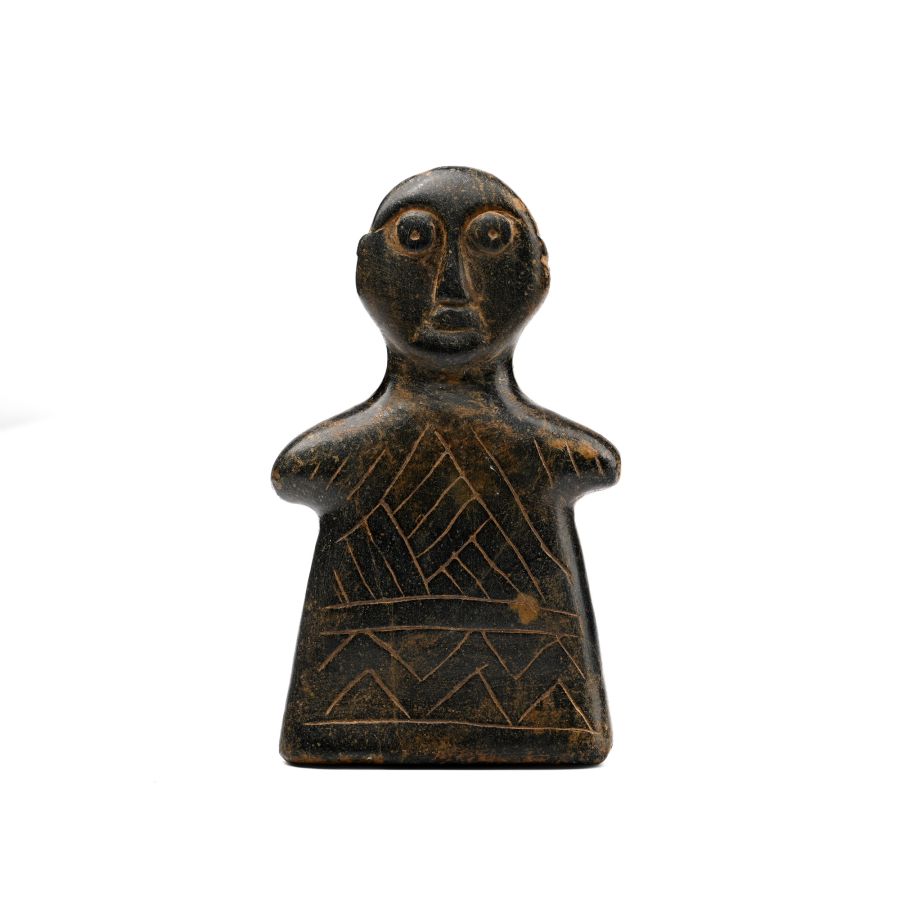
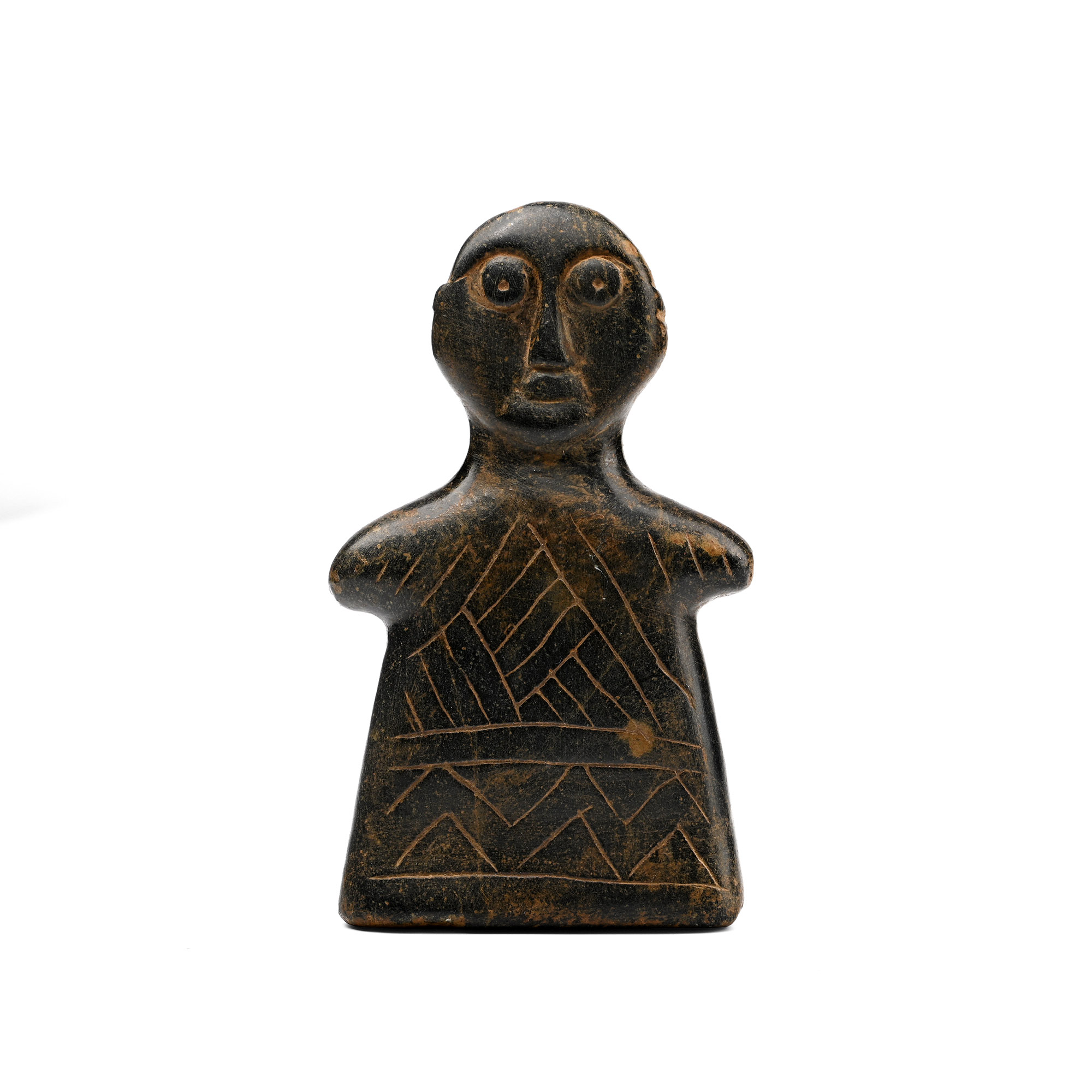
Anatolian Black Stone Idol
3RD MILLENNIUM B.C.
4 in. (156 grams, 10.1 cm).
Carved in the half-round with hatched detailing to the tunic and belt, discoid head with reserved annulet eyes and trapezoidal nose, lateral stub ears.
ProvenanceEx Swiss European collection, 1980s.
Private collection, 1994.
Private collection, since the late 1990s.
This lot has been checked against the Interpol Database of stolen works of art and is accompanied by a search certificate number no.12874-241677.
This lot has been cleared against the Art Loss Register database, and is accompanied by an illustrated lot declaration signed by the Head of the Antiquities Department, Dr Raffaele D'Amato.
Cf. for a similar idol Atakuman, Ç., ‘Figurines of the Anatolian Early Bronze Age: The assemblage from Koçumbeli-Ankara’ in Anatolian Studies, 67, Ankara, 2017, pp.85-108, fig.5, lett.e.
CONDITIONTimeLine Auctions follows a vetting process to ensure the authenticity and legality of all items, reinforcing our commitment to integrity and responsible trading. Each antiquity, antique, and coin lot undergoes thorough examination by a vetting committee of at least ten external specialists, professional trade association members, scientists, and archaeologists: Our Vetting Process
AUCTIONS:
TimeLine is a leading auction house specialising in antiquities, ancient art, collectables, natural history, coins, medals, and books. Our auctions offer museums, collectors, historians, and enthusiasts the opportunity to acquire unique and historically significant pieces.
LOT 0266
Anatolian Black Stone Idol
Estimate £4,000 - 6,000€4,640 - 6,960 (for guidance only)$5,400 - 8,100 (for guidance only)
-
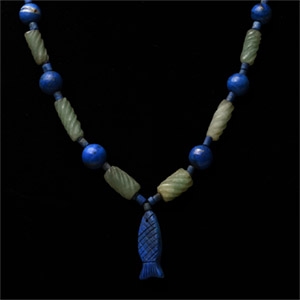
Western Asiatic Lapis Lazuli and Green Stone Bead Necklace String
20th century A.D.Sold for (Inc. bp): £26
Composed of large cylindrical beads with spiral-decoration, interspersed with large spherical and small tubular beads, central feature a fish-shaped pendant. 50 grams, 43 cm
From the London, UK, art market in the 1990s. This lot has been cleared against the Art Loss Register database, and is accompanied by an illustrated lot declaration signed by the Head of the Antiquities Department, Dr Raffaele D'Amato. -
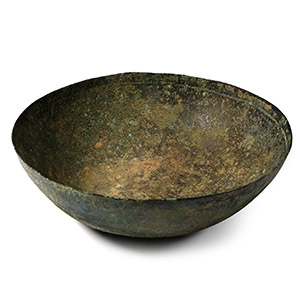
Western Asiatic Bronze Bowl
Late 1st millennium B.C.Sold for (Inc. bp): £59
A shallow hemispherical bowl with rounded base and incised circumferential band beneath the rim. 130 grams, 15.8 cm
Ex London, UK, collections, 1990s-2000s. This lot has been cleared against the Art Loss Register database, and is accompanied by an illustrated lot declaration signed by the Head of the Antiquities Department, Dr Raffaele D'Amato. -
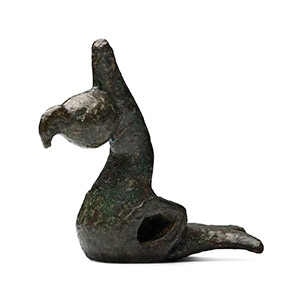
Western Asiatic Bronze Figure of a Bird
Circa 1000-600 B.C.Sold for (Inc. bp): £117
Stylised figure of a standing bird with trefoil tail and tall crest, bulbous head with curved beak; oval socket through the body. 110 grams, 71 mm
Nicolas Koutoulakis (1910-1996), thence by descent. Ex Galerie Khnoum, Geneva, Switzerland. Private collection of Mr K.A. This lot has been cleared against the Art Loss Register database, and is accompanied by an illustrated lot declaration signed by the Head of the Antiquities Department, Dr Raffaele D'Amato.
