
Loading, please wait...


LOT 2075
Anastasia Avante-Garde Fashion Portrait Editorial Proof by Inez van Lamsweerde & Vinoodh Matadin
DATED 11 MAY 2003 A.D.
14 x 11 in. (174 grams, 35.5 x 28 cm including frame).
Framed with a white card reveal, colour image of a young woman with digitally-added eye-mask; with collector's slip stating (inter alia) 'Archive Date: 11/05/03' and 'Historical Significance: Originally captured in 1994 for a groundbreaking 10-page editorial in The Face magazine, "Anastasia" is a museum-grade artwork celebrated as the very first instance of digital manipulation (Photoshop compositing) in fashion history. Large-scale gallery prints of this work are held in elite collections worldwide (including the Sir Elton John collection). This May 2003 proof tracks its syndication in Spain for a major visual arts or digital photography retrospective.' [No Reserve]
ProvenanceAcquired on the USA art market.
Property of a Harwich, UK, collector.
TimeLine Auctions follows a vetting process to ensure the authenticity and legality of all items, reinforcing our commitment to integrity and responsible trading. Each antiquity, antique, and coin lot undergoes thorough examination by a vetting committee of at least ten external specialists, professional trade association members, scientists, and archaeologists: Our Vetting Process
AUCTIONS:
TimeLine is a leading auction house specialising in antiquities, ancient art, collectables, natural history, coins, medals, and books. Our auctions offer museums, collectors, historians, and enthusiasts the opportunity to acquire unique and historically significant pieces.
LOT 2075
Anastasia Avante-Garde Fashion Portrait Editorial Proof by Inez van Lamsweerde & Vinoodh Matadin
Sold for (Inc. bp): £585
-

Post Medieval Silver Ring Group
17th-20th century A.D.Sold for (Inc. bp): £85
Comprising: a flat-section ring with remains of a possible inscription on the bezel; a bronze ring with a cell bezel; a ring with granules flanking a cup-shaped bezel; a ring formed of twisted and hammered chain; a ring with an elaborate filigree bezel. 14.34 grams total, 18-30 mm
Acquired on the UK art market. Property of a Suffolk, UK, gentleman. -
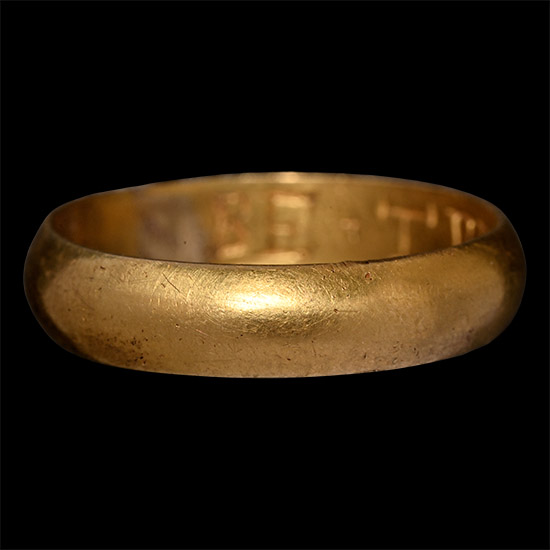
Tudor Gold 'BE . TRVE . IN . HART' Posy Ring
Circa 16th century A.D.Sold for (Inc. bp): £2,470
Featuring a smooth exterior and D-shaped in cross-section, a flat internal face with an inscription in upper case Roman letters, reading 'BE . TRVE . IN . HART' for 'Be true in heart' with the stops formed as small crosses and the N reversed. 4.25 grams, 20.66 mm overall, 18.06 mm internal diameter (approximate size British P, USA 7 1/2, Europe 16.23, Japan 15)
Found whilst searching with a metal detector near Edgmond, Telford & Wrekin, UK, by George Elymn, on 27 October 2024. Recorded with the British Museum's Portable Antiquities Scheme (PAS) with reference no.HESH-B237EA; handed in as Treasure under the Treasure Act, and subsequently disclaimed and returned to the finder. Accompanied by a copy of the Report for H M Coroner on finding of Potential Treasure, with reference no.2025T1645. Accompanied by a copy of a letter from the British Museum explaining that the Crown's interest in this find has been disclaimed.
The 'posy' name is derived from the 'poesy' (motto) engraved around the hoop. In medieval examples, the posy is usually found around the hoop exterior, although on later examples, inscriptions were more usually engraved on the interior. Rings with amatory inscriptions can be found from the 14th century AD onwards, when they served as love gifts, betrothal and wedding rings. Posy rings were also given to friends or used to mark significant occasions. Posies were composed by the giver, kept in stock by goldsmiths, or could be selected from published compendiums or commonplace books such as 'The Mysteries of Love or the Arts of Wooing' (1658 AD), or 'Love's Garland or Posies for Rings, Hand-kerchers and Gloves and such pretty tokens that Lovers send their Loves' (1674 AD). Rings were one genre of personal item amongst many to be adorned with posies at this time. -

Large Chinese Bronze Ewer for the Eastern Market
20th century A.D.Estimate: £300 - 400 (+bp*)
Opening Bid: £160
Tall slender neck with baluster collar, socket to the mouth and domed lid with knop handle; piriform body with fluting, trumpet-shaped foot; curved spout with dragon-head detail to mouth. 3.49 kg, 48.8 cm
Private collection, UK.
