
Loading, please wait...
LOT 1034
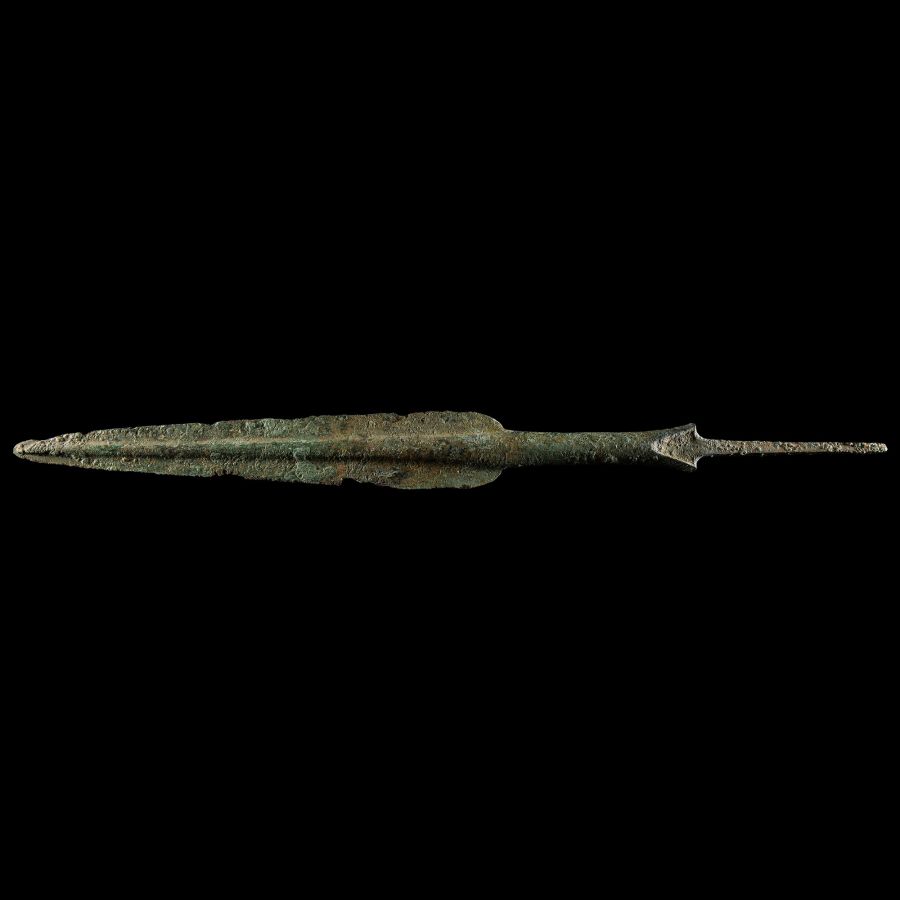
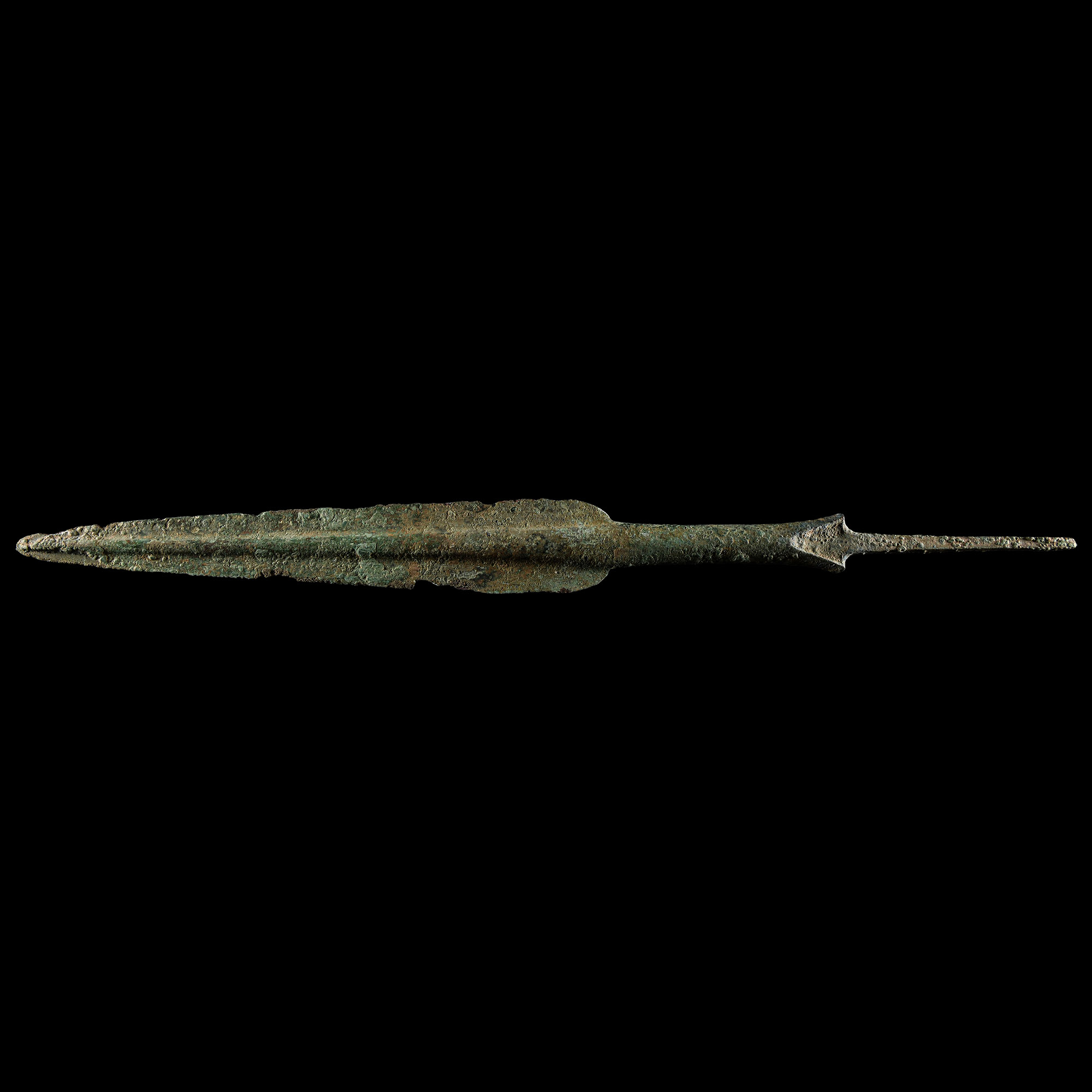
Amlash Type Spearhead Bronze Spearhead Blade
13TH-12TH CENTURY B.C.
17 in. (348 grams, 43.4 cm).
Showing a long tapering blade with rounded shoulders and prominent mid-rib, the tang straight and rectangular in section.
ProvenanceAcquired 1980-2015.
Ex Abelita family collection.
Cf. Khorasani, M.M., Arms and Armour from Iran. The Bronze Age to the End of the Qajar Period, Tübingen, 2006, s. cat 280, for type; Christies, Axel Guttmann collection of Ancient Arms and Armour, Part 2, London, South Kensington, 28th April 2004, lot 40.
FootnotesThe weapon belongs to the type 1 of the Khorasani spearhead classification, mainly from Marlik or Amlash areas. Similar pieces have been dated by Stutzinger to 1200-1100 B.C., but the period of use is attested to at least until 1000 B.C.
CONDITIONTimeLine Auctions follows a vetting process to ensure the authenticity and legality of all items, reinforcing our commitment to integrity and responsible trading. Each antiquity, antique, and coin lot undergoes thorough examination by a vetting committee of at least ten external specialists, professional trade association members, scientists, and archaeologists: Our Vetting Process
AUCTIONS:
TimeLine is a leading auction house specialising in antiquities, ancient art, collectables, natural history, coins, medals, and books. Our auctions offer museums, collectors, historians, and enthusiasts the opportunity to acquire unique and historically significant pieces.
-
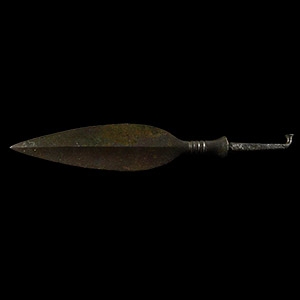
Western Asiatic Bronze Leaf-Shaped Spearhead
Early 2nd millennium B.C.Sold for (Inc. bp): £546
Having ovate blade with central rib and slender shoulders, cylindrical short shaft marked by circular grooves broading towards the end, encasing a rectangular tang with a bent end. 134 grams, 23.5 cm
Acquired 1980-2015. Ex Abelita family collection.
In the 3rd millennium until the first half of the 2nd millennium in the Near and Middle East, in India, the Caucasus and Central Asia, a stalked tip was used for the spear heads, and this model developed in Mesopotamia in the middle of the 3rd millennium B.C. The main types were with a facetted blade on a volumetric pin and a leaf-shaped blade on a flat handle with holes for rivets. The same models spread almost unchanged to the Caucasus, Anatolia and Bactria. -
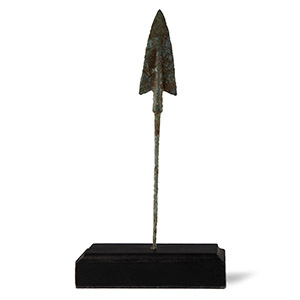
Large Luristan Arrowhead with Stand
14th-11th century B.C.Sold for (Inc. bp): £234
With triangular blade, having a barbed deltoid shape and a rounded projecting midrib tapering towards the sharp point, cylindrical stem and rectangular sectioned tang: accompanied by a custom-made display stand. 36 grams, 21.5 cm (140 grams total, 22.5 cm high including stand)
Acquired 1980-2015. Ex Abelita family collection.
According to Khorasani, this type of arrowhead belongs to a subcategory of the category of type V of Luristan arrow points. In the four categories of triangular bronze arrowheads from Luristan, Marlik and Northern Iran individuated by Negahban, subtypes C and D of type V are larger arrow or javelin heads, C with barbed shoulders and D with round shoulders. -
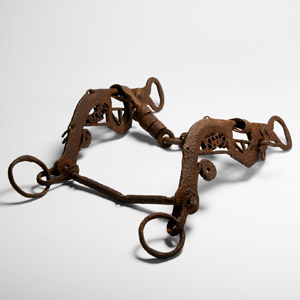
Byzantine Iron Horse Bit
14th-15th century A.D.Estimate: £150 - 200 (+bp*)
Opening Bid: £83
Composed of arched openwork shanks with looped terminals; one end fitted with large hoops and bar between; one end with a tripartite mouthpiece comprising two collared bars connected by a central hoop; Byzantine or early Ottoman. 340 grams, 19.5 cm
Fine condition.
Collection of Dr. Hanns-Ulrich Haedeke (1928-2017), author of ‘Schmuck Aus Drei Jahrtausenden’ and who became the director of the Museum of Klingenmuseum in Solingen, Germany, in 1968; the collection was formed in the early 1960s. From an important private Dutch collection.
This type of horse bit is visible on one of the most important equestrian artworks of the 15th century - the Cappella dei Magi by Benozzo Gozzoli, a painting representing the Three Kings visiting Christ, depicted in costumes belonging to the early quarter of the 15th century. All the cavalrymen in the artwork had heavy curb-bits (with short and curved shanks, as in our specimen) and heavy, single reins.
